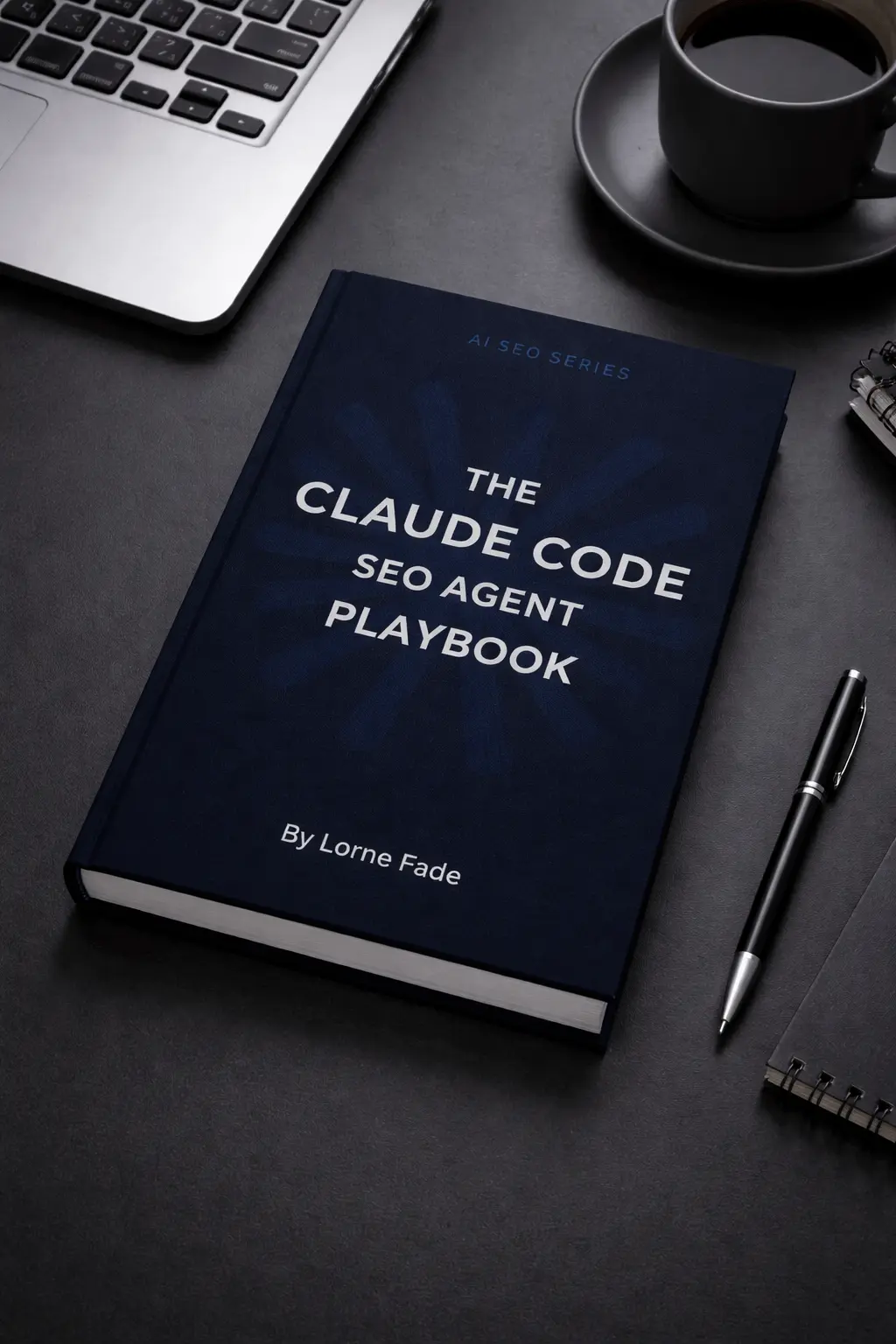
The Claude Code SEO Agent Playbook
Replace $500+/month in SEO tools with a self-improving agent that finds your keyword gaps, maps who's beating you and why, generates a weekly content plan, and tracks rankings on autopilot.
 Powered by Claude Code
Built for three people
This playbook is for the DTC founder or head of growth who knows SEO matters but never has the bandwidth to do it consistently. You're running paid social, managing creative, briefing your team — and organic search keeps getting pushed to "next quarter." This system runs in the background whether you touch it or not.
The agency owner who needs to deliver SEO results across multiple clients without hiring a dedicated SEO person for each account. The same agent, pointed at different domains, handles the weekly research, competitive mapping, and writing loop for all of them.
And the in-house creative strategist who wants to become the person at their company who actually has a functioning SEO system — not just a subscription to a tool nobody logs into.
If you've ever paid for Semrush or Ahrefs and mostly used it to export one CSV, this playbook is for you.
What the system produces every week
These are real files saved to your project folder — not chat responses.
Keyword Opportunity Cards
For each gap zone keyword (positions 5–20), you get impressions, current position, CTR, and a one-line action recommendation specific to that keyword. Not generic advice. Specific instructions.
Competitive Intelligence Report
A table showing who's outranking you on your top keywords, their threat level (high/medium/low), and exactly why they're winning. Not just "they have more backlinks."
Weekly Content Plan
Four article briefs with target keyword, estimated monthly search volume, current position, search intent classification, and a recommended title. Ready to execute.
Weekly Summary
What moved in rankings since last week, what published, and the top 3 targets for next week. One page. Takes 5 minutes to review.
Everything outputs to a /reports/ folder in your project directory, named by date. Week over week, you build a record of what's working.
SEO tools are dashboards, not systems
They show you data. They don't do anything with it.
Semrush tells you which keywords to target. You still have to brief a writer, review the draft, publish the post, and build links to it. Ahrefs shows you competitor backlinks. You still have to do the outreach. Surfer scores your content. You still have to rewrite it.
The result: most DTC brands and agencies are paying $400–600/month for tools that require a full-time operator to extract value from. And that operator rarely exists.
The agent approach flips this. Instead of a dashboard that shows you what to do, you get a system that does it — and gets smarter about your specific business every week it runs.
Three skills that run in sequence every week
Each skill is a set of instructions Claude follows using your real data.
Skill 1: Gap Finder
Connects to Google Search Console and optionally DataForSEO. Pulls your real ranking data — actual positions, clicks, impressions — and identifies your "gap zone": keywords where you're sitting between positions 5 and 20. These are the keywords where one well-written article can push you to page 1.
For each gap zone keyword, it generates a specific action recommendation based on what it finds: is there no existing page targeting this query? Is there a page but no internal links pointing to it? Is the title missing specificity compared to page 1 results?
Output: Keyword opportunity cards (impressions, position, CTR, action recommendation) + movement report.
Skill 2: Competitor Intelligence
Takes your top gap zone keywords and researches who's outranking you on each one. For every competitor page it finds, it analyzes why it's winning — domain authority, recency signals, content depth, specific structural advantages — and assigns a threat level.
HIGH means they're hard to displace — find a related angle instead. MEDIUM means they're beatable with targeted effort in 30–60 days. LOW means one solid article will outrank them.
This is the section most SEO tools either don't do or do poorly. Generic tools tell you a competitor "has more backlinks." This skill tells you their page has "2026" in the title and URL — a recency signal you can fix in 10 minutes.
Output: Competitive intelligence table — keyword, competitor, threat level, specific reason they're winning.
Skill 3: Brand Voice Writer
Before it writes a single word, it interviews you. Eight questions about your brand, your customers, what makes you different, and what you know from actually doing this work. The answers become a voice profile — a document Claude references every time it writes content for your site.
From there, it takes the gap zone keywords from Skill 1, researches the SERP for each one, and generates a weekly content plan: four article briefs with everything you need to execute. When you're ready to write, it drafts the article and runs an "only you could write this" check before saving.
Each week it does a quick check-in: what content performed? Any new products? What are customers asking lately? The voice profile updates. The content compounds because the context compounds.
Output: Weekly content plan (4 article briefs) + drafted articles saved to /drafts/.
The weekly rhythm
Gap Finder + Competitor Intelligence
Pulls latest Search Console data, snapshots rankings, surfaces top keyword opportunities with action recommendations, and maps who's beating you and why.
Content Plan + First Draft
Brand Voice Writer picks the top opportunity, does the weekly check-in, generates 4 article briefs, and drafts the priority article.
Internal Linking Audit
Agent scans existing content and flags cross-link opportunities for the new article. 10 minutes of your time to add the links.
Competitor Gap Check
Run against one new domain. Finds keywords they rank for that you don't — feeds into next week's opportunity list.
Weekly Summary
What indexed, what moved, top 3 targets for next week. Review in 5 minutes, confirm next week's focus, done.
Your hands-on time: about 30 minutes a day.
Unlock the Full SEO Agent Playbook
This playbook took 40+ hours to build. It is free. But it is not public domain.
Enter your email to unlock the full playbook — every prompt, workflow, and implementation step. No spam. No upsells.
The brand interview (do this first — 10 minutes)
Before anything else, run the brand interview. This file is the foundation. Every article the agent writes references it. Every week it runs the check-in, it updates it. The longer you run the system, the better it knows your brand.
I want to set up an SEO content system for my brand. Before we start,
interview me to build my brand voice profile. Ask me these 8 questions
one at a time and wait for my full answer before moving to the next one:

1. What do you sell, and who buys it?
2. What's the primary pain your product solves?
3. What do you know from actual customer experience
   that your competitors don't talk about?
4. What does your brand sound like? Give me a sentence
   that sounds like you.
5. What topics are you the genuine expert on?
6. What do customers keep asking — questions you
   answer over and over?
7. What do competitors get wrong or oversimplify?
8. What's your unfair advantage — the thing you can
   say that no one else can?

After I answer all 8, synthesize my answers into a brand-voice.md
file with these sections: Voice & Tone, Positioning, Core Topics,
Customer Language, Things We Never Say.

Save it to my project folder as brand-voice.md.
Setting up the three skill files
Create a folder in your Claude Code project called /skills/. Add three files.
# Gap Finder Skill

## What This Skill Does
You are an SEO analyst. When asked to run the weekly gap analysis:
1. Connect to Google Search Console via the GSC API
2. Pull ranking data for the past 90 days
3. Identify the gap zone: keywords ranked positions 5–20,
   sorted by impression volume
4. For each gap zone keyword, diagnose the specific issue
   and write a one-line action recommendation
5. Output the top 10 opportunities this week
6. Flag any keywords that moved 3+ positions since last
   week's snapshot

## Action Recommendation Logic
For each keyword, determine which applies:
- No existing page → "New article opportunity..."
- Page exists, no internal links → "Add internal links..."
- Page exists, weak title → "Update the title..."
- Page exists, structural issue → "Restructure..."
- Keyword cluster, no hub → "Add a hub page..."

## Output Format
Save to /reports/gap-analysis-[YYYY-MM-DD].md:
- Summary: total gap zone keywords, top opportunity, biggest mover
- Keyword cards: keyword | impressions | position | CTR | action
- Movement report: what climbed/dropped 3+ positions
- Recommended focus: single best keyword to target this week

## Trigger
"Run this week's gap analysis"
# Competitor Intelligence Skill

## What This Skill Does
You are a competitive SEO analyst. When asked to run
competitor intelligence:
1. Pull the top 5–10 keywords from the latest gap analysis
2. For each keyword, identify the top 3 pages outranking you
3. Analyze specifically why each competitor page is winning
4. Assign a threat level: HIGH, MEDIUM, or LOW
5. Generate a specific, actionable insight for each entry

## Threat Level Criteria
HIGH: Structural advantages hard to overcome (DR 80+,
      brand term, exact-match domain). Target a related angle.
MEDIUM: Beatable with targeted effort in 30–60 days.
LOW: Thin content, weak domain. One solid article wins.

## Output Format
Save to /reports/competitive-[YYYY-MM-DD].md:
- Table: Keyword | Competitor | Threat | Why They Win
- Quick wins: 3 LOW-threat competitors displaceable this month
- Avoid list: 3 keywords where HIGH-threat makes it not worth it

## Trigger
"Run competitor intelligence for this week's top keywords"
# Brand Voice Writer Skill

## What This Skill Does
You are a content strategist and writer. When asked to
generate a content plan or write an article:
1. Read brand-voice.md — required before any content task
2. Pull the latest gap analysis and competitive intel reports
3. Generate a weekly content plan (4 briefs) OR write a draft

## The "Only You Could Write This" Check
Before saving any draft, verify:
- At least one insight from actual customer experience?
- At least one section reflecting a unique brand position?
- Would this make sense on a generic content farm?
  (If yes: rewrite it.)
If any check fails, flag the specific section before saving.

## Triggers
"Generate this week's content plan" → 4-brief plan
"Write this week's article targeting [keyword]" → full draft
# SEO Agent — [Your Brand/Domain]

## Skills Available
- /skills/gap-finder.md — keyword discovery and monitoring
- /skills/competitor-intel.md — competitive intelligence
- /skills/brand-writer.md — content planning and article writing

## Session Start Protocol
1. Confirm which skill(s) are being used today
2. Read the relevant skill file(s) before any action
3. Read brand-voice.md before any content task
4. Check /reports/ for the most recent gap analysis

## File Structure
/skills/      — skill instruction files
/reports/     — weekly outputs
/drafts/      — article drafts pending review
brand-voice.md — brand voice profile (updated weekly)
.env           — API credentials (GSC, DataForSEO)
Full setup checklist
One-time setup (~45 minutes)
- Install Claude Code
- Create your project folder: /projects/[brand]-seo/
- Run the brand interview, save brand-voice.md
- Create /skills/gap-finder.md
- Create /skills/competitor-intel.md
- Create /skills/brand-writer.md
- Create CLAUDE.md in the project root
- Create /reports/ and /drafts/ folders
- Set up Google Search Console OAuth (10 minutes)
- Optional: sign up at apify.com (~$5/month at normal volume)
- Run first gap analysis
- Run competitive intelligence
- Generate first content plan
Weekly from there
- Monday: Run gap analysis + competitor intelligence
- Tuesday: Generate content plan + write the priority article
- Wednesday: Audit internal links for the published article
- Thursday: Competitor gap check against a new domain
- Friday: Weekly summary — review, confirm focus, done
Cost breakdown
| The Old Way | This System |
|---|---|
| Semrush: $200/mo | Apify (rag-web-browser): ~$5/mo |
| Ahrefs: $200/mo | Google Search Console: free |
| Content writer: $300+/mo | Claude Code: ~$20/mo usage |
| Your time: 5–10 hrs/mo | Your time: 2–3 hrs/mo |
| $700+/mo | $0–70/mo |
Start at $0 with GSC only. Apify handles all competitor web scraping with no separate API keys — Claude Code uses it natively.
Why this ranks better than generic AI content
The reason most AI-written content underperforms isn't the writing quality. It's the lack of perspective.
Google's systems are trained to identify content that could have been written by anyone about anything. Generic structure, generic claims, generic advice. When AI flooded the internet with that content, Google deprioritized it.
What keeps ranking is content with a point of view — real experience, specific claims that only someone who's actually done the work would know to make. That's what the brand interview creates. The voice profile is the competitive moat baked into every output.
The competitor intelligence layer adds another edge: instead of guessing why you're not ranking, you know exactly what's in your way and have a specific fix for each one. That turns SEO from a long-shot into a system with predictable outputs.
The longer you run it, the better it gets. Week 4 is smarter than week 1. Week 12 is a machine.
Quick-start prompts
Copy and paste these into Claude Code to get running immediately.
Read /skills/brand-writer.md, then run the brand interview.
Ask me the 8 questions one at a time. When done, save
results as brand-voice.md.
Read /skills/gap-finder.md and CLAUDE.md. Run this week's
gap analysis — connect to Google Search Console, pull 90-day
rankings, identify gap zone keywords, generate action
recommendations for the top 10, save to
/reports/gap-analysis-[today's date].md.
Give me a 3-sentence summary when done.
Read /skills/competitor-intel.md and the latest report in
/reports/. Run competitor intelligence on the top 5 keywords
from this week's gap analysis. For each keyword, identify
who's outranking me, why they're winning (be specific),
assign a threat level. Save to
/reports/competitive-[today's date].md.
Read /skills/brand-writer.md, brand-voice.md, and the latest
gap analysis and competitive intel reports. Run the weekly
check-in first. Generate this week's content plan — 4 briefs
with keyword, volume, position, intent, and recommended title.
Save to /reports/content-plan-[today's date].md.
Read /skills/brand-writer.md and brand-voice.md. Write this
week's SEO article targeting [keyword]. Research top 10 SERP
results first. Draft in my brand voice. Run the "only you
could write this" check before saving.
Save to /drafts/[keyword-slug]-[today's date].md.
Read CLAUDE.md and all reports from /reports/ dated this week.
Give me a weekly summary: what moved in rankings, what
published, competitive intel highlights, and top 3 keyword
targets for next week. Save as
/reports/weekly-summary-[today's date].md.
Ready to stop paying for dashboards and start building systems?
Fade Digital builds custom Claude Code SEO agents for DTC brands and agencies. We set it up, train it on your brand, and hand it off — or run it for you.
 Get Your Free AI Audit
Or read how Claude Dispatch works →
Get Your Free AI Audit
Or read how Claude Dispatch works →