You open ChatGPT. You type "write me a marketing email." You get back something that sounds like it was written by a corporate robot who learned English from a terms-of-service agreement.
So you try again: "write me a better marketing email." Slightly less robotic. Still useless.
This is where most people give up and decide AI isn't that useful. But the problem was never the AI. The problem was the prompt. And the gap between a bad prompt and a good one is smaller than you think — it's about five extra seconds of specificity.
This playbook teaches you how to close that gap. No jargon, no "prompt engineering" mystique, no technical background required. Just the principles that make ChatGPT, Claude, and Gemini actually useful, with real before-and-after examples you can steal.
By the end you'll know how to get a useful answer on your first try instead of your fifth.
Why AI gives you garbage (and it's not AI's fault)
Every AI model — ChatGPT, Claude, Gemini, Perplexity — works the same way at a fundamental level: it predicts what comes next based on what you gave it. If you give it almost nothing, it fills the void with the most generic, statistically average response it can produce.
"Write me a marketing email" gives the AI:
No audience
No product
No tone
No goal
No length
No context about your business
So it writes for everyone, which means it writes for no one.
The fix isn't learning a special syntax or memorizing magic phrases. It's giving the AI enough context to write for you specifically. Every technique in this playbook is a variation of one idea: more context in = more useful output out.
The 5 building blocks of a good prompt
Every effective prompt, whether it's one sentence or a full paragraph, uses some combination of these five elements. You don't need all five every time — but the more you include, the better the output.
1. Role — tell the AI who to be
Starting with "You are a..." or "Act as a..." changes the AI's entire frame of reference. It shifts vocabulary, tone, depth, and assumptions.
Without role
Write a summary of this contract clause.
With role
You are a commercial real estate lawyer in Ontario. Summarize this contract clause in plain English, flagging anything a first-time tenant should worry about.
The second prompt gets you a response that's specific to your jurisdiction, calibrated to your audience, and focused on what actually matters — not a generic paraphrase.
Roles that work well:
"You are a senior marketing strategist at a DTC brand"
"You are a pediatric dentist explaining a procedure to an anxious parent"
"You are a financial advisor speaking to someone with no investing experience"
"You are a copy editor reviewing this for a professional blog"
2. Context — tell the AI what it's working with
Context is everything the AI needs to know about your situation that it can't guess. The more relevant context you provide, the less the AI hallucinates or defaults to generic advice.
Without context
Give me ideas for a social media campaign.
With context
I run a boutique physiotherapy clinic in midtown Toronto. We specialize in sports rehab for recreational runners. Our Instagram has 2,400 followers and we post 3x/week. We're trying to book more initial assessments. Give me 5 social media campaign ideas.
The second prompt eliminates thousands of irrelevant suggestions and gives the AI a clear target.
Context to include when relevant:
Your industry, location, and business size
Your target audience and what they care about
What you've already tried
Constraints (budget, timeline, team size)
The specific problem you're solving
3. Task — tell the AI exactly what to do
Vague tasks get vague outputs. Specific tasks get specific outputs. This is the simplest lever and the one most people skip.
Vague
Help me with my resume.
Specific
Rewrite the "Experience" section of my resume. I'm a project manager with 6 years of experience applying for a senior PM role at a fintech startup. Emphasize cross-functional leadership and quantified results. Keep each bullet to one line.
4. Format — tell the AI how to structure the output
AI defaults to walls of text. If you want something usable, tell it the format.
Useful format instructions:
"Give me a bulleted list"
"Respond in a table with columns for [X], [Y], [Z]"
"Write this as a 3-paragraph email"
"Give me a numbered step-by-step guide"
"Keep it under 200 words"
"Use headers and subheadings"
"Write this as if it's a LinkedIn post"
You can also give it an example of the format you want: "Structure your response like this: [example]." AI is excellent at pattern-matching — show it the shape you need and it'll fill it.
5. Tone — tell the AI how to sound
If you don't specify tone, AI defaults to a helpful-but-bland corporate voice. Adjusting tone is a single phrase that transforms the output.
Tone modifiers that work:
"Write in a conversational, friendly tone — like you're explaining to a smart friend over coffee"
"Be direct and concise. No fluff."
"Use a professional but approachable tone suitable for a law firm blog"
"Write like a founder pitching to investors — confident, data-driven, concise"
"Match the tone of [brand or publication]"
Putting it together: the RCTFT framework
When you're staring at a blank prompt and not sure where to start, use this checklist:
Role — who should the AI be?
Context — what does it need to know about my situation?
Task — what exactly should it do?
Format — how should the output be structured?
Tone — how should it sound?
You won't use all five for every prompt. A quick question might only need Task + Format. A complex request might need all five. But scanning through RCTFT before you hit enter catches the missing pieces that turn a mediocre prompt into a useful one.
Example — all five elements:
Complete RCTFT prompt
You are a senior content strategist (Role). I run a dental clinic in Scarborough that specializes in Invisalign and cosmetic dentistry. Our website gets about 3,000 visits/month and we publish a blog post every two weeks (Context). Write 10 blog post title ideas that would attract patients actively considering Invisalign — focus on questions they'd actually ask before booking a consultation (Task). Present as a numbered list with a one-sentence justification for each title (Format). Keep the tone helpful and reassuring — not salesy (Tone).
That prompt will get you a response you can actually use. Compare it to "give me blog post ideas for a dentist."
The follow-up: why one prompt is never enough
The biggest misconception about AI is that you're supposed to get the perfect answer in one shot. You're not. AI conversations are iterative — the first response is a draft, and the follow-ups are where the real value emerges.
"This is good but too long. Cut it to half the length without losing the key points."
"Make the tone more conversational — it reads too formal."
"The third point is wrong. [Correct information]. Rewrite that section."
"Now give me 5 variations of just the headline."
"Good. Now write this same thing but for [different audience]."
"Add specific numbers and examples — the current version is too vague."
The key insight: you don't need to re-explain the full context on every follow-up. AI remembers the conversation. Just tell it what to change.
Full Playbook — Free
You've got the framework.
Enter your email to unlock the 10 everyday scenarios with copy-ready prompts, the one-page cheat sheet, when to use ChatGPT, Claude or Gemini, and the rate-your-prompt checklist.
No spam. Unsubscribe anytime.
10 everyday scenarios with real prompts
Scenario 1: Writing a professional email
Bad prompt
Write an email to a client.
Good prompt
I need to email a client who's been waiting 2 weeks for a project deliverable that's a week late. The delay was caused by a vendor issue, not our team. Write a professional but honest email that acknowledges the delay, explains the cause without making excuses, gives a new realistic timeline (5 business days), and reinforces our commitment to quality. Keep it under 150 words.
Scenario 2: Preparing for a meeting
Bad prompt
Help me prepare for a meeting.
Good prompt
I have a 30-minute meeting tomorrow with a potential client — a mid-size law firm in Toronto considering our SEO services. They currently rank on page 2-3 for most of their practice area keywords. Give me: 5 discovery questions to ask in the first 10 minutes, 3 talking points that demonstrate expertise without being salesy, and 2 specific things I should research about their firm before the meeting. Bullet format.
Scenario 3: Summarizing a long document
Bad prompt
Summarize this document.
Good prompt
Summarize this 30-page lease agreement into a one-page brief for the tenant. Focus on: monthly rent and escalation terms, maintenance responsibilities, renewal and termination clauses, and any unusual provisions. Flag anything that's tenant-unfriendly. Use plain English — no legal jargon.
Scenario 4: Getting a second opinion on your writing
Bad prompt
Is this good?
Good prompt
Review this landing page copy for a physiotherapy clinic. Score it from 1-10 on: clarity, persuasiveness, and trustworthiness. For anything below 7, explain what's wrong and rewrite that specific section. The target audience is recreational athletes aged 30-50 in Toronto who are dealing with a nagging injury and considering booking their first physio appointment.
Scenario 5: Learning something new
Bad prompt
Explain SEO.
Good prompt
I'm a small business owner with no marketing background. Explain SEO to me like I'm smart but completely new to this. Cover: what it actually is in one sentence, why it matters for a local business, the 3 most important things I should do first, and how long it realistically takes to see results. No jargon — if you use a technical term, define it immediately.
Scenario 6: Creating social media content
Bad prompt
Write me a social media post.
Good prompt
Write a LinkedIn post for a real estate agent in Toronto. The post should share a genuine market insight about the spring 2026 condo market in Liberty Village — something that positions the agent as knowledgeable without being salesy. Include a specific data point (you can reference average price per square foot trends). End with a soft call-to-action that invites comments, not DMs. Keep it to 150 words. No hashtag stuffing — 3 max.
Scenario 7: Brainstorming business ideas
Bad prompt
Give me business ideas.
Good prompt
I'm a licensed physiotherapist in Toronto with 8 years of experience, mostly sports rehab. I want to create an additional revenue stream that doesn't require me to be physically present with a patient. I have $5K to invest upfront and about 10 hours/week of available time. I'm not interested in creating a course. Give me 5 specific ideas, each with: what it is, estimated startup cost, time to first revenue, and the main risk.
Scenario 8: Drafting a proposal
Bad prompt
Write a proposal.
Good prompt
Draft a consulting proposal for a 3-month engagement with a dental clinic that wants to improve their online presence. The scope includes: website audit and recommendations, Google Business Profile optimization, schema markup implementation, and monthly performance reporting. The fee is $2,500/month. Format it with: Executive Summary, Scope of Work (bulleted), Timeline, Investment, and Next Steps. Professional tone — this is going to the clinic owner, not a marketing team.
Scenario 9: Analyzing a decision
Bad prompt
Should I hire someone?
Good prompt
I'm deciding whether to hire a full-time marketing coordinator ($55K/year) or continue using freelancers ($3K/month across 3 freelancers). My company is a 12-person B2B SaaS startup in Toronto with $1.2M ARR. We currently need: regular blog content, social media management, and email campaigns. Give me a structured pros/cons comparison, then recommend one option with your reasoning. Be honest about the trade-offs.
Scenario 10: Repurposing content
Bad prompt
Turn this blog post into social media content.
Good prompt
I have a 1,500-word blog post about AI visibility for dental clinics. Repurpose it into: 1 LinkedIn post (150 words, thought-leadership tone), 1 Twitter/X thread (5 tweets, punchy and data-driven), 3 Instagram carousel slide headlines with subtitle text, and 1 email newsletter intro paragraph (50 words) that links to the full post. Keep the core message consistent across all formats but adapt the tone and structure for each platform.
The cheat sheet
Bookmark this. Use it before every AI conversation.
Before you prompt, check:
Element
Ask yourself
Example addition
Role
Who should the AI be?
"You are a commercial real estate lawyer..."
Context
What does it need to know?
"I run a 12-person SaaS startup at $1.2M ARR..."
Task
What exactly should it do?
"Compare these two options and recommend one..."
Format
How should the output look?
"Numbered list with one sentence each..."
Tone
How should it sound?
"Direct and concise. No corporate fluff."
When the first answer isn't right:
"Too long — cut by half"
"Too generic — add specific examples"
"Wrong tone — make it more [conversational/formal/direct]"
"Good, but also address [missing angle]"
"Give me 3 more variations"
Power moves:
Paste in examples of what you want and say "match this style"
Ask the AI to critique its own output: "What's weak about this response?"
Chain prompts: "Now take #3 and expand it into a full [document/email/plan]"
Use "Before you respond, ask me any questions you need answered" to let the AI fill its own context gaps
ChatGPT vs Claude vs Gemini: which to use when
All three respond to the same prompting principles. Here's where each shines:
Capability
ChatGPT
Claude
Gemini
Creative writing & brainstorming
Best
Strong
Strong
Long document analysis
Strong
Best
Strong
Following complex instructions
Strong
Best
Good
Current web information
Strong
Good
Best
Image generation
Best
No
Strong
Image/PDF understanding
Strong
Strong
Best
Code generation
Strong
Best
Strong
Nuanced / careful reasoning
Strong
Best
Good
Google Workspace integration
No
No
Best
Concise by default
Verbose
Balanced
Balanced
Best in class Strong Good / Varies Not available
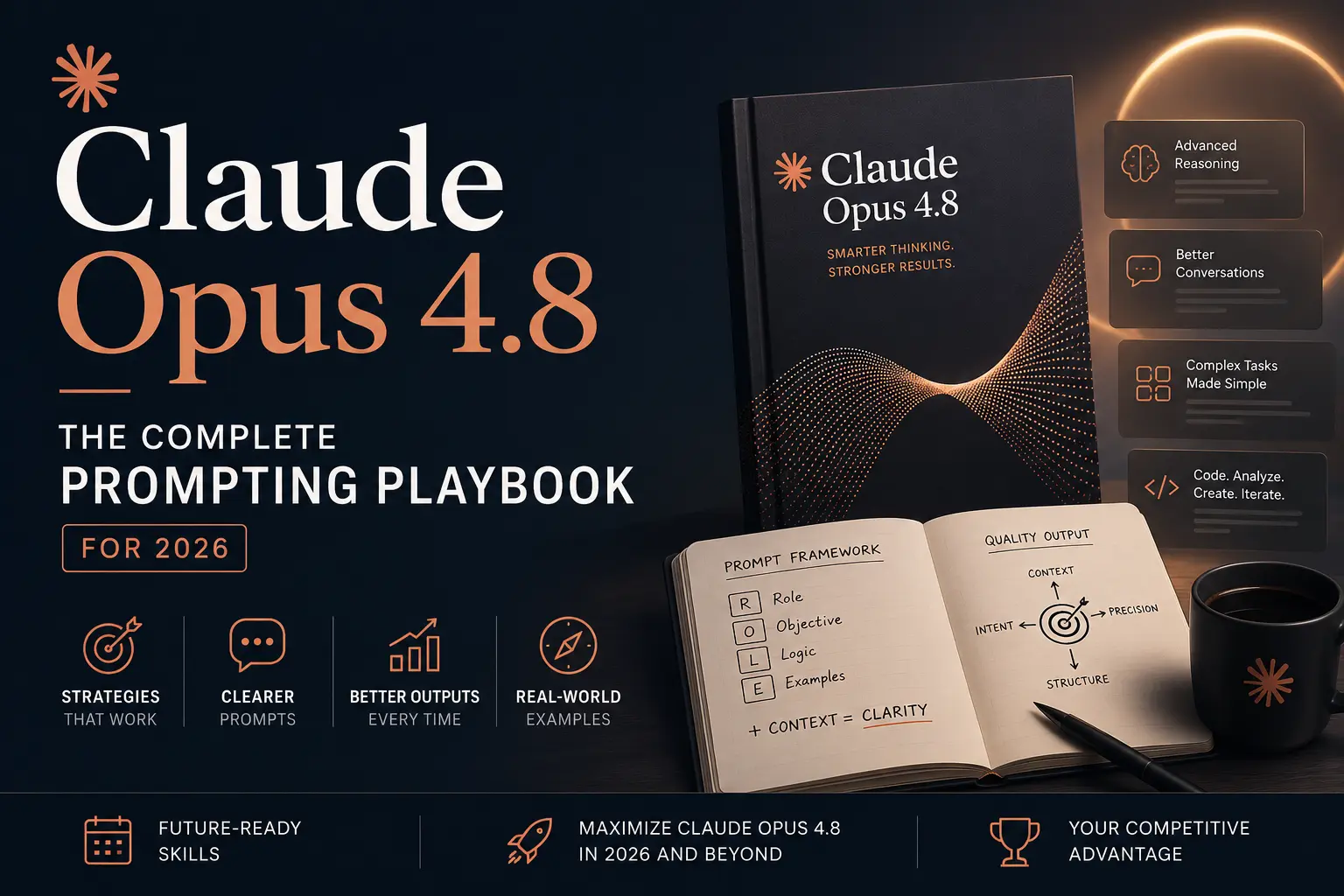
The prompting principles in this playbook work on all three. The RCTFT framework, the follow-up loop, and the example prompts will improve your results regardless of which platform you use. If Claude is your main tool, our Claude Opus 4.8 prompting playbook covers the Claude-specific settings on top of these: effort levels, XML structure and workflows.
Rate your prompt
Before you send your next prompt, score it against the RCTFT framework. Check each element you've included:
0/5
Prompt Score
Check each element you've included
Role Told AI who to be
Context Gave situation details
Task Specific instruction
Format Defined output shape
Tone Set the voice/style
The one thing that matters more than any technique
You will forget the framework names. You will lose the cheat sheet. But if you remember one thing from this playbook, let it be this:
The quality of AI's output is directly proportional to the specificity of your input.
Every time you're about to type a prompt, pause for five seconds and ask: "What do I know about this situation that the AI doesn't?" Then tell it. That's the entire skill.
The people who say AI is useless are typing "write me an email" and getting garbage. The people who say AI is transformative are spending five extra seconds on context and getting output they'd pay a consultant for.
Those five seconds are the only difference.
Frequently asked questions
What is prompt engineering?
Prompt engineering is the practice of crafting inputs to large language models that produce useful, specific, and accurate outputs. It's less about memorizing magic phrases and more about providing sufficient context — role, situation, task, format, and tone — so the AI can generate a response tailored to your needs rather than a generic default.
Which AI is best for beginners — ChatGPT, Claude, or Gemini?
All three respond to the same prompting principles. ChatGPT is the most widely used and best for conversational tasks and brainstorming. Claude excels at careful analysis and following complex instructions. Gemini is strongest when you need current web information or Google Workspace integration. Start with whichever you already have access to — the RCTFT framework works on all of them.
How long should a prompt be?
There's no ideal length — there's ideal specificity. A 20-word prompt with clear context beats a 200-word prompt full of vague instructions. Use the RCTFT checklist: if you've covered Role, Context, Task, Format, and Tone in two sentences, that's enough. If the task is complex, a longer prompt with more context will get better results.
Can AI replace professional advice?
AI can draft, brainstorm, analyze, and accelerate work — but it's not a substitute for professional judgment in legal, medical, financial, or compliance contexts. Use it as a first draft generator and research accelerator, then apply human expertise for final decisions. AI hallucinates — it can produce confident-sounding statements that are factually wrong.
What's the difference between prompting and GEO?
Prompting is how you talk to AI as a user. Generative Engine Optimization is how you structure your business's data so AI recommends you to other users. This playbook covers the first skill. Our GEO playbooks cover the second.
This playbook is part of the Fade Digital Playbooks collection. If you're a business owner wondering how AI search platforms like ChatGPT and Gemini decide which businesses to recommend, start with our Ultimate Guide to GEO in 2026 — it's the business-specific application of everything you just learned about prompting.
Lorne runs an AI-native digital marketing agency. He writes about generative engine optimization, AI search citation mechanics, and entity architecture — the infrastructure layer that determines whether AI recommends your brand or your competitor's.