
Services
AI Search & GEOGet recommended by ChatGPT, Gemini and Google AI Local SEOWin the map pack and "near me" searches Content StrategyContent that AI engines quote Web Design & CROSites that turn visitors into bookings Paid MediaGoogle and Meta ads that feed your AI visibility All ServicesIndustries · Healthcare
Healthcare & Clinics Dentists Optometrists Chiropractors Physiotherapy Med SpasIndustries · Professional Services
Law Firms Real Estate AccountantsIndustries · Home & Local
Home Services All industries ResultsResources
Blog Learn GEOGlossary, learning paths and GEO stats Playbooks State of AI Search 2026Company
About Partners Careers ContactGenerative Engine Optimization for Optometrists in Toronto
Your next patient isn't scrolling Google listings — they're asking ChatGPT "who's the best optometrist near me for dry eye?" and booking whoever the AI names. GEO makes sure that's you.
Last updated: July 2026
The Shift
Why are optometrists losing new patients to AI search?
Optometrists are losing patients to AI search because ChatGPT, Gemini and Perplexity now answer "which eye doctor should I see?" with two or three specific clinic names — and clinics without machine-readable data, consistent listings and citable mentions are simply never named, no matter how good their care is.
The numbers behind that shift are hard to ignore. OpenAI reported ChatGPT passed 800 million weekly users in October 2025. Google says AI Overviews now reach more than 1.5 billion people per month (Alphabet Q1 2025 earnings). And Gartner projected traditional search volume would drop 25% by 2026 as consumers shift to AI assistants.
Eye care is especially exposed. Vision questions are confusing — coverage rules, exam frequency, "is this urgent?" — so patients ask AI in plain language instead of scanning ten blue links. The AI answers with a short list. If your clinic isn't on it, you lost a patient you never knew existed.
Your competitors on that list didn't get there by accident. They got there because a machine could read, verify and trust their data. That's a fixable problem.
Real prompts your future patients type into AI
The AI answers each of these with named clinics. High-intent, ready-to-book patients — and the recommendation happens before they ever see a search results page.
Definition
What is GEO for optometrists?
GEO (Generative Engine Optimization) for optometrists is the practice of structuring your clinic's website, business data and third-party mentions so AI engines like ChatGPT, Gemini and Perplexity recommend your practice by name when patients ask for an eye doctor, a specific treatment or an urgent exam.
Where SEO earns you a ranking, GEO earns you a recommendation. Our full framework — audit, foundation, authority, proof — is documented on our methodology page.
The Mechanism
How does AI decide which optometrist to recommend?
AI engines recommend the optometrists they can verify. They cross-reference your website's structured data, the consistency of your name-address-phone across the web, your review signals, and whether credible third-party pages list you as a real option — then name the clinics where all of those signals agree.
Is your clinic one consistent entity?
AI engines build a profile of your clinic from every mention on the web. If your name, address, phone and doctor roster differ between your site, Google Business Profile and directories, the model can't verify you — and skips you. Entity consistency is the entry ticket.
Can a machine read your services?
Structured data (JSON-LD schema) tells AI exactly what you offer: comprehensive exams, dry eye therapy, myopia control, ortho-k, emergency visits. Clinics with Optometric and MedicalClinic schema get parsed correctly; clinics without it get guessed at — or ignored.
Do your reviews say what you're best at?
AI doesn't just count stars — it reads review text. Fifty reviews that mention "thorough dry eye workup" and "great with kids' first exams" teach the model what to recommend you for. Volume, recency and specificity all feed the answer.
Who else says you're good?
Generative engines lean heavily on citable third-party sources: "best of" lists, local publications, professional directories, association pages. The Princeton GEO study (KDD 2024) found citations and statistics lift generative-engine visibility by up to 40%. If no third party lists you, AI has nothing to cite.
Can AI crawlers even reach your content?
GPTBot, ClaudeBot and PerplexityBot must be able to crawl your site. Blocked crawlers, JavaScript-only content and buried service pages mean your clinic is invisible at the source. Technical GEO fixes access first — everything else builds on it.
Does your content answer real questions?
Patients ask AI full questions: "How often should I get my eyes checked?" The Canadian Association of Optometrists recommends regular exams at least every two years for most adults — and clinics whose pages answer questions like that directly, in plain language, become the source the AI quotes.
Side by Side
Traditional SEO vs GEO for eye care clinics: what's the difference?
Traditional SEO competes for a position on a results page; GEO competes for a mention inside an AI answer. For an eye care clinic the difference is practical: SEO wins clicks from patients still comparing, while GEO wins the recommendation that patients act on directly.
| Traditional SEO | GEO | |
|---|---|---|
| Goal | Rank your clinic's pages on Google for terms like "optometrist Toronto" | Get your clinic named when a patient asks AI "which optometrist should I see?" |
| Where you appear | Search results pages and the local map pack | Inside answers from ChatGPT, Claude, Perplexity, Gemini, Grok and Copilot |
| Key signals | Keywords, backlinks, page speed, local citations | Entity consistency, JSON-LD schema, review text, citable third-party mentions, crawler access |
| Timeline | Typically 6–12 months to move competitive rankings | First movement in 30–90 days; AI answers refresh faster than rankings |
| How it's measured | Rankings, organic traffic, map-pack position | AI answer share: how often six engines cite your clinic on real patient prompts, tracked monthly |
You need both. GEO builds on a sound SEO foundation — see how the two connect for chiropractors and dentists, where the same mechanics apply to different patient journeys.
The Program
What's included in Fade Digital's GEO program for optometrists?
Every engagement follows the same four-stage system — the AI Visibility Engine: a paid AI Visibility Audit to establish the baseline, technical and schema foundation work, authority and citation building, and monthly AI visibility reporting across six engines tied to actual patient inquiries.
AI Visibility Audit — where you stand today
We run real patient prompts ("best optometrist near [your neighbourhood]", "dry eye specialist Toronto") across ChatGPT, Claude, Perplexity, Gemini, Grok and Copilot, and record exactly where your clinic appears, where competitors appear instead, and which broken signals are causing it. You get the full report whether or not you continue.
Technical GEO & schema — make your clinic machine-readable
AI crawler access (GPTBot, ClaudeBot, PerplexityBot), JSON-LD schema for your clinic, doctors and every service — exams, contact lens fittings, dry eye therapy, myopia control — plus entity cleanup so your name, address, hours and roster match everywhere a machine looks.
Authority & citations — give AI something to quote
Answer-first content for the questions patients actually ask AI, review strategy that surfaces your specialties in review text, and placement in citable third-party sources — the neutral lists and local publications generative engines pull recommendations from.
Monthly AI visibility reporting — proof, not vanity metrics
Every month we re-run the prompt set across all six engines and report your AI answer share, which services you're being recommended for, and how that maps to new-patient inquiries. You see the same data we do — no black box.
Proof
What does this program look like at an eye care clinic?
Toronto Eye Care, an active Fade Digital client, runs this exact program: schema rollout across FAQ, service and homepage templates, Google Ads management, search-console and Bing Webmaster monitoring, and a neutral "10 Best Eye Care Clinics in Toronto" listicle built as a citable asset for AI engines.
Structured data across the clinic’s key templates
Run alongside the GEO work, not instead of it
Indexing and query data reviewed through the engagement
We don’t publish patient growth, lifetime value or savings figures for this engagement without a documented reporting period and attribution method. It combines paid media, search and website work, so no single number can be credited to GEO alone.
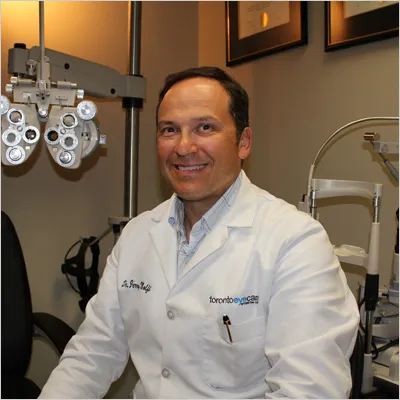
"Lorne has been a pleasure to work with, helping us grow our rankings, while improving our website conversion rates and maximizing our ad spend for efficiency. Total package!"
Dr. Jerry Nolfi · Toronto Eye Care
Transparent Pricing
How much does GEO cost for an optometry practice?
GEO for an optometry practice starts at $499 for the AI Visibility Audit, and ongoing GEO programs start at $2,850 per month. We publish pricing because AI engines favour pages with visible, verifiable pricing — the same transparency we build for your clinic.
AI Visibility Audit
Your clinic tested across six AI engines with real patient prompts, competitor comparison, and a prioritized fix list. Credited toward your first month if you continue.
Monthly GEO Program
Technical GEO, schema, entity cleanup, authority content, citation building and monthly six-engine AI visibility reporting. Scope scales with locations and service lines — no surprise line items.
Optometrist GEO: frequently asked questions
Find out what AI says when patients ask for an optometrist.
The AI Visibility Audit shows you exactly which engines recommend your clinic, which recommend your competitors, and the fastest fixes — in plain language, with no obligation to continue.
See how the same system applies to med spas and physiotherapy clinics, or read the guide to choosing a GEO agency in Toronto.