
Services
AI Search & GEOGet recommended by ChatGPT, Gemini and Google AI Local SEOWin the map pack and "near me" searches Content StrategyContent that AI engines quote Web Design & CROSites that turn visitors into bookings Paid MediaGoogle and Meta ads that feed your AI visibility All ServicesIndustries · Healthcare
Healthcare & Clinics Dentists Optometrists Chiropractors Physiotherapy Med SpasIndustries · Professional Services
Law Firms Real Estate AccountantsIndustries · Home & Local
Home Services All industries ResultsResources
Blog Learn GEOGlossary, learning paths and GEO stats Playbooks State of AI Search 2026Company
About Partners Careers ContactSupporting Toronto Eye Care with search, website and paid media work
A downtown Toronto optometry clinic, a combined digital marketing engagement, and the client's own account of working with Fade Digital.
By the Fade Digital team.
Last updated: July 2026
The Clinic
Who is Toronto Eye Care?
Toronto Eye Care is an established optometry clinic in downtown Toronto, led by Dr. Jerry Nolfi. It operates in one of Canada's most competitive eye care markets, where independent clinics, national chains and directory sites all fight for the same patients within a few city blocks.
The clinic wasn't struggling on care. It was well-reviewed, and its work in corneal and dry eye treatment gave it a genuine specialty — the kind of complex, long-term care that most competitors don't handle.
The problem was distribution. Good clinical work doesn't market itself, and in a downtown core, the clinic that gets found first usually wins the booking — regardless of who would have delivered better care.
- Industry
- Optometry
- Market
- Downtown Toronto
- Principal
- Dr. Jerry Nolfi
- Engagement
- Paid media + GEO, ongoing
The Problem
Why did a well-reviewed clinic need GEO?
Toronto Eye Care needed GEO because the economics of patient acquisition were breaking: cost per click on core eye care terms had climbed past $15, directory sites outranked the clinic for its own specialties, and patients were increasingly asking AI assistants — not Google — which eye doctor to book.
Each of those pressures alone is survivable. Together, they compound. Rising CPCs mean every paid patient costs more this year than last. Directories owning the rankings means organic clicks route through a middleman. And AI answers mean a growing share of patients never see a results page at all.
The clinic could keep outbidding competitors on a treadmill that gets faster every quarter — or build the machine-readable authority that makes AI engines and search features cite it directly. It chose the second option, without abandoning the first.
The shift behind the problem
Weekly ChatGPT users reported by OpenAI in October 2025 — a patient pool that never sees a search results page.
People reached by Google's AI Overviews every month, per Alphabet's Q1 2025 earnings — AI answers sitting above the ads the clinic was paying $15+ per click for.
Gartner's projected decline in traditional search volume by 2026 as consumers shift to AI assistants.
The Work
What did Fade Digital actually do?
We ran paid and organic acquisition as one system: Google Ads management for immediate demand, plus a GEO build-out — schema across FAQ, service and homepage templates, search console and Bing monitoring, a citable listicle asset, and knowledge-graph entity work targeting dry eye and LASIK queries.
Google Ads management — keep demand flowing while authority builds
GEO compounds, but it doesn't fill Tuesday's appointment book. Managed Google Ads kept high-intent patients coming in from day one — and the campaign data showed exactly which queries and services actually convert, which told us where the GEO work would pay off fastest.
Google Search Console monitoring — watch what Google actually reads
AI Overviews are built on Google's index, so Search Console is the closest thing to a window into what feeds them. Ongoing monitoring told us which pages Google was surfacing, which queries were gaining impressions, and whether each schema and content change was being picked up — evidence, not guesswork.
Schema rollout — FAQ, service and homepage templates
We deployed JSON-LD structured data across the clinic's FAQ, service and homepage templates. Schema is how a machine reads a clinic: what it treats, who runs it, where it is. Pages an AI engine can parse with certainty get cited; pages it has to guess at get skipped. This is the foundation everything else stands on.
Bing Webmaster Tools — the index behind ChatGPT and Copilot
Most clinics obsess over Google and forget that ChatGPT and Microsoft Copilot lean on Bing's index when they search the web. If Bing can't crawl and index your site cleanly, you're invisible to a whole class of AI answers. Setting up and verifying Bing Webmaster Tools closed that gap.
A citable asset — the "10 Best Eye Care Clinics in Toronto" listicle
AI engines prefer citing neutral comparison pages over a clinic's own marketing. So we published a neutral "10 Best Eye Care Clinics in Toronto" listicle, marked up with ItemList, MedicalClinic and FAQPage schema. When an engine needs a source for "best eye clinic in Toronto," there's now a structured page it can read, verify and quote.
Knowledge-graph entity work — own dry eye and LASIK queries
AI engines don't rank pages; they resolve entities. We built the structured data layer that defines Toronto Eye Care as the entity associated with dry eye and LASIK treatment in Toronto — so when a patient asks a specific, high-value question, the model connects the condition to the clinic instead of to a directory.
This is the same four-stage system — audit, foundation, authority, proof — documented on our methodology page. For the eye care version of the full program, see the optometry GEO program.
Measurement
Separate the work from the outcome
This engagement brings together paid media, search and website work. A website enquiry, a booked appointment and a new patient are different outcomes. An AI mention is different from a referral that converts.
We are not publishing channel-specific patient growth, lifetime value or savings figures here without a documented reporting period and attribution method. Dr. Nolfi's testimonial below describes his experience in his own words.
The Client
What does Dr. Nolfi say about working with Fade Digital?
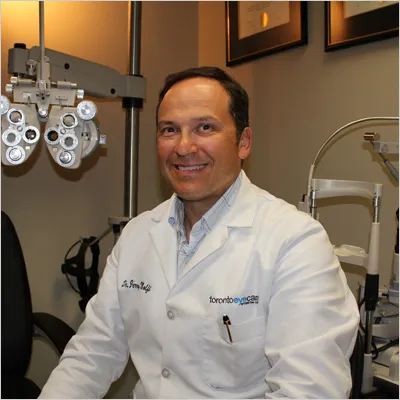
"Lorne has been a pleasure to work with, helping us grow our rankings, while improving our website conversion rates and maximizing our ad spend for efficiency. Total package!"
Dr. Jerry Nolfi · Toronto Eye Care
Want the eye care version of this program? See GEO for optometrists, browse all published results, or read the methodology behind the system.
Questions about this case study
Find out what AI says about your clinic.
Toronto Eye Care's results started with a baseline: knowing exactly where the clinic appeared in AI answers and where competitors did. The AI Visibility Audit gives you the same starting point — in plain language, with no obligation to continue.
Written by the Fade Digital team.