
Fade Digital
Home

Services

Get Found by AI Paid Client Acquisition Local Dominance Content & Authority Website & Conversion

Industries

Healthcare Dental & Clinics Legal Real Estate
Results

Playbooks

Google Ads Playbook Claude Design Playbook SEO Agent Playbook Dispatch Frameworks View All Playbooks

Company

About Us GEO Insights Knowledge Base Contact Client Portal

Apr 21, 2026

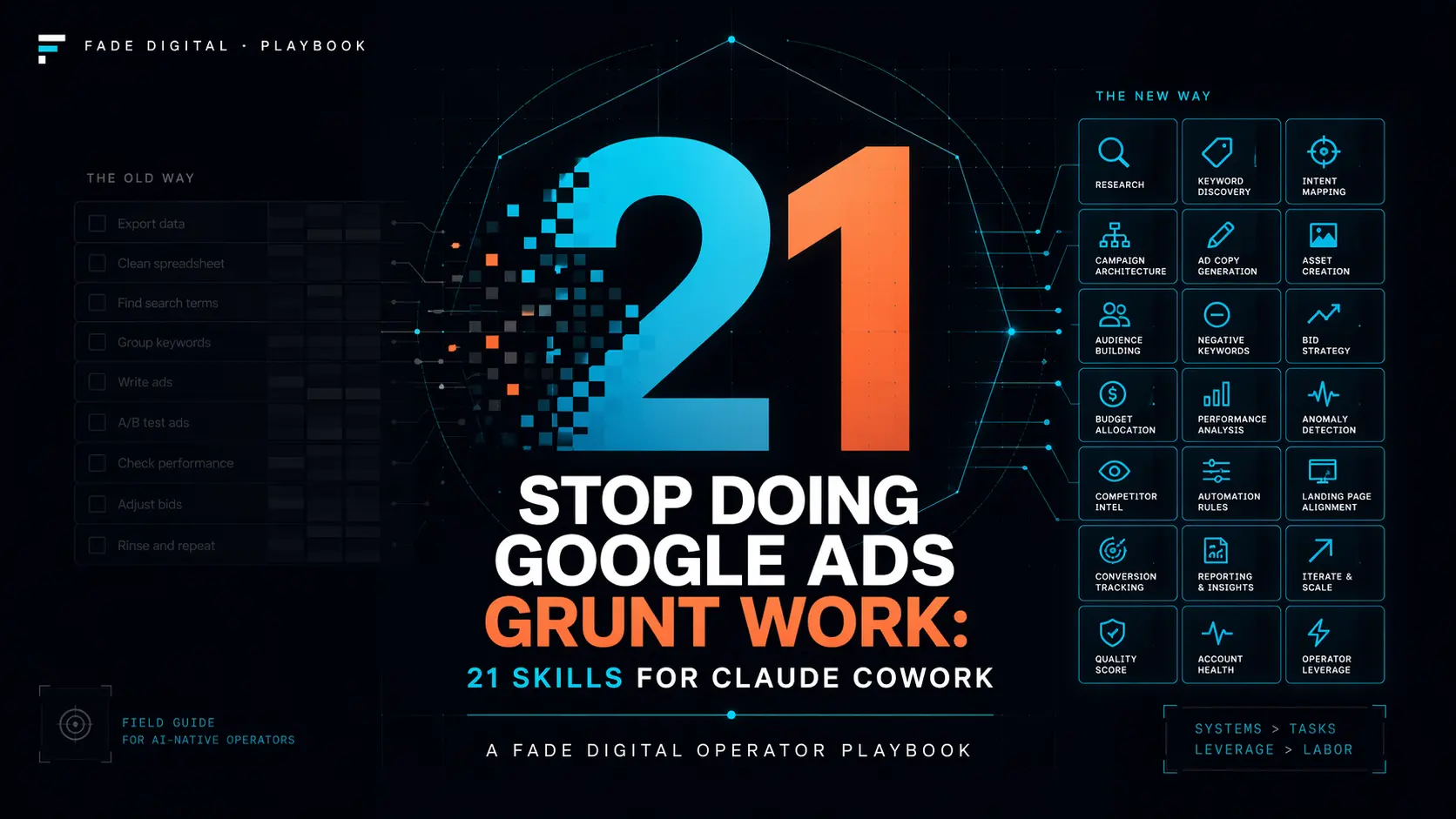
21 Google Ads Skills for Claude: The DTC & Agency Optimization Playbook

Connect Claude to your Google Ads account and run audits, find wasted spend, diagnose CPA spikes, mine search terms, and generate client reports — all in plain English. 21 ready-to-use skills for agencies and DTC brands.

21 Google Ads Skills for Claude: The DTC & Agency Optimization Playbook

What if you could ask Claude "where am I wasting money in Google Ads this month?" and get back an exact dollar figure, the campaigns responsible, and a prioritized fix list — without exporting a single spreadsheet?

That's what this playbook builds. Twenty-one reusable skills that connect Claude directly to your live Google Ads data. Each one is a specific analysis you'd normally spend 30–60 minutes doing manually: account audits, wasted spend detection, CPA spike diagnosis, search term mining, quality score repair, budget reallocation, competitor analysis, and client-ready reporting.

This is the optimization stack we use internally at Fade Digital for paid media clients, and it's the same methodology behind our Paid Media service. If you're an agency running multiple accounts or a DTC brand managing your own spend, these skills replace hours of manual spreadsheet work with a conversation.

How it works: the GoMarble MCP connector

The skills in this playbook use the GoMarble MCP connector — a free tool that handles Google Ads API authentication and gives Claude read-only access to your live account data. No developer tokens, no Google Cloud setup, no OAuth flows. You install it once and Claude can query your campaigns, ad groups, keywords, search terms, and conversion data in plain English.

It also connects to Meta Ads, Google Analytics, and Shopify if you want cross-platform analysis, but for this playbook we're focused on Google Ads.

Important: the connector is read-only. Claude can analyze your data and recommend changes, but it cannot modify campaigns, adjust bids, or pause keywords. You stay in control.

Setup (5 minutes)

  1. Download the GoMarble .dxt installer from gomarble.ai
  2. Log in with your Google account and connect your Google Ads account
  3. Generate an API key from your profile page
  4. Open Claude Desktop → File → Settings → Extensions
  5. Drag-drop the .dxt file to install, paste your API key
  6. Enable the GoMarble MCP Server
  7. Start querying your live data

Full documentation: gomarble.ai/docs/connect-to-claude-desktop

How to use the skills

Each skill below is a structured prompt you can give to Claude. For best results:

  1. Create a Claude Project called "Google Ads Analyst" and save your most-used skills as persistent project instructions
  2. Start with Skill 1 and 2 — the full account audit and wasted spend finder give you the lay of the land
  3. Run Skill 5 monthly — search term mining is the highest-ROI recurring task
  4. Schedule Skill 4 weekly — automated performance reports replace manual dashboarding

You can also save any skill as a reusable Claude Skill file. Create a folder with a SKILL.md file inside, zip it, and upload via Claude Desktop → Settings → Capabilities → Skills.


Section 1: Account Performance & Auditing

Skill 1: Full Account Audit

Pull 30 days of account data and analyze: total spend, impressions, clicks, CTR, CPC, conversions, CPA, and ROAS. Break down performance by campaign, then drill into ad-group-level data for the top 3 campaigns by spend. Look for day-of-week patterns, hour-of-day trends, and device performance splits.

Flag anything where:

  • CPA is more than 2x the account average
  • A campaign is spending more than 20% of budget with zero conversions
  • Week-over-week swings exceed 15%

Deliverable: top 5 issues ranked by budget impact, with specific recommended actions for each.

Skill 2: Wasted Spend Finder

The average Google Ads account wastes 20–30% of its budget. This skill quantifies exactly where yours is leaking.

Define "waste" as:

  • Search terms with more than $50 in spend and zero conversions
  • Keywords with CPA more than 3x the account average
  • Ad groups with more than $100 in spend and zero conversions
  • Campaigns spending more than 30% of budget on non-converting terms

For each waste source, report the exact dollar amount, explain why it's waste, and recommend a specific action: pause, negate, restructure, or adjust bid.

Deliverable: total wasted spend as a dollar figure and a percentage of total account spend.

Full Playbook — Free

You've seen the first 2 skills.

Enter your email to unlock all 21 Google Ads skills — account audits, search term mining, quality score repair, budget optimization, competitor analysis, shopping feed optimization, and client-ready reporting templates.

No spam. Unsubscribe anytime.
Skill 3: CPA Spike Diagnosis

When CPA spikes, this skill runs a 7-day comparison to find the root cause. Investigate across seven dimensions:

  1. Which campaigns had the biggest CPA increase?
  2. Within those campaigns, which ad groups and keywords drove the spike?
  3. Which search terms got clicks but no conversions?
  4. Did impression share change (competitive pressure)?
  5. Did conversion rate drop (landing page or offer problem)?
  6. Did CPC increase (auction pressure)?
  7. Were there recent account changes (budget shifts, new keywords, bid changes)?

Deliverable: root causes ranked by severity with specific fixes for each.

Skill 4: Weekly Performance Report

Generate a report designed for a founder or marketing manager to read in under 2 minutes:

  1. Executive summary — 3 sentences: what happened, why, and what you're doing about it
  2. Metrics table — spend, impressions, clicks, CTR, CPC, conversions, CPA, ROAS — all with week-over-week change
  3. Top 3 winning campaigns — what's working and why
  4. Top 3 struggling campaigns — diagnosis and planned response
  5. Search term changes — new high-volume converters and new wasters added to negatives
  6. Prioritized action items for the coming week

No jargon. Write for someone who approves budgets, not someone who manages bids.


Section 2: Search Terms & Keywords

Skill 5: Search Term Mining

Analyze all search terms from the last 30 days and categorize into three buckets:

  1. "Add as keywords" — high-performing terms not yet added as exact-match keywords
  2. "Negate immediately" — high-spend, zero-conversion terms and irrelevant queries
  3. "Review" — borderline cases that need human judgment

Also identify: high CTR but low conversion rate terms (intent mismatch), and patterns in converting terms (common words, phrases, modifiers that appear repeatedly).

Deliverable: estimated monthly savings from the recommended negations.

Skill 6: Negative Keyword Discovery

Pull 60 days of search term data and identify terms that should be negated. Categorize by type:

  • Irrelevant intent — informational queries (how-to, reviews, free, DIY)
  • Wrong product/service — queries for things you don't sell
  • Competitor brand terms — unless you're intentionally bidding on them
  • Geographic mismatch — out-of-target locations
  • Job-related — people looking for employment, not your product
  • Waste patterns — common word stems that consistently don't convert

Organize into campaign-level vs. account-level negatives. Recommend exact match vs. phrase match for each. Prioritize by spend impact.

Skill 7: Keyword Performance Analysis

Pull all keywords with significant spend and categorize into four performance buckets:

  1. Stars — high volume, low CPA, high ROAS → increase bids and budget
  2. Opportunities — decent metrics with room for optimization → test match types, improve ad relevance
  3. Money pits — high spend, poor CPA or zero conversions → pause, restructure, or lower bids
  4. Long tail gold — low volume but excellent CPA → expand with similar variations

For each keyword, include: text, match type, impressions, clicks, CTR, CPC, conversions, CPA, ROAS, and quality score.


Section 3: Quality Score & Ad Relevance

Skill 8: Quality Score Audit

Pull quality score data for all keywords and analyze:

  • Distribution across the 1–10 scale
  • Impression-weighted average quality score
  • Keywords with QS below 5 that have more than $20 in spend (last 30 days)

For each low-QS keyword, break down the three components — ad relevance, expected CTR, and landing page experience — and identify which is below average. Recommend specific fixes for each.

Key benchmark: each quality score point above average reduces CPC by approximately 16%. Estimate the CPC savings available from fixing the identified issues.

Skill 9: Ad Copy Performance Analysis

Analyze all active ads and identify:

  • Top 5 by CTR — what headline structures are winning (question, benefit, number, urgency)?
  • Top 5 by conversion rate — what messaging converts (price/discount vs. value-focused)?
  • Bottom 5 by CTR — why aren't these getting clicked?
  • Bottom 5 by conversion rate — these attract clicks but don't convert — why?

Look for patterns: which CTAs perform best, which headline structures consistently win, whether price-driven or value-driven messaging converts better.

Deliverable: 5 new ad copy variations based on the winning patterns found in your account data.


Section 4: Bidding & Budget

Skill 10: Budget Allocation Optimizer

For each campaign, pull: daily budget, actual spend, conversions, CPA, ROAS, impression share, and impression share lost to budget and rank.

Optimization logic:

  • Shift budget from high-CPA campaigns to low-CPA campaigns
  • Increase budget on campaigns losing impression share due to budget
  • Reduce budget on campaigns with diminishing returns
  • Keep total account spend the same (budget-neutral reallocation)

Deliverable: before/after comparison showing projected impact on total conversions and average CPA.

Skill 11: Bid Strategy Analysis

For each campaign, analyze: current bid strategy type (manual CPC, maximize conversions, target CPA, target ROAS, etc.), the target setting, actual performance against the target, and whether the strategy is meeting its goal.

Identify:

  • Strategies missing their target by more than 20%
  • Campaigns that should switch strategy types
  • Targets that are too aggressive (limiting spend) or too loose (allowing waste)

Deliverable: specific strategy changes per campaign with projected performance impact.


Section 5: Audience & Targeting

Skill 12: Device Performance Breakdown

Pull 30 days of data split by device (desktop, mobile, tablet) for each campaign. Report: spend, impressions, clicks, CTR, CPC, conversions, CPA, ROAS.

Identify:

  • Which device converts best and at what CPA
  • Mobile CPA more than 2x desktop (landing page problem or bid adjustment needed)
  • Tablet spending significant budget with minimal conversions

Deliverable: specific device bid adjustments per campaign.

Skill 13: Geographic Performance Analysis

Pull the top 20 locations by spend with per-location metrics: impressions, clicks, CTR, CPC, conversions, CPA, ROAS.

Identify:

  • Top 5 locations by CPA efficiency (scale these)
  • Bottom 5 locations by CPA (reduce or exclude)
  • High-spend, zero-conversion locations (exclude)
  • Locations that justify bid adjustments

Deliverable: specific geographic bid adjustments and exclusion recommendations.

Skill 14: Audience Segment Analysis

Analyze 30 days of data across all audience segments: in-market, affinity, remarketing, customer match, and any custom audiences.

For each segment report: impressions, clicks, CTR, CPC, conversions, CPA, ROAS.

Answer:

  • Which segments convert best?
  • Which have high spend but poor CPA?
  • How does remarketing compare to prospecting?
  • Which segments should be added, excluded, or have bids adjusted?

Deliverable: audience bid adjustments and new targeting opportunities.


Section 6: Shopping Campaigns (DTC / E-commerce)

Skill 15: Shopping Campaign Audit

Pull 30 days of shopping performance broken down by: product, product type, brand, custom label, and category.

Identify:

  • Top 10 products by ROAS (your hero SKUs)
  • Bottom 10 by ROAS with significant spend (drag on account)
  • High impressions but low CTR (listing quality problem — title, image, price)
  • High CTR but low conversion rate (landing page or pricing problem)
  • Zero-impression products (feed or bidding issue)

Recommendations: products to exclude, products that deserve dedicated campaigns, and feed optimization priorities.

Skill 16: Shopping Feed Optimizer

Analyze the top 50 products by spend and evaluate each on:

  • Title quality — is it descriptive with key attributes? (brand, product type, features, size, color)
  • Description quality — does it include relevant search terms?
  • Category accuracy — is the product mapped to the most specific Google category?
  • Image quality — resolution, background, clarity
  • Price competitiveness — how does it compare to competitors?

Title rewrite format: [Brand] + [Product Type] + [Key Attribute 1] + [Key Attribute 2] + [Size/Count]

Deliverable: specific title rewrites for the top 10 underperforming products.

Note: your Google Shopping feed is also what AI engines like ChatGPT and Perplexity pull from when recommending products — optimizing it for Shopping also optimizes it for agentic commerce.


Section 7: Competitor Analysis

Skill 17: Auction Insights Analyzer

Pull auction insights data for the top 5 campaigns by spend over the last 30 days.

Per competitor, analyze: impression share, overlap rate, position above rate, top-of-page rate, and outranking share.

Identify:

  • Which competitors consistently outrank you
  • Competitors gaining impression share (emerging threats)
  • Whether you're losing share due to budget or rank
  • New competitors entering the auction

Deliverable: specific bid increases, ad quality improvements, and budget adjustments to respond.

Skill 18: Competitor Ad Copy Research

Using the competitor domains from auction insights, research their current ad strategy:

  • What headlines are they running?
  • What offers or promotions are live?
  • What CTAs do they use?
  • Where do their ads land?
  • How is their messaging differentiated from yours?

Gap analysis: what do competitors offer that your current ads don't address?

Deliverable: 5 specific ad copy improvements based on competitive gaps.


Section 8: Reporting & Briefs

Skill 19: Monthly Executive Summary

Compare this month vs. last month and produce a one-page executive summary:

  1. Headline result — one sentence on ROI direction and magnitude
  2. Metrics table — spend, conversions, CPA, ROAS, CTR — all with month-over-month change
  3. Two biggest performance drivers — what moved the needle most
  4. Budget efficiency score — percentage of spend going to converting vs. non-converting campaigns
  5. One specific recommendation with expected impact

Audience: founder, CMO, or client stakeholder. One page maximum.

Skill 20: Client-Ready Performance Report

Generate a full client report with 8 sections:

  1. Account overview with month-over-month trends
  2. Campaign-by-campaign summary
  3. Top wins — what worked and why
  4. Areas of concern — underperformance and your response
  5. Search term highlights — best new terms, worst negated terms
  6. Competitive landscape changes
  7. Recommendations and next steps
  8. Budget utilization summary

Tone: professional, confident, specific. No vague "we're continuing to optimize" statements — every observation needs a number and an action.


Section 9: Testing & Optimization

Skill 21: Next Test Recommender

Based on current account data, recommend the top 5 tests to run in the next 2 weeks. For each test, provide:

  1. What to test — ad copy, keywords, bid strategy, audience, or landing page
  2. Why it matters — the performance data supporting the hypothesis
  3. How to set it up — specific implementation steps
  4. Success definition — target metric and threshold for a winner
  5. Test duration — how long to run before evaluating

Prioritize by estimated impact on CPA or ROAS. Every recommendation must be data-driven and account-specific — no generic best practices.


Setup checklist

  • Download GoMarble .dxt installer and connect your Google Ads account
  • Generate API key and install the extension in Claude Desktop
  • Create a "Google Ads Analyst" Claude Project
  • Save your most-used skills as Project instructions
  • Run Skill 1 (Full Account Audit) and Skill 2 (Wasted Spend Finder) first
  • Run Skill 5 (Search Term Mining) monthly at minimum
  • Schedule weekly reports using Skill 4
  • Bookmark this playbook — we update it as new optimization patterns emerge

This is the same optimization stack we run for paid media clients at Fade Digital. If you want us to run it for you instead of doing it yourself, get in touch.

Google AdsClaudePaid MediaAI ToolsAgency OperationsDTC
Lorne Fade
Lorne Fade

Founder & CEO, Fade Digital

Lorne runs the world's first AI-Native digital marketing agency. He writes about generative engine optimization, AI search citation mechanics, and entity architecture — the infrastructure layer that determines whether AI recommends your brand or your competitor's.

Free · No credit card · Results in 24 hrs

Is AI recommending your competitors instead of you?

Get your AI Visibility Score across ChatGPT, Gemini, and Claude — free scan, instant results, no fluff. See exactly where you're invisible and what to fix first.

Back to Intelligence Hub