ChatGPT is the most-used AI assistant on the planet. As of this week, you can buy ads inside it.
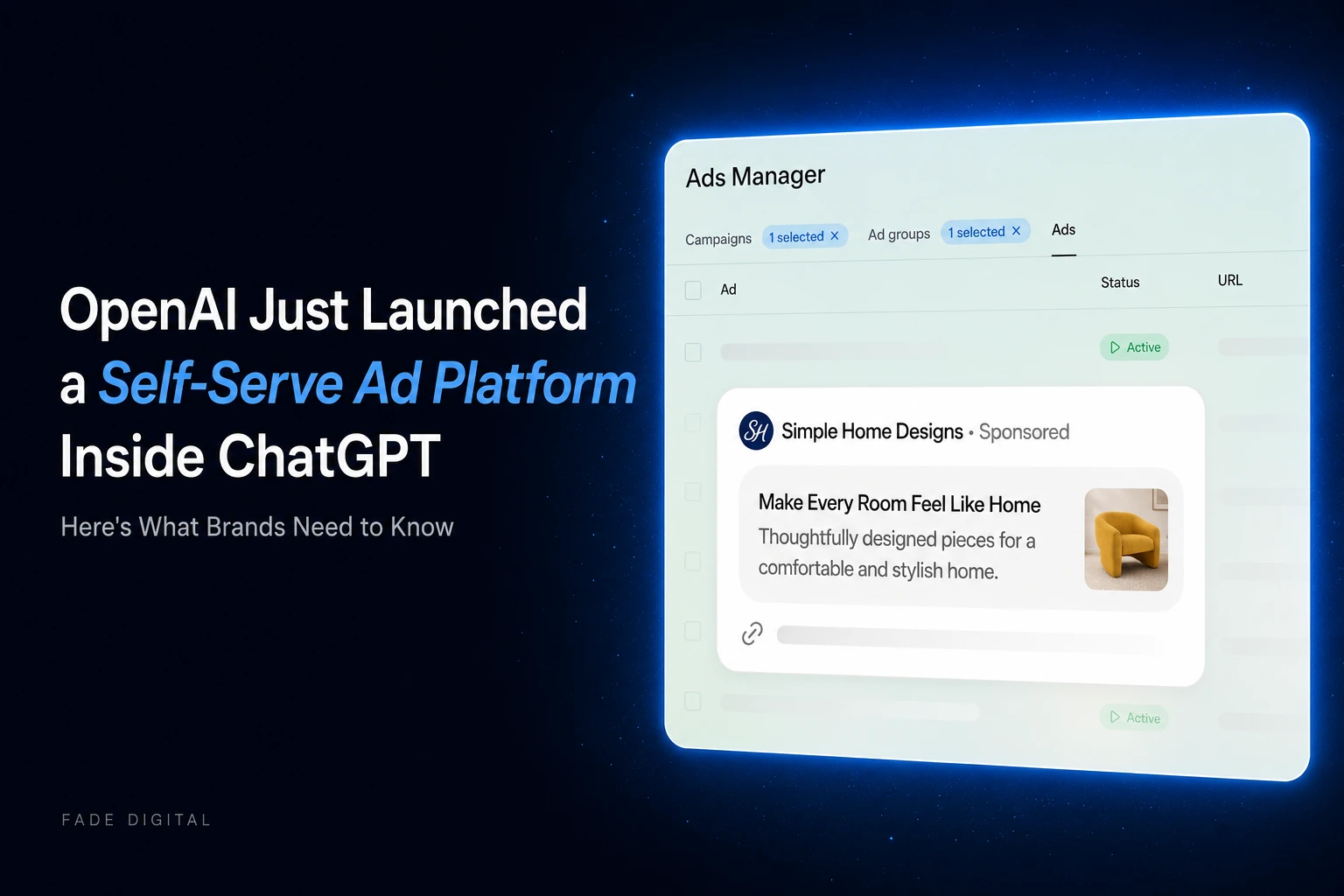
Not through a sales rep. Not via a six-figure committed insertion order. Not through an opaque pilot program. A real, self-serve ad platform where you log in, fund a campaign, set a daily budget, pick a bidding model, and run text ads that appear below ChatGPT's responses to relevant conversations.
This is the start of a new advertising channel that, if even half the early projections hold, will become one of the largest digital ad platforms in the world inside five years. OpenAI has publicly stated a target of $2.5 billion in ad revenue this year, and $100 billion by 2030. That second number is roughly the size of the entire global out-of-home advertising market today.
Most marketers haven't noticed it's even open yet. The pilot phase reportedly committed $100 million from advertisers nudged by FOMO, and the self-serve rollout to U.S. businesses started quietly. There's no big keynote announcement. No press tour. The platform is just live.
If you've spent the last 18 months trying to get your brand cited by AI through Generative Engine Optimization (GEO) — earning organic mentions in ChatGPT, Gemini, Perplexity, and Claude — this is the paid lane that runs alongside it. And like Google Search Ads in 2002, the early bidders are going to learn the playbook while everyone else is still arguing about whether AI answers will hurt their traffic.
This post is the explainer for brands who haven't touched this yet. What it is, how it works, who should test it first, what the ad copy actually looks like, what the targeting and measurement really do, and where it fits alongside the organic GEO work you're already doing. If you want the strategic backdrop on how AI search is reshaping discovery itself, start with our ultimate guide to AI SEO and GEO in 2026, then come back here.
What OpenAI's Ad Platform Is
Strip away the hype and here's what launched.
OpenAI Ads Manager is a self-serve buying tool that lets advertisers create, fund, and manage campaigns that appear inside ChatGPT conversations in the United States. It's currently in beta, which in OpenAI's case means "open to U.S. advertisers but still rolling out features." Agency partners — Dentsu, Omnicom, Publicis, and WPP — already have access through their own buying tools, and ad tech platforms like Adobe, Criteo, Kargo, Pacvue, and StackAdapt are integrating too. But the news here is that you no longer need to be one of those agencies or hit a $50,000 minimum spend to get in. The previous test threshold has been removed.
The format is text. Short, conversational ad copy in a clearly-labeled "Sponsored" box that appears below or alongside ChatGPT's organic response, never inside the response itself. OpenAI is calling this a "tinted box" — a visually distinct unit with a background color shift that separates it from the AI answer.
The bidding works two ways:
- Reach campaigns are bought on a cost-per-thousand-impressions (CPM) basis. You pay for views.
- Click campaigns are bought on cost-per-click (CPC). You pay only when someone clicks your ad.
OpenAI's recommended starting maximum bid for CPC campaigns is $3 to $5 per click. That's lower than top-end Google Search CPCs in many high-intent verticals (legal, dental, financial services, B2B SaaS), and significantly lower than the cost of acquiring the same intent through display or programmatic.
Targeting isn't behavioral demographic stacking. It's conversational context. When ChatGPT determines a user's conversation is about a topic relevant to your campaign — say, the user is researching meal kits, or asking how to whiten their teeth, or comparing law firms — your ad becomes eligible to be shown. OpenAI's official language: "ads are selected by matching ads submitted by advertisers with the topic of the user's conversation, past chats, and past interactions with ads."
Measurement is starting to look familiar. Ads Manager reports impressions, clicks, spend, click-through rate, average CPC, average CPM, and conversions. OpenAI has launched a Conversions API and pixel-based measurement so advertisers can attribute real outcomes — purchases, leads, sign-ups — back to ad engagement. CPA bidding has been promised but isn't fully live yet, and third-party measurement integrations are being developed.
That's the platform. Now let's talk about why it matters.
Why this is bigger than another ad channel
Two things make ChatGPT ads different from anything that came before.
The first is conversational intent. People don't search ChatGPT the way they search Google. They type — or speak — full sentences. They explain their situation. They ask follow-up questions. They reveal context most search queries never carry: the budget they have, the constraints they're working under, the alternatives they've considered, the deadline they're up against. A query like "best family lawyer in Toronto for an amicable divorce, no kids, under $5K retainer" is the kind of buyer signal a Google Ads keyword campaign can't see. An advertiser who can write copy that responds to that conversation, in tone and content, is buying the warmest commercial intent that's ever been available at scale.
The second is the size of the inventory. ChatGPT has hundreds of millions of weekly active users. Google ran on 3.5 billion daily searches. ChatGPT is processing billions of conversations a week, growing fast, and has effectively no advertising in the system today. The supply-demand curve right now favors advertisers in the same way Google Search ads did in their first three years. CPCs are low. Competition is sparse. Inventory is enormous.
When a new advertising channel opens at scale, there's typically a 12 to 24-month window where the first wave of advertisers — the ones who experiment while everyone else is still skeptical — develops the playbook, captures the cheapest impressions, and locks in account performance history that becomes a moat. We saw this with Google AdWords in 2003. With Facebook Ads in 2010. With Instagram in 2014. With TikTok in 2020. ChatGPT ads in 2026 is that same window, opening now.
How ChatGPT ads actually look on screen
Most marketers haven't seen one yet. Here's what the format looks like in practice.
A user types a query into ChatGPT — let's say "what's the best way to whiten teeth at home." ChatGPT generates its organic response: a numbered list of methods, the relative effectiveness of each, what to avoid. Below that response, in a visually distinct tinted box with a clearly-marked "Sponsored" label, an ad appears. Maybe it's from a DTC oral care brand. The headline is short. The body copy is conversational, almost like another sentence in the same response — "Skip the trial-and-error. SmileDirect's at-home whitening kit ships in 48 hours and is dentist-formulated." There's a click-through link, and a small control that lets the user dismiss the ad, learn why they were shown it, or tell ChatGPT not to show ads like this again.
The ad doesn't sit inside ChatGPT's answer. The answer is generated independently, then the ad is shown alongside. This is a critical design choice and it has a name.
The Answer Independence Principle (and why it matters for GEO)
OpenAI has stated explicitly, in its official advertising principles and its privacy policy, that advertising does not influence the responses generated by ChatGPT. The ad system is separate from the language model that writes the answers. An advertiser cannot pay to be recommended in an organic response. An advertiser cannot pay to be cited as a source. An advertiser cannot pay to suppress mentions of their competitors.
This is sometimes called the Answer Independence Principle, and it's the most strategically important detail of the entire platform.
Here's why. If OpenAI had blurred the line — if paying for ads bought you better organic placement, or if ads bled into citations — the entire trust foundation of ChatGPT collapses. Users would treat AI answers the way they treat sponsored search results: with reflexive skepticism. The model's commercial value depends on the model's perceived honesty. So OpenAI architected a wall between the answer and the ad, and they've made that wall a public commitment.
For brands doing GEO work, this is excellent news. The thing you've been investing in — earning citations in organic AI answers through structured data, knowledge graph optimization, digital PR, and authoritative content — keeps its full value. The ads layer doesn't compete with the organic layer. It's a separate channel that runs alongside it. A brand with strong GEO presence and ChatGPT ads gets shown twice in a relevant conversation: once cited inside the answer (organic), once below it in the tinted box (paid). A brand with neither gets shown zero times.
If you haven't started the organic side, start there. We covered the foundation in Hacking the ChatGPT Knowledge Graph and The AI Knowledge Graph Playbook. The paid layer compounds with it; it doesn't replace it.
How the auction actually works
ChatGPT ads run as a real-time auction, similar to other digital ad platforms but with three differences worth understanding.
Bidding objectives. You pick what you're optimizing for at the campaign level. A "Reach" objective buys impressions on a CPM basis — useful for upper-funnel awareness or category education. A "Clicks" objective buys clicks on a CPC basis, with a max bid you set. The recommended starting range is $3 to $5 per click; you can go higher if you're chasing competitive impression share, or lower if you're testing.
Relevance scoring. When multiple advertisers are eligible to be shown in a conversation, ChatGPT picks the most contextually relevant one. This is closer to Google's Ad Rank than to Facebook's bidder. A high bid alone doesn't win — your ad copy needs to match the conversational context. Generic ad copy bidding aggressively will lose to specific ad copy bidding moderately. This rewards advertisers who write tightly-scoped campaigns aligned to specific user intents, the same way Google Search Ads rewards advertisers who segment account structure by query intent.
Frequency capping by user. Conversation context isn't a one-shot lookup. ChatGPT incorporates a user's past chats and past interactions with ads into the targeting decision. A user who dismisses your ad or reports it as irrelevant is much less likely to see it again. This means careless creative gets quietly filtered out of the auction over time. The platform is biased toward genuinely useful, well-scoped ads.
The practical implication: your account structure should mirror your conversational intent map, not your product taxonomy. Build campaigns around the questions people ask in the moments your business can answer, not around your SKU list. This is the same principle we covered in Keyword patterns for LLMs — the queries that lead to AI conversions look different from the queries that lead to Google clicks.
Targeting: what's different from Google and Meta
Most digital advertisers come to ChatGPT ads expecting Google-style keyword targeting or Meta-style audience targeting. It's neither.
There's no upload of a customer email list to retarget. There's no lookalike audience built off a pixel. There's no demographic slicing by age, gender, household income, or interest taxonomy. The targeting is the conversation itself.
What this means in practice:
- Bottom-of-funnel commercial queries are the highest-value placements. Conversations where a user has already qualified themselves — they've stated their problem, narrowed their options, asked for a specific recommendation — are what your campaign is trying to be eligible for. Write copy that earns the click in that moment.
- Geographic targeting is implicit in the conversation when the user mentions a location. ChatGPT picks up "near me" and city names without you needing to bid them as keywords. For local service businesses, this is a structural advantage — your ad becomes eligible the moment a user names your city.
- Brand-safety and category exclusion are still being built out. Today you control eligibility through your campaign topic and ad copy. Negative-keyword-style blocking and detailed brand-safety controls are part of the roadmap but not fully exposed in the beta UI.
If you're a service business, this dynamic is enormous. The vague top-of-funnel awareness inventory most channels sell is replaced by qualified, in-the-moment commercial intent. A user asking ChatGPT "I'm looking for a family dentist in Toronto, prefer one that takes my insurance, kid-friendly office" is a qualified lead. If your campaign is eligible to appear there, you're paying CPC pricing for what would cost you 20-50× as much through a paid lead-gen vendor.
Measurement, attribution, and what you can actually track
The early measurement story is more grown-up than most new ad channels at launch.
Ads Manager reports the basics — impressions, clicks, CTR, spend, average CPC, average CPM, and conversions — directly in the dashboard. The bigger development is the Conversions API and pixel-based measurement. You install a pixel on your site (or fire server-side conversion events through the API), and the platform attributes downstream actions back to the original ad engagement. Purchases, leads, sign-ups, account creations, demo bookings — anything you can fire as a conversion event.
This is significantly more sophisticated than what most early-stage ad platforms launch with. It also means CPA-style optimization is on the near horizon. CPA bidding has been publicly promised, and once it's available, advertisers will be able to optimize toward cost-per-acquisition rather than CPC, which is when ChatGPT ads start competing directly with Google Performance Max and Meta Advantage+ on a like-for-like basis.
For now, set up the pixel from day one even if you're testing with small budgets. The conversion data you accumulate during the early phase becomes account history that informs auction performance later. We covered the broader measurement landscape — including how to track AI-driven discovery beyond just paid ads — in The AI Visibility Tracking Playbook.
Who should test ChatGPT ads first
This isn't a "every brand should be running this tomorrow" recommendation. The right early-mover profile looks like one of these:
High-LTV service businesses where a single new client is worth $2,000+ over their lifetime. Legal, dental, healthcare, real estate, financial advisory, B2B services. The math on $3-5 CPCs reaching qualified bottom-of-funnel intent is favorable even at conservative conversion rates. If a new client is worth $5,000 and you can convert 1 in 50 clicks, you can pay $100 per acquisition profitably — which translates to a $5 CPC at 5% click-to-lead conversion. That math doesn't require optimism, it requires presence.
DTC brands with conversational product categories. Anything where the buying decision involves research, comparison, or how-to questions: skincare, supplements, fitness equipment, home goods, kitchen tools. ChatGPT is being used as a personal shopping advisor for these categories already. Being eligible in those conversations — paid or organic — is high-leverage.
B2B SaaS with sub-$200/mo plans. Free-trial and self-serve B2B fits the conversational intent pattern beautifully. A user asking ChatGPT "what's the best project management tool for a remote team of 8" is qualified to see a relevant ad and click into a free trial.
Agencies running tests on behalf of clients. Same logic, but you also get the strategic advantage of building agency-side expertise on a new platform before it becomes table stakes. We've seen this pattern repeatedly in our own client work, and it mirrors the AI-tooling patterns covered in our Google Ads + Claude playbook.
Brands that should probably wait: very low-LTV impulse purchases (under $20), highly regulated categories where ad copy approval may take time, and any business whose entire competitive advantage is media-buying scale (you'll want to wait until the platform is stable enough to deploy real budgets).
Writing ChatGPT ad copy: this is a new skill
Most paid media practitioners reflexively reach for the formats they know — Google Search headlines, Facebook DPA cards, programmatic display creative. ChatGPT ad copy is structurally different and the early-mover advantage is in figuring out the new craft.
Three principles based on what we've seen in the early format.
Match the conversational register. Don't write headlines that scream "SAVE 50% TODAY." ChatGPT users are reading conversational text and your ad sits in the middle of that flow. Your copy should sound like another sentence in a knowledgeable friend's reply, not a billboard. "If you're choosing between [Option A] and [Option B], here's a third path most people don't know about" beats "BEST DEAL OF THE WEEK." Conversational context is the carrier; ad copy that breaks the register sticks out the wrong way.
Answer the question the user just asked. This sounds obvious. It is, in practice, ignored. The user typed a specific question. ChatGPT gave them a specific answer. Your ad sits below that answer. The right copy doesn't pivot to a different message — it extends the answer with a relevant offer. If the user asked "how do I whiten my teeth at home" and ChatGPT gave them five methods, your ad should not be a generic "Try our amazing toothpaste." It should be "Skip the trial-and-error — Method 6: a dentist-formulated kit that works in 7 days." You're adding to the answer, not interrupting it.
Lead with the differentiator, not the brand name. In conversational format, brand-led copy reads like a billboard. Differentiator-led copy reads like a recommendation. "[Brand] is the best [thing]" is weak. "[Specific, non-obvious benefit]. By [Brand]." is strong. The user is mid-conversation. They don't have time to figure out why your brand is special. Tell them in the first three words.
This is also where structured product data on your website starts to compound. ChatGPT's relevance ranking weighs the topic match between user query and your ad and your landing page. If your landing page is structured for AI extraction — schema, FAQ markup, clear product attributes — your ad relevance scores improve, which lowers your effective CPC. The same structured-data discipline that wins organic GEO wins paid relevance too. We laid out the JSON-LD templates in Schema Markup for AI, and the strategic case for machine-readable infrastructure in Agentic Commerce Is Coming.
How ChatGPT ads fit alongside your GEO work
The instinct for marketers steeped in Google's ecosystem is to think of ads and SEO as parallel competing channels. ChatGPT ads and GEO don't work that way. They're sequential layers of presence.
GEO earns your brand a place in the organic answer. Citations, recommendations, mentions. This is unpaid and depends on entity strength, knowledge graph signals, and authoritative content. It's the ceiling — what AI says about you when no one is paying.
ChatGPT Ads earns your brand a place in the tinted box below the answer. This is paid and depends on bid, relevance, and conversion track record. It's the floor — guaranteed presence for any conversation that matches your campaign topic, regardless of whether you've earned organic citation yet.
The strongest brands in this new landscape will run both. GEO ensures you're recommended when ChatGPT is asked who's the best in your category. Ads ensure you're shown even in conversations where ChatGPT recommended a competitor — or didn't recommend anyone at all because the conversation was about a how-to, not a vendor comparison. Combined, you cover the full conversation surface: cited inside the answer when you've earned it, present below the answer when you've paid for it.
For brands that haven't started either yet, the sequence is straightforward. Start GEO first because it's the more durable asset and informs the data structures that also help paid relevance. Then layer ChatGPT ads on top of the GEO-optimized brand entity, with campaigns aligned to the same intent map you built for organic. Same conversational intents, same content infrastructure, two channels of presence.
A practical checklist for getting started
If you've decided to test, here's what the first 30 days look like.
Get access to the self-serve ad platform. U.S. advertisers can sign up directly. Outside the U.S., you'll need to wait for international rollout or work through one of the agency partners (Dentsu, Omnicom, Publicis, WPP).
Install the Conversions pixel on your site or set up server-side events through the Conversions API. Don't skip this — the conversion data you accumulate is the foundation for later CPA optimization.
Build a conversational intent map. Pull your top 20 high-intent buyer queries from Google Search Console, Google Ads search terms, and your sales team's notes. Translate each into the conversation a user might have with ChatGPT. "How much does Invisalign cost in Toronto" becomes a conversation that includes "I'm 32, I have mild crowding, I work in finance and can't have visible braces, what's the right option for me." The conversation is richer than the query.
Write 3-5 conversational ad variations per campaign. Different angles, different differentiators, all aligned to the same intent. Treat early creative as a discovery layer — you're learning what register and structure works in this format.
Start with CPC bidding at $3-5 max bid. Don't aim for impression share dominance. Aim for the cleanest possible attribution data. Spend $500-2,000 per campaign in the first 14 days, watch CTR and conversion rates by ad variant, kill what doesn't work, iterate.
Track downstream metrics, not just clicks. CTR is interesting; cost-per-lead and cost-per-customer are decisive. The pixel will show you which variants are converting on-site, not just clicking. Optimize toward conversion economics, not click economics.
Audit your landing pages for AI extraction. Structured data, FAQ schema, clear pricing, machine-readable booking workflows. This affects ad relevance and post-click conversion both. The same audit also strengthens your GEO posture — see the GEO architecture deep-dive for the full checklist.
Re-evaluate at 30 days. You'll know by then whether the channel is working for your category. If it is, scale spend. If it isn't, document why specifically — it's almost always either an intent mismatch or a landing page conversion issue, both fixable.
What we don't know yet
Honesty about open questions is part of being early to a channel.
Brand-safety controls are still maturing. The negative-keyword-equivalent and category-exclusion mechanics aren't fully exposed yet, and a few advertisers in the pilot reported wanting more granular control over where their ads appeared. This will improve as the platform matures, but for sensitive categories it's worth budgeting in some manual monitoring time.
International rollout is on the roadmap but not committed to a public date. Today the self-serve platform is U.S. advertisers. If your business is in Canada, the U.K., the EU, or elsewhere, you can either wait for direct access or run through an agency partner that has it.
Click-through rates are still being benchmarked. Reports from the pilot phase suggested CTRs lower than legacy Google Search ads, which is unsurprising for a new format users are still learning to engage with. The advertisers winning early are those who optimize for downstream conversion economics rather than top-of-funnel CTR — clicks that come from conversational ads tend to convert at higher rates than display clicks because the user is mid-decision.
Long-term ad load is unknown. Today, ads appear in a small minority of conversations and are visually subordinated to the answer. OpenAI has been clear that user trust is non-negotiable, which suggests they'll under-monetize rather than over-monetize early. As volumes grow, the inventory dynamics will shift, but the early window is favorable.
The bottom line
OpenAI just turned on a self-serve advertising platform inside the most-used AI assistant in the world. CPC bidding starts at $3-5. Targeting is conversational context. Ad copy is short and contextual. The Answer Independence Principle protects organic value, so GEO and paid ads compound rather than compete. Measurement is grown-up enough — pixel and Conversions API — to track real outcomes, not just clicks.
The last time a major advertising platform opened at this scale with this little competition was Google AdWords in the early 2000s. The advertisers who tested it then weren't the biggest brands. They were the ones willing to learn a new format while everyone else waited for the channel to "mature." Twenty years later, the brands that captured those early CPCs and built the playbook compounded that advantage into category leadership.
The ChatGPT ads window is open. The playbook is being written right now, by whoever shows up to test it.
If you want help building a GEO-first brand presence that stacks paid ChatGPT ads on top of strong organic citation, book a free AI Visibility Scan. We'll show you where your brand is and isn't getting cited across ChatGPT, Gemini, Claude, and Perplexity — and where the highest-leverage paid testing opportunities sit for your category. For the paid side specifically, see our Paid Media service.