A mother in Scarborough opens Perplexity at 7 AM. Her toddler has had a recurring rash for two weeks and the walk-in clinic she went to last time prescribed a cream that didn't work. She types: "best pediatric dermatologist accepting new patients near Scarborough." Perplexity returns three names. Two of them are doctors she's never heard of. The third is a directory page on Healthgrades.
Your clinic — the one with a pediatric dermatologist on staff, the one five minutes from her house, the one with 200 Google reviews — isn't mentioned.
This is the scenario we hear from healthcare clients more than any other. The phones slow down. The intake forms go quiet. Google rankings look fine. But somewhere between the patient's question and your front desk, an AI decided you weren't worth recommending.
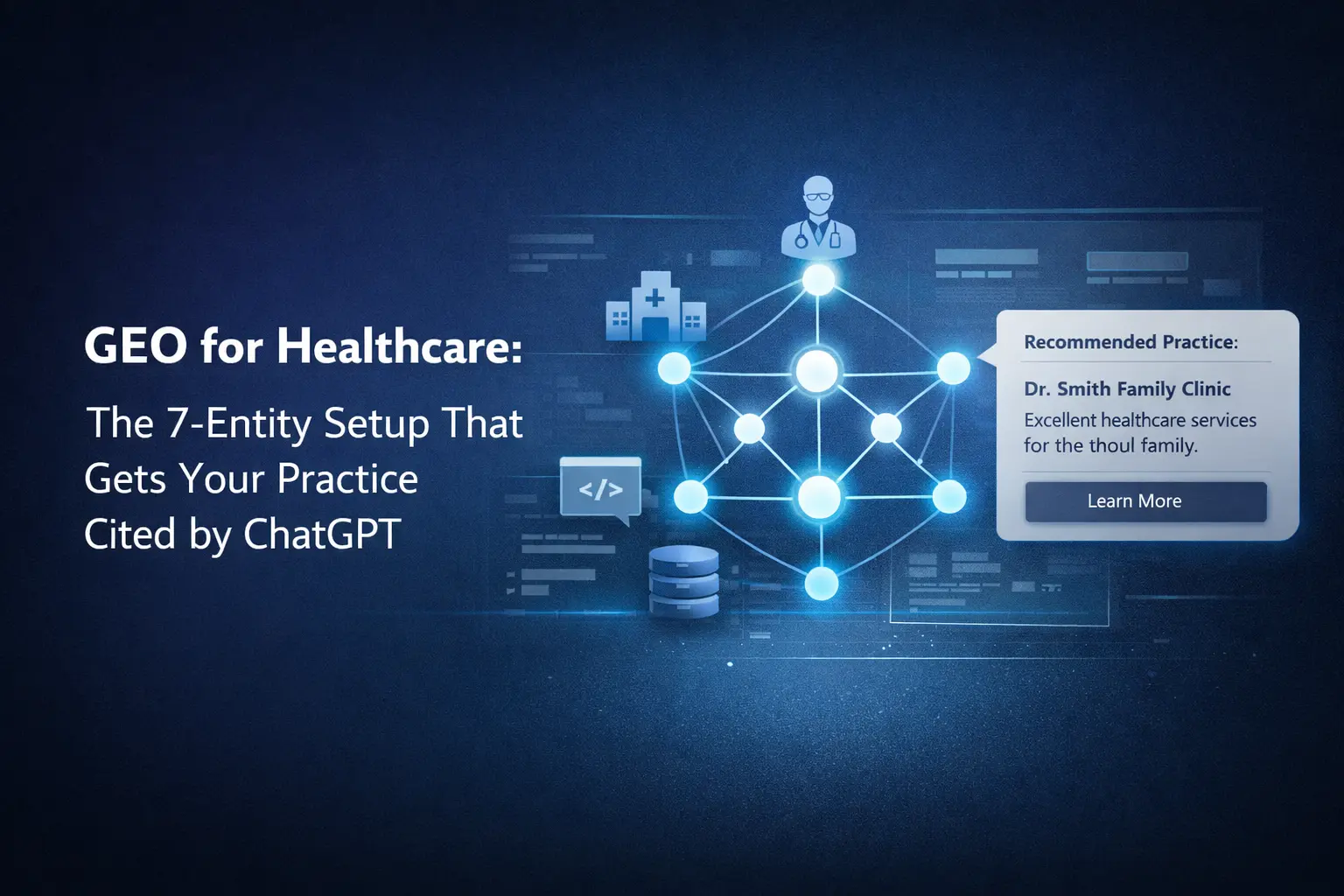
The fix isn't more blog content or a better Google Ads campaign. It's entity architecture — a specific way of structuring your practice's data so that LLMs can parse, trust, and cite you. For healthcare practices, we've found that seven entities, properly linked, produce more AI visibility than any volume of traditional marketing.
Here's the full playbook. For the broader strategic context, start with our Ultimate Guide to AI SEO and GEO in 2026. This post is the vertical-specific build for medical practices.
Why healthcare is uniquely positioned for GEO
Healthcare sits at the intersection of three things AI models care about more than almost any other vertical.
First, it's high-trust. LLMs apply stricter citation thresholds for medical queries because wrong answers have consequences. This means the bar is higher — but it also means that once you clear it, competitors without structured trust signals can't touch you.
Second, it's credential-dense. Medical degrees, board certifications, hospital affiliations, specialty designations, licensing bodies — every physician carries a trail of verifiable credential data. This is exactly the kind of structured information that LLMs use to disambiguate and trust entities.
Third, it's procedure-specific. Patients don't ask "who's a good doctor." They ask "who does Botox for migraines in Markham" or "best clinic for vasectomy reversal in the GTA." These long-tail queries map perfectly to structured procedure entities — if they exist on your site.
The problem is that most medical practices have all this information scattered across unstructured About pages, staff bios, and service lists that no machine can parse. The seven entities below fix that.
The 7 entities, in order of deployment
1. Each physician as a Person entity
Every doctor in your practice needs their own profile page — not a card on a team grid — with Person schema containing jobTitle, medicalSpecialty, alumniOf (medical school), memberOf (CPSO, CMA, specialty colleges), credential (FRCPC, CCFP, board certifications), and sameAs links to their CPSO public register listing, LinkedIn, and any hospital affiliation pages.
This is the single highest-impact entity for healthcare GEO. A "Dr. Priya Sharma" with no schema is one of thousands. A "Dr. Priya Sharma" linked to the University of Toronto Faculty of Medicine, the College of Physicians and Surgeons of Ontario, Women's College Hospital, and a specific dermatology clinic in Scarborough is a unique, citable entity that LLMs can confidently recommend.
The CPSO public register link is especially powerful. It's a high-authority entity node in Google's Knowledge Graph and in LLM training data. 80% of the clinics we audit are missing this one link.
2. The practice as a MedicalBusiness entity
Use @type: "MedicalBusiness" (or the more specific Physician, MedicalClinic, or DiagnosticLab subtypes where applicable). This gives you both the medical-entity signals that AI systems weight for healthcare queries and the local-business signals Google uses for Maps.
Critical properties most practices get wrong:
medicalSpecialty— declare every specialty served, not just the practice name. General Practice, Dermatology, Cardiology, Pediatrics, Sports Medicine.availableService— an array ofMedicalProcedurereferences, not a text list.employee— array ofPersonreferences linking to your physician entities.areaServed— specific neighbourhoods and postal-code prefixes, not just "Toronto."isAcceptingNewPatients— this property exists in Schema.org and directly answers one of the most common AI queries about medical practices.
3. Each service as a MedicalProcedure entity
Every procedure or service your practice offers needs its own dedicated URL with MedicalProcedure schema. Skin biopsies. Allergy testing. Well-baby checkups. Sports physicals. Botox. Vasectomies. Each one.
Why dedicated URLs? Because when ChatGPT answers "who does allergy testing in North York," it needs a canonical source to cite. A URL with MedicalProcedure schema that declares the procedure, the location, the physicians who perform it, and the conditions it addresses is a complete citation target. A bullet on a services page is not.
At minimum, each procedure page needs:
{
  "@context": "https://schema.org",
  "@type": "MedicalProcedure",
  "name": "Comprehensive Allergy Testing",
  "procedureType": "Diagnostic",
  "bodyLocation": "Skin / Blood",
  "howPerformed": "Skin-prick panel or blood draw for IgE antibodies.",
  "preparation": "No antihistamines for 5 days prior to testing.",
  "performedBy": { "@id": "https://yourclinic.com/#clinic" },
  "availableIn": { "@id": "https://yourclinic.com/#clinic" }
}
For the full JSON-LD pattern library, see our Schema Markup for AI templates.
4. Medical specialties as explicit entities
This is the entity most practices skip entirely. Don't just mention "we offer cardiology services" in your copy — declare MedicalSpecialty as a named entity linked to the practice and to the physicians who practice it.
Specialty queries are among the highest-intent in healthcare AI search. "Best cardiologist in Mississauga" is a specialty-keyed query. The LLM triangulates: physician + specialty + location. If any side of that triangle is missing from your structured data, you don't get cited.
Specialties to declare where applicable: Family Medicine, Internal Medicine, Dermatology, Cardiology, Orthopedics, Pediatrics, Obstetrics/Gynecology, Psychiatry, Sports Medicine, Geriatrics.
5. Conditions treated as MedicalCondition entities
Patients search by symptom and condition more often than by procedure. "Doctor for chronic migraines in Toronto" is a condition-driven query. MedicalCondition entities for conditions like hypertension, Type 2 diabetes, eczema, anxiety disorders, chronic pain, and PCOS give AI systems a direct mapping between what the patient is experiencing and what your practice treats.
Link each condition to the procedures that address it and the physicians who manage it. This creates the semantic web that LLMs traverse when matching a patient query to a provider.
6. Structured reviews with AggregateRating
Most medical practice websites have patient testimonials — carefully anonymized quotes in a carousel, maybe some Google review embeds. Almost none have them structured as Review objects inside an AggregateRating on the practice entity.
The rule: AggregateRating belongs on the MedicalBusiness entity, not floating as decorative HTML. Individual Review entities should include author, datePublished, reviewBody, and itemReviewed pointing back to the practice's @id.
Google reviews alone aren't enough. We covered this in detail in Why Your 5-Star Google Reviews Mean Nothing to ChatGPT. AI models weight first-party structured reviews on your own domain alongside third-party signals — you need both.
7. FAQPage answering real patient intake questions
Generic health education FAQs ("What is high blood pressure?") don't earn citations. High-intent, practice-specific FAQs do:
- "Is [clinic name] accepting new patients in 2026?"
- "Does [clinic name] offer same-day appointments?"
- "How much does a skin biopsy cost at [clinic name] without OHIP coverage?"
- "Does Dr. [Name] specialize in [condition]?"
- "What insurance plans does [clinic name] accept?"
These get quoted verbatim by ChatGPT when patients ask the matching question. Mark them up with FAQPage schema and publish them on URLs you control.
How the seven entities work together
The power isn't in any single entity — it's in the graph. Every entity should reference every other relevant entity via @id:
Physician → employed by → Practice → offers → Procedure → treats → Condition → covered by → Insurance → reviewed in → AggregateRating → answered in → FAQPage.
When an LLM parses your site, it assembles a small knowledge graph specific to your practice. The denser and more interlinked that graph is, the more confidently the model recommends you. For the theory behind this, our AI Knowledge Graph Playbook covers how entity graphs propagate into citations across platforms.
What changes after deployment
We've deployed this architecture for medical practices in Toronto, Vaughan, and Hamilton over the past year. The pattern mirrors what we see in dental: within 30 days, the practice starts appearing in long-tail ChatGPT responses ("walk-in clinic near me that does sports physicals on weekends"). Between 60 and 90 days, specialty queries start landing ("best dermatologist in [neighbourhood]"). Traditional Google rankings usually improve as well, because the same structured data feeds Google's Knowledge Graph.
The clinics that see the fastest lift are the ones that don't shortcut the entity model. Physician profiles without CPSO links, procedure pages without dedicated URLs, specialties mentioned but not declared — each gap weakens the graph.
Where to start if you're a practice owner
If you're reading this and your site has one or two of these seven in place, you're in the same position as 90% of the practices we audit. Start with entities 1, 2, and 3 — physician profiles, practice entity, and individual procedure pages — because those three produce the largest single jump in AI visibility. Everything else compounds on top.
This is exactly the architecture we build as part of our GEO Architecture and Local Growth engagements for healthcare providers. If you want to see what happens when a patient asks ChatGPT about your practice today, request a free AI Visibility Scan — we'll show you which entities are missing and which competitors are winning the queries that should be going to you.
The practices that build this infrastructure in 2026 will own the AI recommendation layer for the next decade. The ones that wait will keep losing patients to competitors whose only advantage is better structured data.