A prospective client in Yorkville opens ChatGPT at 11:30 PM on a Tuesday and types "best real estate lawyer in Toronto for closing a condo pre-construction." They get three names. None of them pay for Google Ads. None of them are on the first page of Yelp. And unless you are one of the twelve firms we're about to describe, none of them are you.
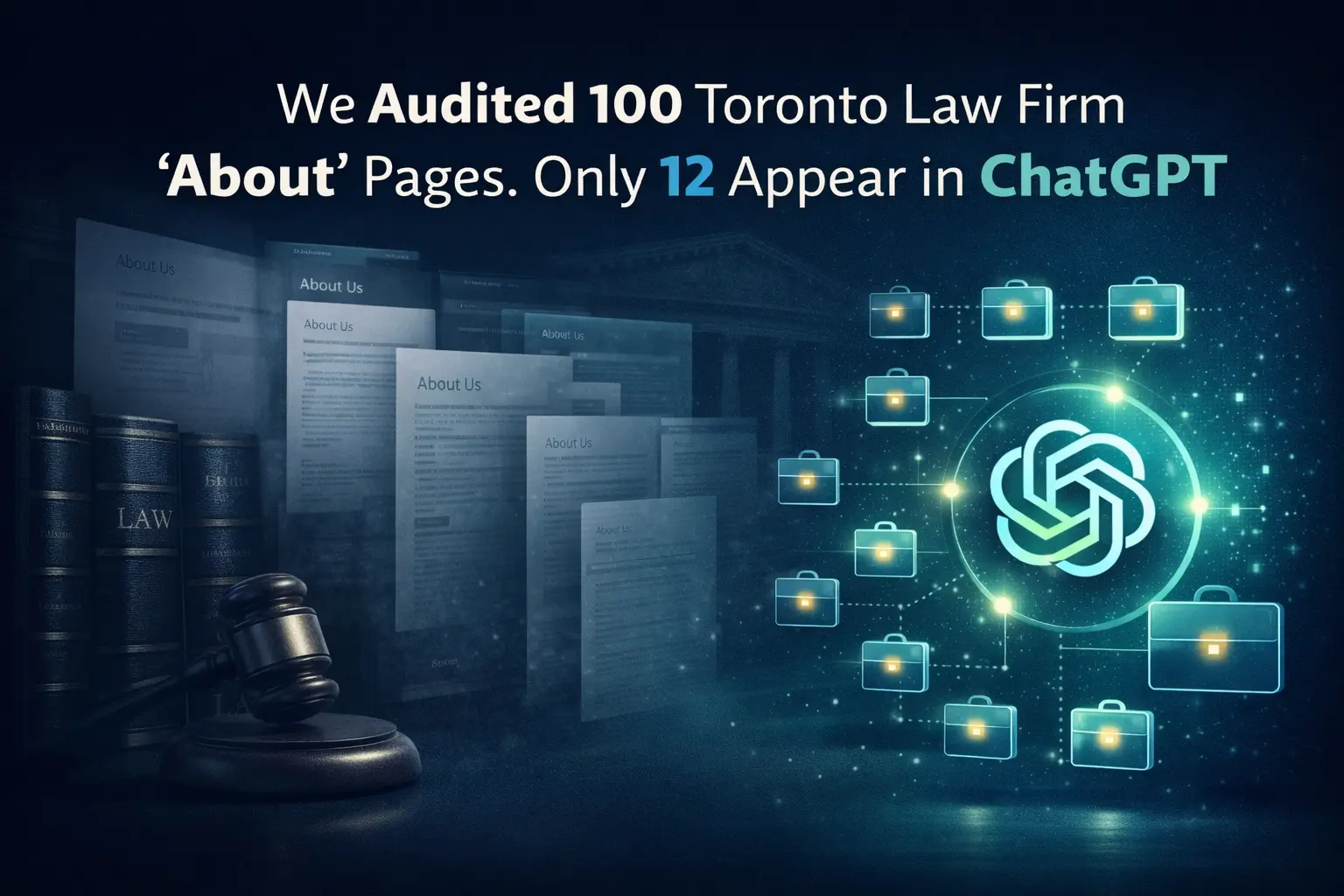
Over the past month at Fade Digital, we ran a structured audit of 100 Toronto law firms across four AI answer engines — ChatGPT, Gemini, Perplexity, and Claude. We wanted to know, empirically, how often a mid-sized Canadian legal practice actually shows up in an AI-generated recommendation. The short answer: 12% of the time, and only when very specific things are true.
This post is the long answer. If you are running a small or mid-size firm and your intake is slipping, this is the audit you wish you had run yourself.
The sample and the method
We pulled 100 Toronto law firms from a mix of Law Society of Ontario registrant filters, LinkedIn firm directories, and local business listings. The sample skews mid-market — firms with between 2 and 30 lawyers, a functioning website, and at least one identifiable practice area. Big-five downtown firms were excluded. So were solo practitioners without a standalone site.
For each firm we ran twelve prompts across the four engines — three queries per engine, chosen to mirror how real prospective clients actually phrase things:
- Recommendation queries: "Best [practice area] lawyer in Toronto", "Who should I hire for [scenario] in Toronto"
- Comparison queries: "[Firm A] vs [Firm B] for [practice area]", "Alternatives to [known firm]"
- Trust queries: "Is [Firm name] a reputable Toronto law firm", "Reviews of [Firm name]"
A firm "appeared" in ChatGPT if it was named in the body of an answer or cited as a source. For the recommendation and comparison queries, we counted only unprompted mentions — the user never said the firm's name. We logged 4,800 total query–engine combinations. Here is what came back.
The headline number
Only 12 of the 100 firms appeared as unprompted recommendations across all four engines in at least two of the three query types. That's the group we'll call the cited twelve.
Another 21 firms appeared sporadically — named in a specific practice area on one engine, invisible on the others. The remaining 67 were either completely absent from unprompted recommendations or only surfaced when we fed the firm name into a trust query (i.e., they exist, but no AI will offer them up on its own).
For context, our informal baseline for Canadian dental practices — using a similar methodology — is closer to 18%. Legal is harder. The reasons are structural, and once you see them they are almost embarrassingly easy to fix.
| Category | Count | % of Sample |
|---|---|---|
| Cited across all 4 engines (the "cited twelve") | 12 | 12% |
| Sporadic — cited on 1 engine only | 21 | 21% |
| Invisible — never recommended unprompted | 67 | 67% |
The five failure modes
When we categorized the 88 firms that didn't make the cited twelve, every one of them failed on at least two of the following. Most failed on all five.
| Failure Mode | Firms Affected (of 88) | % |
|---|---|---|
| No Person schema for attorneys | 61 | 69% |
| Practice areas listed, not declared | 54 | 61% |
| Missing jurisdictional/bar entity linking | 73 | 83% |
| Reviews not structured as schema | 61 | 69% |
| About page is a paragraph, not an entity | 42 | 48% |
1. No Person schema for the attorneys
Sixty-one of the 88 failing firms had bios for their lawyers — often lovely, well-written bios — wrapped in exactly zero structured data. No Person entity, no jobTitle, no alumniOf, no memberOf, no sameAs link to the lawyer's Law Society of Ontario profile or LinkedIn.
This is the single biggest miss in legal GEO. LLMs triangulate people through relationships — where they went to law school, what jurisdictions they're called to, what associations they belong to. A lawyer with no schema is one of ten thousand. A lawyer with Person schema linked to Osgoode Hall, the LSO, and a specific firm is a specific, citable individual. Without it, even if the lawyer has been practicing for twenty years, the model can't disambiguate them from every other "John Smith" in the country.
Our Schema Markup for AI templates walks through the exact JSON-LD we ship for professional profiles.
2. The About page is a paragraph, not an entity
Forty-two of the 88 had About pages that read as one flowing corporate paragraph: "Founded in 1998, our firm has served Toronto families with personalized legal service for over two decades…" Lovely. Useless to a machine.
The cited twelve, by contrast, used their About pages the way AI search expects them to be used: with an Organization or LegalService entity, founder relationships, areaServed populated with actual neighbourhoods and postal-code prefixes, and employee properties referencing the Person entities from the team bios. The About page becomes the anchor node of the firm's knowledge graph, not a narrative.
3. Practice areas listed, not declared
On 54 of the failing firms, practice areas were a bulleted list somewhere on the homepage. "Family Law. Real Estate. Wills & Estates. Immigration." No schema. No dedicated URLs. No LegalService entity per area.
The cited twelve had individual URL per practice area, each with its own LegalService schema that declared the service, the jurisdiction, the attorneys who practice it (via provider), and the related conditions or scenarios it addresses. When someone asks ChatGPT "real estate lawyer in Toronto for condo pre-construction," the engine has an exact, structured object to match against.
4. Missing jurisdictional + bar entity linking
Every jurisdiction in Canadian legal marketing is its own entity — the Law Society of Ontario, the Canadian Bar Association, specialty bodies like the Ontario Trial Lawyers Association. These entities are heavily represented in LLM training data and are high-authority nodes in Google's Knowledge Graph.
Seventy-three of the 88 failing firms did not sameAs-link their lawyers or firm to any of these authoritative bodies. The cited twelve did. In most cases this is a five-minute schema edit — the data is already on the LSO public directory, it just isn't wired into the firm's structured data.
5. Reviews treated as decoration, not data
Sixty-one firms had client reviews on their site — testimonials, Google embeds, star strips — but only nine of the 100 had them implemented as structured Review objects inside an AggregateRating on the firm entity. Visual social proof without machine-readable semantics is invisible to AI.
And before you object — no, your Google Business Profile reviews are not a substitute. We covered this in detail in Why Your 5-Star Google Reviews Mean Nothing to ChatGPT. AI engines weight first-party structured reviews differently from third-party platform reviews, and the cited twelve understood this.
What the twelve winners had in common
Rather than list every attribute, we'll compress the shared pattern into seven items. If you match all seven, you will almost certainly start appearing in AI recommendations for your practice area in Toronto.
Dedicated attorney profile pages — not a combined "Our Team" page — each with a canonical URL, a photo, and a
Personentity containingjobTitle,alumniOf,memberOf,worksFor, andsameAslinks to at least the LSO profile and LinkedIn.A declared firm entity —
LegalServiceorAttorneySchema.org type, anchored on the About page or the footer, withaddress,areaServed,founder,employee, andknowsAboutproperties populated.One URL per practice area — each with its own
LegalServiceschema, a brief plain-language explainer, and references back to the lawyers who practice it.Jurisdictional triangulation —
sameAslinks from the firm and each attorney to the Law Society, Canadian Bar Association, and any specialty associations relevant to the practice areas listed.Structured reviews with authors and dates —
Reviewobjects inside anAggregateRatingon the firm entity, not floating as inline HTML testimonials.FAQ content answering real intake questions — "How much does an uncontested divorce cost in Ontario?" "Do I need a lawyer to close a condo in Toronto?" — marked up with
FAQPageschema and published at URLs the firm controls.Consistent NAP across the website, the Law Society directory, Google Business Profile, and LinkedIn — address, phone, and legal name identical in every location, including the schema.
None of these seven are expensive or time-consuming in isolation. They are, however, easy to skip one at a time, which is why 88% of the firms we audited have skipped most of them.
The legal GEO checklist you can copy
If you are running a Toronto firm and you want to move from the invisible 88 to the cited 12, here is the prioritized order we use at Fade Digital. The first three produce the largest single jumps in AI visibility:
- Build individual attorney profile pages with full
Personschema, including LSO and LinkedInsameAslinks. - Declare the firm as a
LegalServiceentity withemployeereferences to the attorneys. - Split practice areas into dedicated URLs with individual
LegalServiceschema each. - Publish an FAQ page using real intake questions, marked up with
FAQPageJSON-LD. - Wire structured
ReviewandAggregateRatingobjects into your firm entity. - Audit NAP consistency across web, LSO, GBP, and LinkedIn.
- Add
sameAslinks from the firm entity to the LSO, CBA, and any relevant specialty associations.
For the architectural context on how these nodes interlink, start with our AI Knowledge Graph Playbook. For the platform-level picture, our Ultimate Guide to GEO in 2026 covers why each of these signals matters to specific engines.
The competitive window is smaller than you think
Legal is, at this point in the AI search curve, one of the most under-optimized verticals we work in. The barrier to entering the cited group is structural work, not budget. That's the good news and the bad news — good because a small firm can out-position a much larger competitor in a month, bad because the firms that move first will lock in citations that compound over time.
Our audit was run in April 2026. We'll rerun it in six months. The firms that make the changes above between now and then will appear in the next cohort. The firms that don't will find themselves losing recommendations not just to local competitors, but increasingly to out-of-market firms and legal directories that happen to have better structured data.
If you want to see exactly where your firm stands across ChatGPT, Gemini, Perplexity, and Claude today, run a free AI Visibility Scan — we'll flag which of the seven winning attributes your site is missing, and show you which competitors are currently being recommended in your practice areas. It is the fastest way to know whether you're one of the 12 or one of the 88.
Prefer to have it built for you rather than working the checklist yourself? See how we deliver GEO for law firms end to end — it runs on the same GEO Architecture framework outlined above.
The next time someone in Yorkville asks ChatGPT for a Toronto real estate lawyer at 11:30 PM on a Tuesday, you want your firm on that list.