Every article you've read about agentic commerce focuses on retail. Shopify merchants selling sneakers inside ChatGPT. Walmart building a checkout app. Target, Sephora, and Nordstrom plugging product catalogs into AI agents so someone can buy a candle without leaving a conversation.
That's fine for them. But if you run a dental practice, a law firm, a med spa, or a home services company, you probably skimmed those headlines and thought "this doesn't apply to me."
It does. And the window to prepare is shorter than you think.
Agentic commerce isn't just about buying products inside a chatbot. It's about AI agents that can research, evaluate, select, and take action on behalf of a user across any type of transaction. Today that means purchasing a pair of shoes. Tomorrow it means booking a dental cleaning, requesting a legal consultation, scheduling a home inspection, or enrolling in a treatment plan. The infrastructure being built right now will determine which service businesses get chosen by AI agents and which get skipped entirely. If you want the strategic backdrop on how AI search is reshaping discovery before transactions even enter the picture, start with our ultimate guide to AI SEO and GEO in 2026.
What agentic commerce actually is (without the hype)
Strip away the buzzwords and here's what's happening. OpenAI, Google, Shopify, Stripe, Visa, and Mastercard are all building systems that let AI agents complete transactions on behalf of users. Not just recommend. Not just link. Complete.
OpenAI launched the Agentic Commerce Protocol (ACP) with Stripe last year. It's an open standard that lets AI agents read product catalogs, understand inventory, and facilitate purchases. Shopify and Google co-developed the Universal Commerce Protocol (UCP), a separate open standard that does something similar across Google AI Mode and the Gemini app. Stripe released its Agentic Commerce Suite, which lets businesses make their products discoverable to AI agents and accept agentic payments through a single integration.
The early rollout has focused on physical products because that's the easiest transaction type to standardize. A product has a SKU, a price, a stock level, and a shipping method. Structured, predictable, machine-readable.
But the protocols themselves aren't limited to products. UCP, for instance, was explicitly designed to support "all types of transactions, not just retail commerce but also for other verticals in the future." The architecture supports checkout flows where a customer needs to select a delivery date, confirm selling terms, or provide custom information. That's the blueprint for appointment booking, intake forms, and consultation requests.
McKinsey estimates the global agentic commerce opportunity could reach $3 trillion to $5 trillion by 2030. Travel and hospitality are already following retail, with agents managing planning, pricing, and multi-step bookings. Healthcare, legal, and professional services are next in line. The pattern is clear: any industry where a customer researches options, evaluates providers, and commits to a transaction will eventually be mediated by AI agents.
Why service businesses should care right now
Here's where the disconnect happens. Most service business owners hear "agentic commerce" and think it's a 2030 problem. Something to worry about later, after the tech matures, after someone else figures it out.
That's the same thing people said about mobile-first indexing in 2015. And about Google My Business optimization in 2018. And about AI Overviews in 2024. The businesses that moved early owned their categories. The ones that waited spent years trying to catch up.
That timeline just compressed. OpenAI's GPT-6 Astra scores 72.6% on a benchmark that tests whether an AI can operate a real computer, and OpenAI's own demos show it filling in forms and booking appointments.
Agentic commerce for services won't arrive all at once. It'll happen in stages, and the first stage is already here: AI-powered discovery.
Right now, when someone asks ChatGPT "who's the best immigration lawyer in Toronto" or tells Gemini "find me a dermatologist who does Botox near Yorkville," the AI agent is already doing the first half of an agentic transaction. It's researching. It's evaluating. It's selecting a provider to recommend. And as we've covered in ChatGPT's local business errors, it's getting a lot of this wrong for businesses that haven't structured their data.
The only thing it can't do yet is complete the booking on the user's behalf. But that's a when, not an if. When that capability arrives, which businesses will the agent be able to transact with?
The ones whose data is machine-readable.
The machine-readability gap in service businesses
Retail businesses have spent years making their data machine-readable. Product feeds, inventory APIs, structured catalog data, standardized pricing. That's table stakes for selling on Amazon, Google Shopping, or any marketplace. When agentic commerce arrived, retailers already had the infrastructure.
Service businesses have almost none of this.
Think about what a typical dental practice, law firm, or home renovation company has online right now. A website with marketing copy describing their services in paragraph form. Maybe a "Contact Us" page with a phone number and a form. Pricing that's either hidden entirely or described vaguely as "competitive" or "call for a quote." Hours of operation buried in a footer. Service descriptions written for humans, not machines.
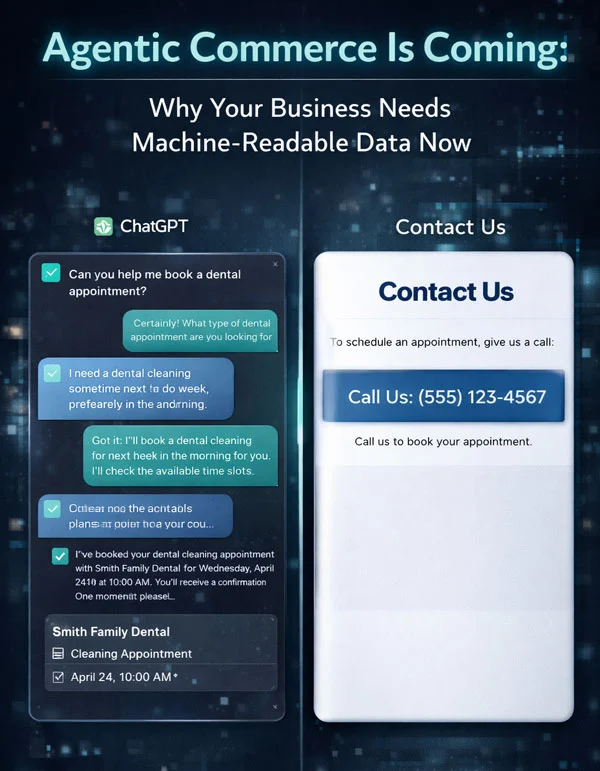
An AI agent can't book an appointment with a paragraph. It needs structured data. It needs to know what services you offer, in what format, with what availability, at what price range, in what geographic area, and through what booking mechanism. If that information isn't machine-readable, the agent moves on to a competitor whose data is.
This is the same dynamic that played out with Google's Knowledge Graph. Businesses that deployed structured schema markup got featured. Businesses that didn't were treated as unstructured blobs of text that Google had to interpret, often incorrectly. We unpack exactly how that graph forms in The AI Knowledge Graph Playbook. The stakes are higher now because AI agents don't just display information. They act on it.
What "machine-readable" means for a service business
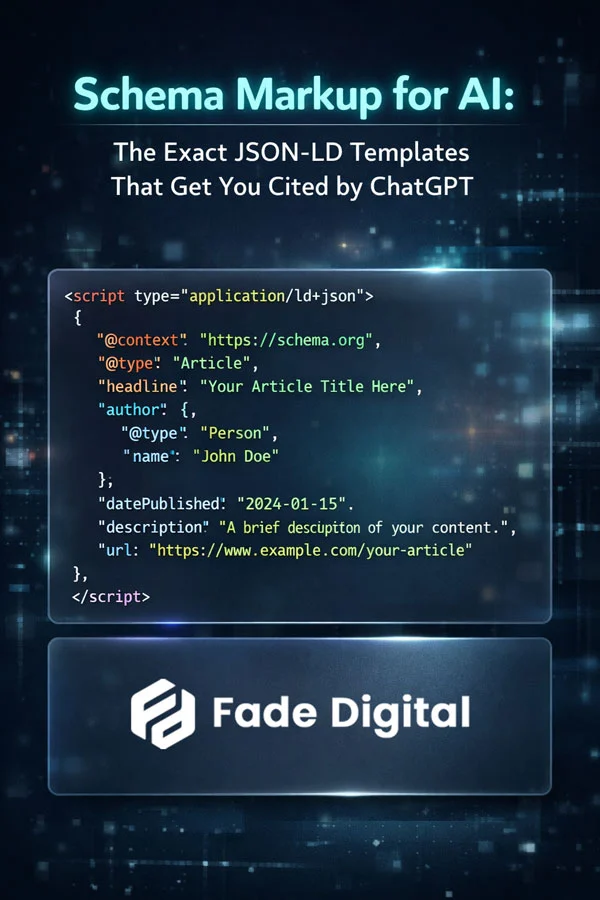
Making your business machine-readable doesn't require building an API or integrating with Shopify. It means structuring your existing digital presence so that AI systems can extract, interpret, and act on your business data without guessing. We cover the exact JSON-LD templates for this in our companion post on schema markup for AI, but here's what the bigger picture looks like in practice:
Structured schema markup on every page. Not just basic Organization schema. Full LocalBusiness schema with your specific business subtype (Dentist, LegalService, RealEstateAgent, HomeAndConstructionBusiness), service catalog, geographic coverage, operating hours, and accepted payment methods. When we deploy this for clients, we include hasOfferCatalog with individual service descriptions, pricing ranges, and duration estimates. That's the closest thing a service business has to a product feed, and it's what an AI agent will eventually parse to determine if you can fulfill a user's request.
Consistent entity data across every platform. Your name, address, phone number, service descriptions, and business category need to be identical on your website, your Google Business Profile, your directory listings, your social profiles, and your schema markup. AI agents cross-reference multiple sources to build confidence in an entity. Inconsistency doesn't just confuse them. It actively reduces their confidence in recommending you. For deeper tactics on reinforcing your entity across the web, see Hacking the ChatGPT Knowledge Graph.
Service pages structured for extraction, not persuasion. Most service pages are written to sell. Long paragraphs about your approach, your philosophy, your commitment to excellence. An AI agent doesn't care about your philosophy. It cares about what service you provide, who it's for, how long it takes, what it costs, and how to book it. That doesn't mean you remove the persuasive copy. It means you add structured, extractable data blocks alongside it. A clear service name, a one-sentence definition, a price range, a duration, and a booking URL. Those blocks can live at the top of the page or in a structured sidebar. The marketing copy can do its job for human visitors while the structured data does its job for AI agents.
FAQ content mapped to buyer questions. When an AI agent evaluates service providers on behalf of a user, it's essentially running a comparison. Does this provider offer the service the user needs? Are they in the right location? What do they charge? What's the process? FAQ schema with specific, detailed answers to these questions gives AI agents exactly the data they need to include you in that comparison set. The questions should match what buyers actually type into AI platforms — see Keyword patterns for LLMs for how to mine and structure those queries: "how much does teeth whitening cost in Toronto," not "what makes our whitening different."
A machine-accessible booking mechanism. This is the bridge between discovery and transaction. If your booking system is a phone number and a contact form, an AI agent can recommend you but can't complete the transaction. If you use an online booking platform like Jane App, Calendly, Acuity, or any system with a bookable URL, you're one step closer to an agent being able to send a user directly to a scheduling page with pre-filled parameters. The businesses that will benefit first from agentic service commerce are the ones that already have digital booking workflows.
The protocols coming for services
The current wave of agentic commerce protocols (ACP, UCP, Agent Pay) are designed with extensibility in mind. They aren't locked to retail.
UCP's architecture separates responsibilities into layers. There's a shopping service layer that defines transaction primitives like checkout sessions and line items. Then there are capability layers that add functional areas like catalog, checkout, and orders. And then there are extension layers that let domain-specific schemas plug in.
That extension architecture is how service-industry transactions will eventually be supported. A dental appointment has different parameters than a sneaker purchase, but the underlying pattern is the same: a user has intent, an agent evaluates options, a provider's data is queried, and a transaction is initiated or completed.
Travel is already there. AI agents can now manage flight bookings, hotel reservations, and itinerary changes through structured APIs. The travel industry had a decades-long head start because of GDS systems (Global Distribution Systems) that standardized inventory and booking data across airlines, hotels, and rental car companies.
Healthcare, legal, and home services don't have an equivalent standard yet. But the building blocks exist: schema.org already defines types for MedicalBusiness, LegalService, HomeAndConstructionBusiness, and dozens of other service categories. Online booking platforms already expose scheduling data through embeddable widgets. Payment processors already handle service-based transactions. The missing piece is the connecting protocol, and based on how fast ACP and UCP are evolving, that piece will arrive faster than most service business owners expect. If you want a refresher on how these layers stack against traditional search, SEO vs AEO vs GEO explained breaks the disciplines apart.
What to do now: a concrete action plan
You don't need to wait for the protocols to mature. Everything you do now to make your business machine-readable improves your AI visibility today and positions you for agentic transactions tomorrow. The work compounds.
Audit your schema markup. Run your key pages through Google's Rich Results Test. If you have no schema, or only basic auto-generated markup, you're behind. Deploy full LocalBusiness schema with your specific subtype, service catalog, geographic coverage, and operating hours. If you published your schema before 2025, review it. The requirements for AI visibility have evolved.
Build a machine-readable service catalog. For each service you offer, create a structured block with the service name, a one-sentence plain-language description, a price range or starting price, estimated duration, and a link to book or inquire. Encode this in your schema using hasOfferCatalog. This is the single most impactful thing a service business can do to prepare for agentic commerce, because it transforms your services from marketing copy into queryable data.
Standardize your entity data. Pick your canonical business name, address, phone number, and service descriptions. Deploy them identically across your website schema, Google Business Profile, Apple Business Connect, Bing Places, and every directory listing. Use schema sameAs to cross-reference all your profiles. AI agents treat entity consistency as a trust signal.
Structure your FAQ content around buyer queries. Test the questions your potential clients ask by typing them into ChatGPT, Gemini, and Perplexity. Note which competitors appear and what information is surfaced. Then create FAQ schema with specific, data-rich answers to those exact questions. Include numbers: prices, timeframes, success rates, process steps. Our post on the basics of LLM SEO covers the fundamentals if you're starting from zero.
Implement or upgrade online booking. If you're still running on phone calls and contact forms, add a digital booking option. It doesn't have to replace your existing intake process. It just needs to exist as a machine-accessible endpoint. An embeddable booking widget with a direct URL is the minimum. Bonus if your booking system has an API, because that's what will eventually connect to agentic commerce protocols.
Monitor your AI visibility monthly. Run your top 10-15 buyer queries through ChatGPT, Gemini, and Perplexity every month. Track whether you're cited, who else is cited, and what information the AI surfaces about your business. If the AI is getting details wrong, that's an entity consistency problem you can fix. If you're not appearing at all, that's a structured data and citation authority problem you need to address. This is exactly the work we do inside our GEO architecture engagements.
The first-mover advantage is real
There's a pattern in every platform shift. The businesses that build infrastructure before demand arrives capture disproportionate market share when the wave hits. That happened with websites in the late '90s, with mobile optimization in 2012, with Google My Business in 2016, and with AI Overviews in 2024.
Agentic commerce for services is at the infrastructure-building stage right now. The protocols exist. The AI agents are already doing discovery and evaluation. The transaction layer is being built. When it connects, the businesses with machine-readable data, consistent entities, structured service catalogs, and digital booking workflows will be the ones AI agents can actually transact with.
Everyone else will be a paragraph of marketing copy that the agent skips on its way to a competitor who made the investment.
The question isn't whether AI agents will eventually book appointments, request consultations, and initiate service transactions. The question is whether your business will be readable when they do.
Is your business ready for AI agents?
We run a full machine-readability assessment as part of every AI Visibility Audit. We'll show you exactly what AI systems can and can't extract from your current digital presence, and what to fix first.
Lorne Fade is the Founder & CEO of Fade Digital, a Toronto-based agency specializing in Generative Engine Optimization (GEO). He works with healthcare, legal, and service businesses to build the structured data infrastructure that drives AI visibility and predictable client acquisition.