The Search Landscape Has Fractured. Here is Your Map.
For two decades, the goal was simple: rank on the first page of Google. If you optimized your keywords, wrote decent content, and built enough backlinks, you won. You captured the traffic, you captured the lead, and you captured the revenue.
That era is over.
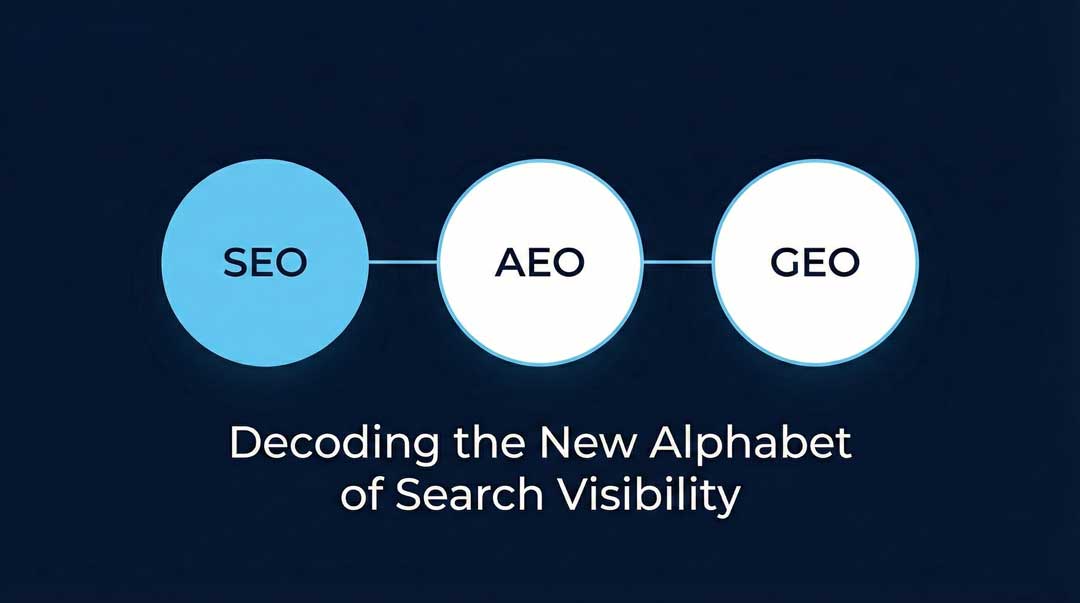
Today, your customers aren't just "searching"—they are asking, prompting, debating, and conversing. This shift in user behavior has birthed a confusing alphabet soup of acronyms that marketing teams are scrambling to decipher.
You likely know SEO. You might have heard of AEO. But if you want to survive the seismic AI shift currently reshaping the internet, you must master GEO.
If you are currently treating your digital strategy as a single-channel effort, you are likely already losing market share to competitors who are optimizing for machines, not just search bars.
Here is the comprehensive breakdown of the three pillars of modern visibility, why they are distinct, and how to build a unified architecture that dominates all of them.
1. SEO (Search Engine Optimization)
The Foundation: Optimizing for the Index
We often hear the hyperbolic claim that "SEO is dead." It isn't. But its role has fundamentally changed.
Traditional SEO is the practice of optimizing content to rank in the "Ten Blue Links" of a Search Engine Results Page (SERP). It focuses on proving to a crawler (like Googlebot or Bingbot) that your page is relevant to a specific keyword and technically sound enough to be indexed.
How It Works
At its core, SEO is a retrieval game. The search engine builds a massive index of the web (think of it as a digital library). When a user types a query, the engine scans the index to find the best match based on hundreds of ranking factors.
- The Goal: Get a user to click a link to leave the search engine and visit your website.
- The Target: Google Search, Bing (Traditional), Yahoo.
- The Currency: Backlinks, Keywords, Click-Through Rate (CTR).
The Tactic: Technical & Relevance
Because SEO relies on a crawler, "technical health" is paramount. If the crawler hits a broken link, a slow-loading script, or a confusing URL structure, it assumes the user experience will be poor and demotes the site.
- Keyword Research: Identifying the exact phrases users type (e.g., "marketing agency toronto").
- On-Page Optimization: Placing those keywords in Title Tags, Meta Descriptions, and H1s.
- Backlinking: Earning links from other reputable sites to prove "authority" via PageRank.
- Technical Hygiene: Core Web Vitals, mobile responsiveness, and clean sitemaps.
The Reality Check: Is It Dead?
No. SEO is the basement.
Think of SEO as the infrastructure of a house. It is the plumbing and the electrical wiring. It isn't the part of the house people admire (that's the content), but if it doesn't work, the house is uninhabitable.
If a crawler cannot index your site technically, the advanced AI models (GEO) cannot read it either. SEO is no longer the whole game, but it is the price of admission. Without strong technical SEO, your GEO strategy has no data to pull from.
2. AEO (Answer Engine Optimization)
The Bridge: Optimizing for the Direct Answer
As mobile usage exploded in the mid-2010s and voice assistants like Siri, Alexa, and Google Assistant entered our homes, user behavior shifted. We stopped typing "weather Toronto" and started asking, "Hey Google, will it rain in Toronto this afternoon?"
This shift from "keywords" to "natural language questions" birthed AEO.
AEO is the art of formatting your content so search engines can extract a single, direct answer without the user needing to click through to your website. It is about conciseness and structure.
How It Works
AEO targets "Position Zero." This appears as the Featured Snippet at the top of Google or the voice response read aloud by a smart speaker. The engine doesn't want to give the user a list of options; it wants to give the user the answer.
- The Goal: Be the single source of truth for a specific question.
- The Target: Voice Assistants, Google Featured Snippets, "People Also Ask" (PAA) boxes.
- The Currency: Conciseness, Schema Markup, factual accuracy.
The Tactic: Structure & Logic
To win at AEO, you must write for a machine that is in a hurry.
- The Inverted Pyramid: Do not bury the lead. If the header is "What is AEO?", the very next sentence should start with "AEO is..."
- Q&A Formatting: Use
<h2>or<h3>headers as literal questions to signal intent. - Listicles & Tables: Machines love data that is organized. Bullet points are easier for AEO algorithms to parse than dense paragraphs.
- Speakable Schema: Using code to explicitly tell bots, "This is the section you should read aloud."
The Fade Take: The Training Wheels
AEO was the training wheels for the AI era. It taught marketers a valuable lesson: Machines prefer structured, logical data over fluffy marketing copy.
If your content is buried in metaphors, jargon, or long-winded storytelling, AEO engines will ignore it in favor of a competitor who answers the question in 40 words or less. However, AEO has a limit: it only retrieves existing snippets. It doesn't create anything new. That is where GEO comes in.
3. GEO (Generative Engine Optimization)
The Future: Optimizing for the Model
This is where the game changes completely. This is the new frontier.
Generative Engine Optimization (GEO) is the strategy of optimizing content for AI-powered search engines and Large Language Models (LLMs) like ChatGPT, Claude, Perplexity, Gemini, and Google’s AI Overviews.
Unlike SEO (which sorts links) or AEO (which extracts snippets), GEO is about synthesis.
How It Works
When you ask ChatGPT a complex question, it doesn't just look for a webpage that matches your keywords. It reads multiple sources, understands the context, connects the dots, and writes a brand-new answer from scratch.
To win here, you don't need a click. You need a citation. You want your brand to be the primary authority that the AI recommends when it synthesizes that answer.
- The Goal: Be cited, synthesized, and recommended by the AI.
- The Target: ChatGPT, Claude, Gemini, Perplexity, SearchGPT.
- The Currency: Information Gain, Entity Authority, Brand Sentiment.
The Tactic: Feeding the Model
AI models are trained to ignore generic content. If your blog post says the same thing as the top 10 results on Google, the AI has no reason to cite you. It already "knows" that information. To win at GEO, you must provide Information Gain.
- Unique Data & Statistics: AI models love hard numbers. If you publish a proprietary study or survey, the AI will cite you as the source of that data.
- Entity Authority: You need to teach the AI who you are. This involves building a robust Knowledge Graph, ensuring your "About" page is detailed, and having your authors listed with their credentials.
- Quotability: Writing short, punchy, statistical sentences. AI models find these "sticky" and easy to reproduce.
- Multi-Modal Content: AI learns from video and images, not just text. If you have a YouTube video discussing a topic, the AI can read the transcript and use that info to generate an answer.
The "Winner Take Most" Dynamic
In SEO, being #3 on Google is still okay; you get traffic. In GEO, being #3 is often invisible. The AI might only synthesize the top 1 or 2 sources. This makes authority and uniqueness more critical than ever before.
The Comparison: At A Glance
To visualize the difference, let's look at how these three engines would handle the same user query: "Best CRM for small business."
| Feature | SEO (Legacy) | AEO (Voice/Snippet) | GEO (AI-Native) |
|---|---|---|---|
| User Query | "CRM for small business reviews" | "What is the best CRM for small business?" | "Compare HubSpot and Salesforce for a 5-person agency with a tight budget." |
| The Result | A list of 10 links to G2, Capterra, and blogs. | A single bolded snippet saying "HubSpot is often rated the best free CRM..." | A generated table comparing features, pricing, and a specific recommendation based on the "tight budget" constraint. |
| Primary Goal | Traffic (Clicks) | Information Delivery | Brand Citation & Influence |
| User Intent | "I want to browse options." | "I want a quick answer." | "I want a synthesis/solution." |
| Key Metric | Keyword Ranking | Featured Snippet % | Share of Voice / Sentiment |
| Winning Strategy | Backlinks & Keywords | FAQ Schema & Structure | Authority, Unique Data & Citations |
The "Triple Threat" Content Architecture
The most common question we get at Fade Digital is: "Do I need to write three different blog posts?"
The answer is no.
You need a Unified Architecture. You can optimize a single high-value asset to capture all three signals if you structure it correctly. We call this the Hybrid Content Model.
1. The Header (AEO Optimization)
At the very top of your article, define your terms immediately.
- Strategy: Ask the core question in an H1 or H2 tag. Answer it immediately in the paragraph below using clear, jargon-free language.
- Why: This increases your chances of capturing the Voice Search result and the Google Featured Snippet (Position Zero).
2. The Body (GEO Optimization)
In the meat of the content, move away from generic advice.
- Strategy: Inject "Information Gain." Use phrases like "In our experience at Fade Digital...", "Our data shows...", or "Contrary to popular belief..."
- Why: This signals to the Large Language Model (LLM) that you possess unique, expert knowledge that cannot be found elsewhere. This increases the likelihood of the AI citing you as a source.
- Pro Tip: Use data tables. LLMs are excellent at reading table structures and will often pull data directly from them to answer user prompts.
3. The Skeleton (SEO Optimization)
Throughout the entire page, maintain your technical discipline.
- Strategy: Ensure your URL slug is clean (
/blog/topic-name), your meta description is enticing, your images have alt text, and your internal linking structure is sound. - Why: This ensures the traditional Googlebot crawler can index the page. If the page isn't indexed, the AI generally won't "see" it to learn from it.
The Fade Protocol: Moving From "Search" to "Visibility"
The mistake most brands are making right now is treating these as separate silos. They have an "SEO team" and maybe they are dabbling in AI, but the strategies are disconnected.
They are not separate. They are layers of the same ecosystem.
- SEO ensures you are found. It is your distribution network.
- AEO ensures you are understood. It is your clarity filter.
- GEO ensures you are trusted. It is your authority signal.
Why "Keywords" Are Not Enough
In the GEO era, keywords are fading. Entities are rising.
An "Entity" is a concept—a person, place, or thing—that the search engine understands as a distinct object, not just a string of letters. Google knows that "Fade Digital" is an Agency and "SEO" is a Service.
Your goal is to build the association between your Brand Entity and the Service Entity so strongly that when an AI is asked about "Modern SEO Services," it naturally retrieves "Fade Digital" from its neural network. You don't achieve this by stuffing keywords. You achieve it by consistently publishing high-authority content that is cited by other reputable sources.
The Shift to "Zero-Click" Marketing
We must accept a hard truth: Traffic to websites will likely decrease.
As AI Overviews and ChatGPT answer more questions directly, fewer users will click through to your blog. This sounds scary, but it is actually an opportunity.
The users who do click through will be higher intent. They aren't looking for basic definitions (the AI gave them that); they are looking for deep expertise, implementation, and partnership.
Your content must shift from "Wiki-style definitions" to "Expert-style implementation."
- Don't write "What is a funnel?" (The AI can answer that).
- Write "How we built a funnel that generated 300% ROI in Q4." (The AI cannot answer that without citing you).
Conclusion: Stop Chasing the Algorithm. Start Feeding the Model.
The days of tricking a robot into ranking you #1 are gone. The new algorithms are too smart, and the new AI models are too nuanced.
If you want to dominate the search landscape of 2025 and beyond, you need to stop thinking about "ranking" and start thinking about "authority." You need to provide value that is so distinct and well-structured that both the traditional crawler and the modern AI have no choice but to prioritize you.
At Fade Digital, we don't just "do SEO." We build GEO Architectures. We rebuild your data schema so crawlers can index you (SEO), structure your content so assistants can quote you (AEO), and inject authoritative signals so LLMs recommend you (GEO).
The alphabet of search has changed. Is your brand speaking the right language?
If you are comparing agencies for this work, our guide to the best GEO agencies in Toronto covers eight with a dedicated AI search service and the questions worth asking before you sign.
Ready to future-proof your visibility?