You've done everything right. Five hundred reviews on Google, a 4.9-star average, customers writing paragraphs about how great you are. You've spent years earning that reputation, one happy client at a time.
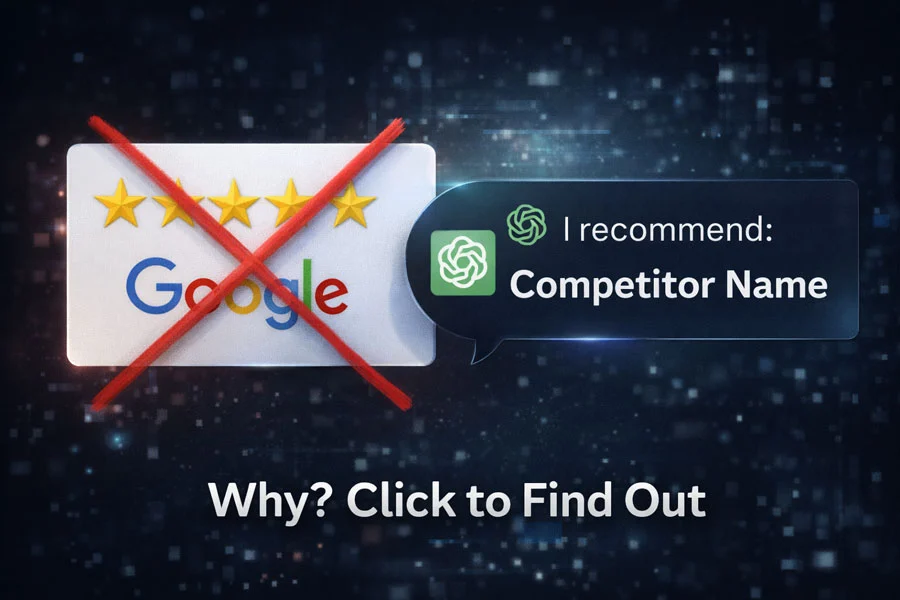
Then someone opens ChatGPT and types "best dentist in Toronto" or "top-rated personal injury lawyer near me." And the AI recommends your competitor. The one with 200 reviews and a 4.3 rating.
You check again a week later. Same result. You're invisible.
This isn't a glitch. It's not random. And it's not going to fix itself. ChatGPT, Gemini, Perplexity, and every other AI platform evaluating businesses right now operate on a fundamentally different system than Google Search. Your five-star review profile is built for a game that AI isn't playing.
Understanding why — and what AI systems actually use to decide who gets recommended — is the difference between owning your category in the next era of search and watching a worse-reviewed competitor take your clients because their data was more readable than yours. (For the broader strategic context, our ultimate guide to AI SEO and GEO in 2026 lays out the full playbook this post lives inside of.)
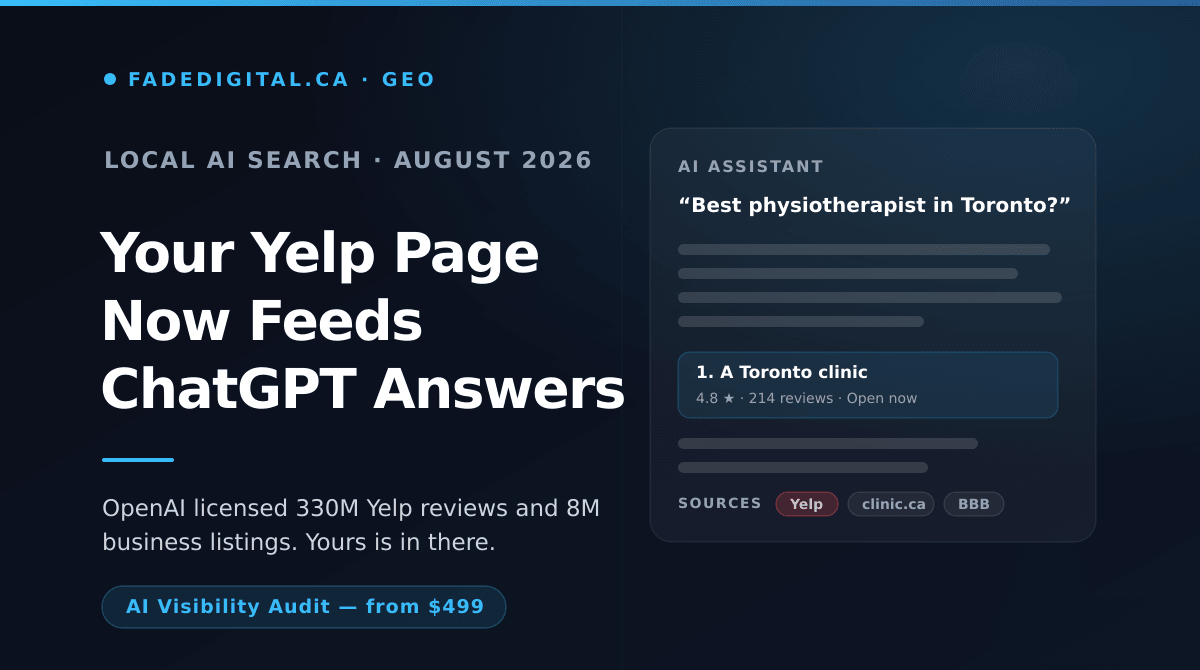
Update, August 2026: OpenAI has since licensed Yelp's 330 million reviews and 8 million business listings for use in ChatGPT's local answers. That doesn't change the argument below — Google reviews still aren't the lever people think they are — but it does mean reviews on one specific platform now carry real weight, because they're being fed in under contract rather than crawled. See Yelp Just Licensed 330 Million Reviews to OpenAI for what changed and what to do about it.
The assumption that's costing you clients
Here's what most service business owners believe: "I have great reviews, so AI will see that and recommend me."
It's a reasonable assumption. Google's local search algorithm weights reviews heavily. A strong review profile pushes you into the Map Pack, earns you star ratings in search results, and helps you rank above competitors. For fifteen years, that system rewarded businesses that earned genuine customer feedback.
But Google Search and AI assistants are different products with different architectures. Google Search ranks pages. AI assistants synthesize answers. When someone asks Google "best dentist in Toronto," Google shows a list of links and lets the user decide. When someone asks ChatGPT the same question, the AI picks for them. It evaluates, selects, and names specific businesses in its response.
Ranks pages, you pick
- • Returns 10 blue links + Map Pack
- • Star rating shown in SERP
- • Reviews directly weighted in local algorithm
- • User decides which result to click
- • Volume of reviews matters a lot
Synthesizes one answer, picks for you
- • Names 1–3 specific businesses in response
- • No SERP, no clicks, no comparison
- • Reviews are one signal among many
- • AI decides on your behalf
- • Entity clarity & cross-platform citations matter most
That selection process doesn't start with your Google review score. It starts with whether the AI can even identify your business as a relevant entity in the first place.
How AI actually decides who to recommend
AI platforms follow a three-step process when generating business recommendations. Understanding each step reveals exactly where most service businesses break down.
Entity recognition
Can the AI resolve you as a distinct, structured entity — name, category, location, services — with a schema fingerprint and verifiable cross-references?
Source corroboration
Does the same entity data appear consistently across Google, Yelp, BBB, LinkedIn, industry directories, and your own schema? AI trusts cross-validated facts.
Authority & trust
Now reviews enter — but quality, depth, recency, and platform diversity matter far more than raw star count. This is where most businesses are losing.
Step one: Entity recognition. Before an AI can recommend you, it has to know you exist as a distinct entity. Not as a paragraph on a website. As a structured, machine-readable entity with a name, category, location, service offerings, and verifiable connections to other platforms. This is built through schema markup, consistent directory listings, and cross-platform presence linked by sameAs references. If the AI can't resolve your business as a clear entity, your reviews are irrelevant — the system never gets far enough to consider them. We break down how this entity layer forms in The AI Knowledge Graph Playbook.
Step two: Source corroboration. AI systems don't trust any single data source. They cross-reference. When evaluating whether to recommend a business, they check whether that business appears consistently across multiple independent platforms. Your Google Business Profile says one thing. Does your Yelp listing say the same? Does your BBB profile match? Does your website schema confirm it? Does your LinkedIn page align? The more independent sources that corroborate your entity data, the higher the AI's confidence in recommending you. For tactics on reinforcing your entity across the web, see Hacking the ChatGPT Knowledge Graph.
Step three: Authority and trust signals. This is where reviews finally enter the picture — but not the way you think. AI platforms don't just count stars. They evaluate review quality, recency, platform diversity, content depth, and response patterns. A review that says "great service, 5 stars" gives the AI almost nothing to work with. A review that says "replaced our HVAC system, arrived on time, explained the warranty options, and cleaned up after" gives the AI specific, extractable data points it can reference when forming a recommendation.
Your 500 five-star reviews on Google might be losing to a competitor's 200 reviews spread across Google, Yelp, BBB, and Facebook — because multi-platform presence signals authenticity in a way that single-platform volume can't replicate. We documented exactly how this plays out in ChatGPT's local business errors.
What Google reviews can't tell an AI
Google reviews are powerful for one thing: telling other humans what your customers thought of you. They're narrative. They're emotional. They're persuasive. And that's exactly why AI systems struggle with them.
Consider what a typical five-star review contains: "Dr. Patel is amazing! My whole family goes here. The staff is so friendly and the office is beautiful. Highly recommend!!"
A human reads that and thinks "this sounds like a great dentist." An AI reads that and extracts almost zero structured data. It can't determine what services were provided, what the outcome was, how long the appointment took, what insurance was accepted, or what made this provider specifically qualified. It's sentiment without substance.
"Dr. Patel is amazing! My whole family goes here. The staff is so friendly and the office is beautiful. Highly recommend!!"
"Got Invisalign treatment with Dr. Patel over 14 months. Final cost was $5,400 including retainers. Direct billing to Sun Life worked seamlessly. Results were exactly as previewed in the 3D scan."
Now consider what the AI can work with elsewhere. Your Google Business Profile has a category, hours, and an address — but that data often conflicts with what's on your website or your Yelp listing. Your website describes your services in marketing copy that an AI has to interpret rather than extract. You have no schema markup declaring your specific service offerings, pricing, or areas of expertise. And you exist on one platform (Google) rather than five.
The competitor who gets recommended instead might have a worse Google rating, but they have consistent entity data across multiple platforms, detailed schema markup that declares their services in machine-readable format, FAQ content that directly answers the questions buyers type into AI, and reviews on three different platforms that mention specific services by name.
The AI isn't ignoring your reviews. It's evaluating a broader set of signals, and your competitor is sending stronger ones.
The six signals AI actually weighs
Based on what we've seen deploying GEO strategies for service businesses over the past 18 months, here's what moves the needle for AI recommendations. I've ranked these roughly in order of impact.
Relative weights based on Fade Digital's GEO deployments across healthcare, legal, and home services verticals (2024–2026).
1. Cross-platform entity consistency. This is the foundation everything else builds on. Your business name, address, phone number, service category, and description need to be identical across your website schema, Google Business Profile, Yelp, BBB, Apple Business Connect, Bing Places, and every industry-specific directory you're listed in. AI systems cross-reference these sources before recommending. Inconsistency creates doubt, and doubt means the AI moves to a competitor with cleaner data.
2. Third-party citations and mentions. AI systems lean heavily on third-party sources when deciding who to recommend. That means your inclusion in "Best Dentists in Toronto" listicles, local business roundups, industry directories, and city-specific publications matters more for AI visibility than almost anything on your own site. AI systems weight independent validation heavily because it's harder to fake. For the latest research on how much of what AI cites comes from third parties, and why two large studies appear to disagree, see 82% of commercial AI citations go to third parties.
3. Structured data and schema markup. Full LocalBusiness schema with your specific business subtype, service catalog, geographic coverage, operating hours, and sameAs links to all your profiles. This tells AI exactly what you are rather than forcing it to guess. We published full copy-paste templates in Schema Markup for AI: The JSON-LD Templates That Get You Cited by ChatGPT.
4. Review diversity and depth. Notice I said diversity and depth, not count. Having reviews on three or more platforms significantly increases AI recommendation frequency compared to having all your reviews on a single platform. And detailed reviews that mention specific services, describe outcomes, and explain the experience give AI extractable data points. The generic five-star review contributes almost nothing to this signal.
5. Content that answers buyer questions directly. When someone asks an AI "how much does a root canal cost in Toronto" or "what should I look for in a family lawyer," the AI looks for pages that answer those exact questions in a clear, extractable format. FAQ pages with specific answers, blog posts that address real buyer queries, and service pages that lead with concrete details (price ranges, timeframes, process steps) rather than marketing language. Keyword patterns for LLMs covers exactly how to mine these queries.
6. Response patterns and engagement signals. This one surprises people. AI systems can detect whether a business responds to reviews — and how. Businesses that respond to all reviews within 24-48 hours have seen measurable increases in AI recommendation frequency. Responses create additional indexable content and signal that the business is active and engaged. A business with 200 reviews and thoughtful responses to every one can outperform a business with 500 reviews and no responses.
What to do about it (this week)
I'm not going to tell you to stop collecting Google reviews. They still matter for Google Search, for social proof on your website, and for the humans who read them before making a decision. Keep earning them.
But if you want AI systems to recommend your business, you need to invest in the signals that AI systems actually use. Here's a prioritized action plan you can start on this week.
-
1Run a five-minute AI checkType your top 3 buyer queries into ChatGPT, Gemini, and Perplexity. Note who gets named, what's said about you, and what's wrong.
-
2Fix entity consistencyPick canonical NAP + description and align Google, Yelp, BBB, Apple, Bing, and your schema. One afternoon, highest ROI of anything on this list.
-
3Expand to 2–3 more review platformsHealthcare → RateMDs, Healthgrades, Zocdoc. Legal → Avvo, Lawyers.com. Home services → HomeStars, Angi. 20–30 reviews on each is enough.
-
4Upgrade your schema markupFull LocalBusiness with subtype, hasOfferCatalog, sameAs to every profile. Templates in our JSON-LD guide.
-
5Coach your review requestsAsk clients to mention the specific service they received. Detail beats sentiment for AI extraction.
-
6Respond to every review within 48 hoursMention the service in your response. Each reply is fresh, indexable, entity-tied content.
Run a five-minute AI check. Open ChatGPT, Gemini, and Perplexity. Type the three queries your ideal clients would use to find a business like yours. "Best [your service] in [your city]." "Top [your specialty] near [your neighborhood]." "[Specific service] cost in [your city]." Note who gets recommended. Note whether you appear. Note what information the AI surfaces. This takes five minutes and tells you exactly where you stand.
Fix your entity consistency. Pick your canonical business name, address, and phone number. Check Google Business Profile, Yelp, BBB, your website, and any industry directories. Fix every inconsistency. This sounds tedious because it is, but it's the single highest-ROI activity for AI visibility. One afternoon of cleanup can change whether AI systems trust your entity data.
Expand your review platforms. If all your reviews are on Google, start collecting them on at least two additional platforms relevant to your industry. For healthcare: RateMDs, Healthgrades, Zocdoc. For legal: Avvo, Lawyers.com, Martindale. For home services: HomeStars, Angi, BBB. For dental: RateMDs, 1-800-Dentist. You don't need hundreds on each — even 20-30 genuine reviews on a second and third platform dramatically change your multi-source signal. For the full entity architecture that makes reviews machine-readable, see our playbooks for dental clinics and law firms.
Upgrade your schema markup. If you have no schema or only what your SEO plugin generates, deploy full LocalBusiness schema with your specific business subtype, a service catalog using hasOfferCatalog, operating hours, geographic coverage, and sameAs links to every platform where you have a profile. We published a full implementation guide with copy-paste templates: Schema Markup for AI: The JSON-LD Templates That Get You Cited by ChatGPT.
Coach your review requests. When you ask clients to leave a review, guide them toward specifics. Instead of "please leave us a review," try "if you could mention the specific treatment you received, that helps other patients know what to expect." This isn't gaming the system. It's encouraging the kind of detailed, informative reviews that help both human readers and AI systems understand what your business actually delivers.
Respond to every review. Every single one. Positive and negative. Within 48 hours if possible. Keep responses specific and mention the service provided. This creates additional indexable content tied to your entity and signals active engagement to every platform that crawls your review data. If you'd rather hand the structural side off, this is exactly what we build inside our GEO architecture engagements, alongside the agentic commerce readiness work every service business needs to start now.
The uncomfortable truth
Here's what I tell every service business owner who calls us frustrated about AI visibility: your five-star Google rating is real. Your reputation is real. Your patients, clients, and customers love you, and that matters.
But AI doesn't know that. AI doesn't sit in your waiting room and feel the energy. AI doesn't read your heartfelt five-star reviews the way a human does. AI processes structured data, cross-references entities across platforms, evaluates source diversity, and makes probabilistic decisions about which business to recommend based on machine-readable signals.
The businesses winning AI recommendations right now aren't the ones with the best reputations. They're the ones whose reputations are structured in a way that AI can read, verify, and cite. That's not a commentary on quality. It's a commentary on infrastructure. And infrastructure is fixable.
Your competitor with the 4.3-star rating and the AI recommendation didn't earn it by being better than you. They earned it by being more readable. Fix your readability, and your reputation does the rest.
Find out what AI actually says about your business
We'll run your business through every major AI platform and show you exactly what comes back — what's accurate, what's wrong, what's missing, and what your competitors are doing that you're not.
Get Your Free AI Scan →Lorne Fade is the Founder & CEO of Fade Digital, a Toronto-based agency specializing in Generative Engine Optimization (GEO). He works with healthcare, legal, and service businesses to build the structured data infrastructure that makes AI systems recommend them instead of their competitors.