A first-time buyer in Liberty Village opens ChatGPT on a Saturday afternoon. She's been browsing Realtor.ca for three months and she's tired of cold calls from agents she doesn't know. She types: "best real estate agent for buying a condo in Liberty Village, Toronto." ChatGPT gives her two names and a Zillow link.
Her friend in Forest Hill asks the same question about luxury homes. Different neighbourhood, different price point — but the same pattern: two named agents and a portal. Neither of them is the agent who's been farming that neighbourhood for fifteen years.
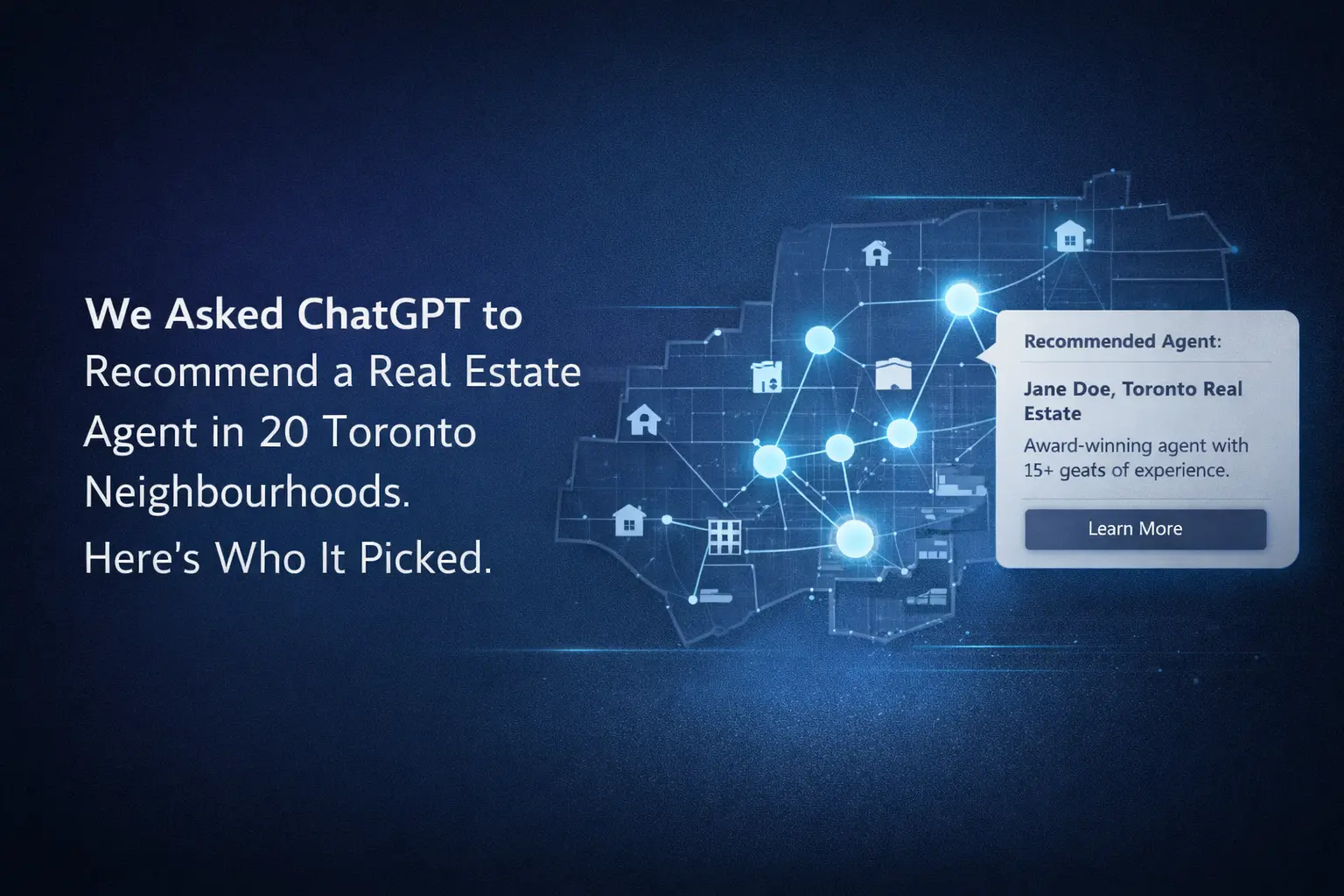
We wanted to know whether this pattern holds across the city. So we ran a structured test across 20 Toronto neighbourhoods, four AI engines, and three query types. The results explain why most agents are invisible to AI search — and what the visible ones are doing differently.
The test: 20 neighbourhoods, 4 engines, 240 queries
We selected 20 neighbourhoods across Toronto that represent different price points, buyer profiles, and market dynamics:
Downtown core: King West, Liberty Village, St. Lawrence Market, CityPlace, Harbourfront Midtown: Forest Hill, Rosedale, The Annex, Yonge & Eglinton, Leaside East: Leslieville, Riverdale, Danforth Village, Beaches, Scarborough Bluffs West/North: High Park, Junction, Etobicoke Lakeshore, Willowdale, Richmond Hill
For each neighbourhood we ran 12 queries across ChatGPT, Gemini, Perplexity, and Claude — three per engine:
- Recommendation queries: "Best real estate agent for [buying/selling] in [neighbourhood]"
- Specialty queries: "Agent specializing in [condos/luxury/first-time buyers] in [neighbourhood]"
- Comparison queries: "Alternatives to [portal/known brokerage] for finding an agent in [neighbourhood]"
A total of 240 query–engine combinations. We logged every named agent, every portal cited, and every brokerage mentioned. Here's what we found.
The headline numbers
Named agents appeared in 31% of recommendation queries. The rest returned portal links (Realtor.ca, Zillow, Zoocasa), brokerage homepages (RE/MAX, Royal LePage, Sotheby's), or generic advice about how to find an agent.
Only 14 unique agents were cited across all 240 queries. That's 14 individual human beings that AI considers worth recommending across 20 neighbourhoods in a city with over 70,000 licensed real estate agents.
Portals dominated: Realtor.ca appeared in 68% of all responses. Zillow appeared in 41%. Zoocasa in 23%. These portals are the default answer because they have the best structured data about listings and neighbourhoods — not because they're the best answer for someone looking for an agent.
Neighbourhood specificity mattered enormously. Agents who appeared for one neighbourhood almost never appeared for others. This isn't a brand-awareness game — it's a neighbourhood-authority game.
| Source Type | % of All Responses | % of Recommendation-Only Queries |
|---|---|---|
| Realtor.ca | 68% | 34% |
| Zillow | 41% | 22% |
| Zoocasa | 23% | 11% |
| Named individual agent | 31% | 48% |
| Brokerage homepage | 14% | 8% |
| Generic advice (no citation) | 12% | 18% |
What the 14 cited agents had in common
When we analyzed the digital presence of the 14 agents who earned unprompted AI citations, every single one shared five structural traits. These aren't marketing tactics — they're data architecture decisions.
1. They had their own domain with RealEstateAgent schema
All 14 had a personal website on their own domain (not a brokerage sub-page). Each site declared a RealEstateAgent entity with name, areaServed (specific neighbourhoods), worksFor (brokerage affiliation), knowsAbout, and sameAs links to their brokerage profile, LinkedIn, and Realtor.ca profile.
This is the foundational difference. An agent on a RE/MAX sub-page is a row in RE/MAX's entity graph. An agent on their own domain with their own schema is an independent entity that AI can reference directly. The brokerage gets cited; the agent doesn't — unless the agent has their own entity.
2. They declared specific neighbourhoods in areaServed
Not "Greater Toronto Area." Not "Toronto." The cited agents had areaServed populated with specific Place entities: "Liberty Village, Toronto, ON", "Forest Hill, Toronto, ON", "Leaside, Toronto, ON."
When someone asks ChatGPT for an agent "in Liberty Village," the engine is matching the query's location against areaServed declarations. An agent who declares three neighbourhoods gets matched to three query sets. An agent who declares "Toronto" gets diluted across the entire city and matched to nothing specific.
3. They had structured reviews on their own site
The 14 cited agents averaged 47 structured reviews on their personal websites — not Google embeds, but Review objects with author, datePublished, reviewBody, and itemReviewed pointing to the agent's @id. Most also had AggregateRating on the agent entity.
This echoes what we found in our law firm audit and what we detailed in Why Your 5-Star Google Reviews Mean Nothing to ChatGPT: AI models cross-reference first-party structured reviews against third-party signals. You need both.
4. They published neighbourhood-specific content pages
The strongest-performing agents had individual content pages for each neighbourhood they serve. Not blog posts about "Toronto real estate trends" — dedicated pages like /liberty-village/, /forest-hill/, /leaside/ with neighbourhood data, recent sales context, and Place entity schema.
These pages serve as citation targets. When Perplexity answers a neighbourhood-specific query, it links to the page that best matches the query's geographic scope. A neighbourhood page with structured data wins over a homepage every time.
5. They were linked from their brokerage AND their own domain
The 14 cited agents didn't abandon their brokerage profiles — they used them as corroboration. Their brokerage profile page linked to their personal site (via sameAs or a direct URL). Their personal site linked back to the brokerage (via worksFor). This bidirectional linking creates entity triangulation that LLMs use to confirm the agent is real, active, and affiliated.
The portal problem — and why it's actually your opportunity
Realtor.ca appearing in 68% of responses sounds dire, but it's actually the opening. Here's why:
Portals are cited for listing queries — "condos for sale in Liberty Village under $700K." They are not well-suited for recommendation queries — "best agent for buying a condo in Liberty Village." The portal has listing data. It does not have agent-as-entity data with credentials, reviews, and neighbourhood expertise declarations.
When we isolated recommendation queries only, portal citations dropped to 34%. Named agent citations rose to 48%. The remaining 18% was generic advice. The recommendation layer is where individual agents can win, because portals structurally can't compete there — they're databases of listings, not graphs of agent expertise.
This mirrors the dynamic we documented in dental, where directory sites like Zocdoc dominate until the clinic builds its own entity graph. The agent version of this play is building your own RealEstateAgent entity with neighbourhood Place nodes that the portals can't replicate.
The neighbourhood authority playbook
Based on the five traits shared by the cited agents, here's the implementation order we use at Fade Digital:
Step 1: Establish your agent entity (Week 1)
Build a personal website on your own domain with a RealEstateAgent entity declaring:
name,jobTitle,imageworksForreferencing your brokerageareaServedwith specific neighbourhoodPlaceentitiesknowsAbout(property types: condos, detached, luxury, pre-construction)sameAslinks to Realtor.ca profile, brokerage profile, LinkedInmemberOf(TRREB, OREA, CREA)
Step 2: Build neighbourhood pages (Weeks 2–4)
Create one page per target neighbourhood with:
- Neighbourhood overview content (transit, schools, price ranges, vibe)
Placeentity schema with geo coordinates- Internal links to your agent entity
- Recent market commentary (updated quarterly at minimum)
- Related procedures: what buying/selling looks like in this specific neighbourhood
Start with 3–5 core neighbourhoods. Add more as you build content.
Step 3: Wire structured reviews (Week 3)
Collect and display client reviews on your own site with full Review schema:
author(client first name + last initial)datePublishedreviewBody— encourage clients to mention the neighbourhood and transaction typeitemReviewedpointing to your agent@idAggregateRatingon the agent entity
Even 15–20 structured reviews on your own domain significantly changes your citation profile compared to agents with zero first-party reviews.
Step 4: Publish a neighbourhood-specific FAQ (Week 4)
Each neighbourhood page should include 3–5 FAQ questions marked up with FAQPage schema:
- "How much does a 1-bedroom condo cost in Liberty Village in 2026?"
- "Is Liberty Village good for first-time buyers?"
- "What are the condo fees like in Liberty Village?"
- "How competitive is the Liberty Village market right now?"
These are the exact questions buyers ask ChatGPT. If your page has the structured answer, you get cited.
Step 5: Build the citation loop (Ongoing)
- Keep your brokerage profile updated and linking to your personal site
- Maintain Realtor.ca, Zillow, and Zoocasa profiles with consistent NAP
- Add neighbourhood-relevant content quarterly
- Collect new reviews after every closing
The competitive window
Real estate GEO is where dental GEO was 18 months ago: almost nobody is doing it, which means the first movers lock in citations that compound. Of 70,000+ licensed agents in Toronto, 14 are being cited by AI. That's 0.02%.
The agents who build their entity architecture now will be the ones ChatGPT, Gemini, and Perplexity default to when buyers and sellers ask for recommendations. The agents who wait will keep paying for Zillow leads and cold-calling expired listings while AI sends their prospects to someone else.
Our test was run in April 2026. We'll rerun it in six months. The agents who make the structural changes above between now and then will appear in the next cohort. The ones who don't will find themselves competing not just against other local agents, but against portal algorithms and out-of-market agents who happen to have better data.
If you want to see exactly how you appear across ChatGPT, Gemini, Perplexity, and Claude for your target neighbourhoods, run a free AI Visibility Scan — we'll show you which of the five structural traits your site is missing, which agents are currently being cited in your neighbourhoods, and the fastest path to becoming one of the 14.
Prefer a done-for-you build? Here's how we run GEO for real estate agents, powered by our GEO Architecture service.
The next time a first-time buyer in Liberty Village asks ChatGPT for an agent recommendation on a Saturday afternoon, your name should be in that answer.