If you are trying to win AI search by optimizing only your own website, you are working on a fraction of the problem.
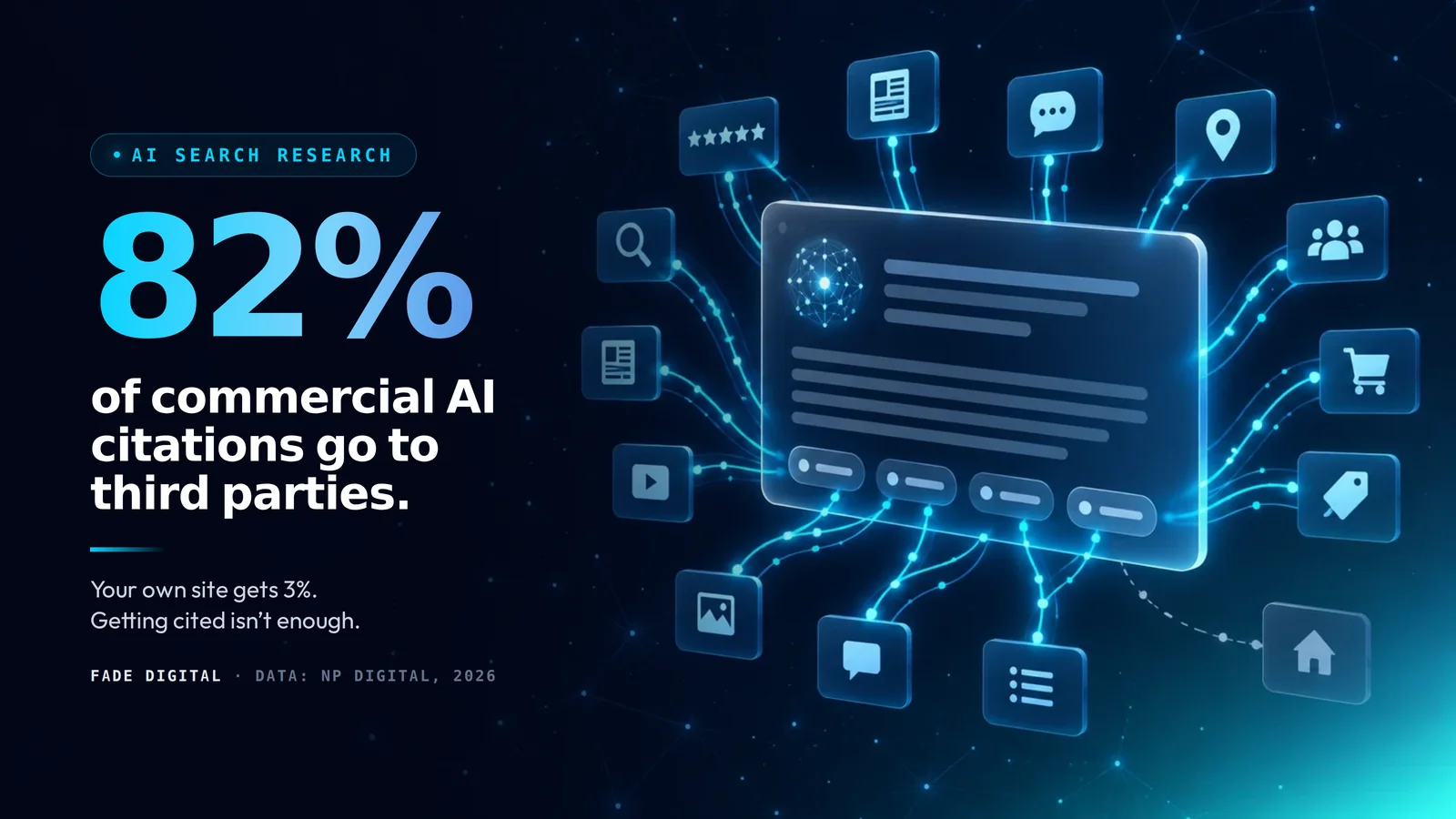
When NP Digital analyzed AI answers to roughly 9 million prompts across nine AI platforms and more than 400 enterprise brands, it found that on commercial-intent prompts, 82% of citations went to third-party sources and just 3% went to the brand's own pages. At the moment a buyer is deciding what to spend money on, the answer engines mostly cite everyone except the seller.
That finding is worth taking seriously, and also worth reading carefully, because a second large study found something that looks like the opposite. The gap between the two is where the useful lesson is. It changes what Generative Engine Optimization (GEO) work should consist of, and it changes what you should be measuring.
The 82% problem
NP Digital presented the research at brightonSEO in April 2026 and published it as AI Visibility at Scale: Learning From 9M Prompts and 400+ Enterprise Brands. Three findings from it matter here.
Third parties own the commercial answer. On prompts with buying intent, 82% of citations pointed to sources the brand did not own, and 3% to the brand's own pages. A third-party citation means the AI system supported its answer with a page on someone else's domain: a publisher, a review site, a comparison page, a forum thread, a video.
Ordinary pages beat engineered ones. 64% of the citations came from ordinary pages, not from listicles, how-to guides or comparison formats. If your GEO plan is mostly reformatting content into shapes that look "AI-optimized", the data suggests the format is not what gets you chosen. Being genuinely useful is.
Owned citations are still the strongest single lever. When a brand's own content was cited, its AI visibility rate rose roughly 5×, the largest lift in the dataset, ahead of YouTube at 2.8×. So the lesson is not that your website is irrelevant. Your website is rare in commercial answers, and enormously valuable when it does appear.
Why another study says almost the opposite
In October 2025, Yext published an analysis of 6.8 million AI citations from 1.6 million location-based queries across ChatGPT, Gemini and Perplexity, collected between July and August 2025 in retail, finance, healthcare and food service. Its headline: 86% of AI citations came from "brand-managed" sources.
Read the two headlines side by side and they contradict each other. Read the methodologies and they mostly don't.
Same question, two answers: who gets cited?
Yext’s 86% headline is brand websites (44%) plus business listings (42%). Count only the brand’s own website and the figure is 44%. Sources: NP Digital (2026); Yext (October 2025).
View the data
| Study | Query type | Category | Share of citations |
|---|---|---|---|
| NP Digital | Commercial intent | Third-party sources | 82% |
| NP Digital | Commercial intent | Brand's own pages | 3% |
| Yext | Location-based | Brand websites | 44% |
| Yext | Location-based | Listings | 42% |
| Yext | Location-based | Reviews and social | 8% |
Three things separate the results.
What counts as "owned". Yext's 86% adds business listings (42%) to brand websites (44%) and counts both as brand-managed. Your Google Business Profile is something you influence, but it is a page on Google's domain, built partly from what customers write. NP Digital's 3% refers to the brand's own pages. Strip Yext's figure back to brand websites alone and it falls from 86% to 44%.
What was asked. "Pharmacy near me open late" pulls listings, because that is where hours and locations live. "Best accounting software for a 20-person firm" pulls reviews, comparisons and publications, because the buyer is asking for judgement, not facts. The two studies sampled different kinds of question.
Who published it. Yext sells listings management. NP Digital sells earned media. Each study's headline supports its publisher's product. That does not make either one wrong, but it is a reason to read the methodology before the headline, and to be wary of anyone who quotes a single number as a law of AI search.
What survives both studies is the part that matters: your own website is a minority of what AI systems cite, whether that minority is 44% on local queries or 3% on commercial ones. A GEO program that only works on your site is working on the smaller half of the problem at best.
AI search isn't just an SEO problem anymore
Traditional SEO asks: do we rank? You compete for a position on a list, and the buyer reads the list.
In AI search, the model reads the list for the buyer. It retrieves sources, weighs them against each other, and writes a single answer. Ranking still matters, because it influences what gets retrieved. But it doesn't decide what the answer says about you. (We set out how SEO, AEO and GEO relate in our explainer on search visibility.)
That changes the shape of the buyer journey:
Question → AI answer → shortlist → brand research → conversion.
The shortlist now forms before anyone visits a website. A buyer asks who they should hire, gets three names, and researches only those three. If you are not one of them, there is no visit to measure, no lost lead to notice and nothing in your analytics to say it happened.
Traffic is no longer a complete measure of search visibility. The question that matters commercially is whether you were on the shortlist.
Citation, mention, recommendation: three different outcomes
Most GEO reporting treats these as the same thing. They aren't, and the difference is where the money is.
Citation
The AI uses your source.
Your page appears as a link or reference supporting the answer. Evidence that your content was useful.
Mention
The AI names your brand.
Your company appears in the answer text itself. The buyer now knows you exist.
Recommendation
The AI tells the buyer to consider you.
You are presented as a viable choice for their need. This is the shortlist position.
These do not arrive as a bundle. You can be cited without being named. You can be named as an example of what to avoid. You can be mentioned in passing and recommended by nobody. And a competitor can be recommended on the strength of a source that you wrote.
A citation is evidence. A mention is awareness. A recommendation is a place on the shortlist. Buyers act on the third.
The ghost citation problem
In June 2026, Semrush published a study run with Kevin Indig and Growth Memo that gave this problem a name. Indig calls it a ghost citation: an AI answer links to your page as a source, but never says your brand name.
The study logged 3,981 domain appearances across 115 prompts in 14 countries on ChatGPT, Gemini, Google AI Overviews and Google AI Mode. 61.7% of citations were ghost citations. And the engines behaved in nearly opposite ways.
ChatGPT tends to cite and not name. Gemini tends to name and not cite. A citation-only dashboard would tell you that you are doing well on ChatGPT and badly on Gemini, when the buyer-facing reality is closer to the reverse. One caution: 115 prompts is a modest sample, so treat the direction as more reliable than the exact rates.
Here is what a ghost citation looks like in practice. A Toronto physiotherapy clinic publishes the clearest guide online to rotator cuff recovery times. A buyer asks ChatGPT which clinic to see for a shoulder injury. The answer uses the clinic's guide to explain recovery, links to it, and then recommends three other clinics by name. The clinic did the work, its competitors got the shortlist, and a citation tracker would record the exchange as a win.
Citation count is an incomplete KPI. It can rise while recommendations fall.
Why third-party authority matters
When a buyer asks an AI system who to choose, the system is making a judgement, and it looks for corroboration. A brand describing itself as the best option is weak evidence. An independent source saying so is stronger. Several independent sources agreeing is stronger still. That is why commercial answers lean so heavily on third parties.
The sources that tend to carry that weight:
- Industry publications and earned media. Coverage in outlets your buyers and your category already trust.
- Comparison and "best of" pages. The pages written to answer the exact question your buyer is asking.
- Review sites. Volume matters less than detail: reviews that name the specific service and outcome give a model something to extract. We covered why in Google reviews mean nothing to ChatGPT.
- YouTube. NP Digital measured a 2.8× visibility lift associated with YouTube, second only to owned content.
- LinkedIn. Particularly for B2B, where expertise is judged by people and their published thinking.
- Reddit and communities. Where buyers describe their real experiences in their own words.
- Directories and listings. Especially for local and regulated categories, where they carry the facts.
- Analyst and industry sources. For categories where a recognized third party already ranks the field.
- Expert citations. Your people quoted as authorities in other people's work.
None of this means spamming Reddit, buying reviews or mass-producing placements on low-quality sites. Astroturfed community posts get found and removed by moderators, and can end up cited as evidence against you. Fake reviews breach platform policies and consumer-protection law. Low-quality placements are exactly the material a model learns to discount. NP Digital's finding that ordinary, useful pages earn most citations points the same way: there is no format trick here. Authority comes from being genuinely relevant and genuinely useful in the places your buyers already read.
Owned authority
Your site, structured data and published expertise. Rarely cited in commercial answers; a large lift when it is.
Third-party authority
Independent sources that corroborate what you say about yourself. Most of what commercial answers cite.
Recommendation signals
The evidence an AI system weighs when deciding whether to put you on a buyer's shortlist.
The new GEO funnel
If a recommendation is the outcome that matters, then GEO needs a funnel that ends there, and then keeps going to revenue.
AI visibility
Your brand or content appears anywhere in answers to the questions your buyers ask.
Citation
AI systems use your content, or sources about you, as evidence.
Mention
Your brand is named inside the answer itself.
Recommendation
You are presented as a choice when buyers ask what to pick.
Share of AI voice
How often you are recommended, relative to competitors, across many prompts and repeated runs.
Branded demand
Buyers who heard your name from an AI search for you directly.
Conversion
Leads, sales and revenue.
Each stage is necessary and none is sufficient. Most GEO reporting stops at stage two.
What to measure
Each metric below maps to a stage of the funnel above, ordered from first contact to revenue.
| Metric | Funnel stage | What it tells you |
|---|---|---|
| AI visibility rate | Visibility | The share of relevant prompts in which your brand or content appears at all |
| Citation rate | Citation | How often your owned pages are used as a source |
| Source overlap | Citation | Which third-party sources appear repeatedly across answers in your category |
| Citation gaps | Citation | Influential sources that cite competitors but not you |
| Brand mention rate | Mention | How often your name appears in the answer text |
| Recommendation rate | Recommendation | How often you are presented as a viable choice |
| Recommendation gaps | Recommendation | Prompts where you are cited or mentioned but not recommended |
| Share of AI voice | Share of AI voice | Your recommendations as a share of all brand recommendations in your category |
| Competitor recommendation share | Share of AI voice | Who is being recommended instead of you, and how often |
| Persistence | Every stage | Whether your position holds across repeated runs and over weeks |
| Branded search lift | Branded demand | Growth in people searching your name directly |
| Referral and direct traffic | Conversion | Visits from AI platforms, where they are attributable |
| Leads and revenue | Conversion | The outcome everything else is a proxy for |
Be honest about the limits. AI answers vary from one run to the next, so a single check of a single prompt tells you very little; you need many prompts and repeated runs. Much AI influence never produces a click, so referral traffic understates it. Branded search lift is a reasonable proxy and not proof of cause. Attribution here is imperfect, and anyone who says otherwise is selling certainty they don't have. Our AI visibility tracking playbook covers how to set the measurement up.
What marketers should do now
- Map your commercial prompts. Write down the questions buyers ask when they are close to choosing: "best X for Y", "X vs Y", "who should I hire for Z in Toronto". These matter more than informational queries.
- Benchmark the recommendations. Run those prompts across ChatGPT, Gemini, Claude, Perplexity and Google's AI experiences, repeatedly. Record who is cited, who is named and who is recommended.
- Identify the recurring sources. Note which publications, review sites, communities and pages keep appearing. That is the map of what AI systems trust in your category.
- Analyze your competitors. For every prompt where a competitor is recommended and you are not, find the sources supporting them.
- Improve your owned authority. Make your own pages the clearest, most specific answer available, with structured data that removes ambiguity about who you are and what you do. Rare citations are still the biggest lift.
- Earn legitimate third-party visibility. Pursue coverage, reviews, community participation and expert citations in the specific sources you identified in step three.
- Measure recommendation share. Track recommendations and share of AI voice, not just citations, and watch for ghost citations.
- Repeat. Answers, sources and competitors move. A benchmark from last quarter is already out of date.
Where Fade Digital fits
This is the work we do. We start by measuring where your brand appears across the prompts your buyers ask, who AI systems recommend instead, and which sources are shaping those answers. Then we work on both halves of the evidence: the owned content and structured data that make you easy to understand and cite, and the third-party authority that gives AI systems a reason to recommend you. Throughout, we measure citations, mentions, recommendations and share of AI voice, so you can see what changed.
We can't make any AI system recommend you, and nobody honestly can. What we can do is improve the quality, authority and availability of the signals those systems rely on. Our GEO service and methodology set out how.
If you want to start with the facts, our free AI visibility scan runs the questions your customers ask and shows where you appear, what AI says about you and which competitors are recommended instead.
Frequently Asked Questions
What is a ghost citation? A ghost citation is when an AI answer cites your page as a source but never names your brand. The term was coined by Kevin Indig. A June 2026 study by Semrush with Indig's Growth Memo found that 61.7% of AI citations across ChatGPT, Gemini, Google AI Overviews and Google AI Mode were ghost citations.
What is the difference between an AI citation and an AI recommendation? A citation means an AI system used your content as a source. A recommendation means it presented your brand to the buyer as a viable choice. The two often occur separately: your content can support an answer that recommends a competitor.
Do third-party citations matter more than my own website? On commercial queries, they appear far more often: NP Digital found 82% of citations went to third parties and 3% to brands' own pages. But owned citations had the largest effect when they did occur, a roughly 5× lift in AI visibility. Both matter, and they reinforce each other.
What is share of AI voice? Share of AI voice is how often your brand is recommended by AI systems, relative to competitors, across a defined set of buyer prompts and repeated runs. It is the AI search equivalent of share of voice in advertising, and a better commercial measure than citation count.
Can an agency guarantee that ChatGPT will recommend my business? No. No one controls what AI systems say, and answers vary between runs. What an agency can do is improve the quality, authority and availability of the evidence those systems rely on, and measure whether your share of recommendations changes as a result.
Sources
- NP Digital, AI Visibility at Scale: Learning From 9M Prompts and 400+ Enterprise Brands, presented at brightonSEO, April 2026.
- Yext, 86% of AI Citations Come from Brand-Managed Sources, October 2025.
- Semrush with Kevin Indig and Growth Memo, Why 62% of AI citations don't lead to brand mentions, June 2026.
- Search Engine Land, Ghost citations: Why AI search cites your content, not your brand.
Figures are as reported by each publisher. Where we could not access a primary page directly, each figure is corroborated by at least two independent reports of the same study.