Most Toronto service businesses have a Yelp profile they have not looked at since roughly 2019. It has the old phone number, three photos taken on somebody's iPhone 8, a category that is almost but not quite what you do, and a handful of reviews you never responded to. Possibly you never even created it — Yelp generated it from a data feed and it has been sitting there ever since.
That page is now a data source for ChatGPT.
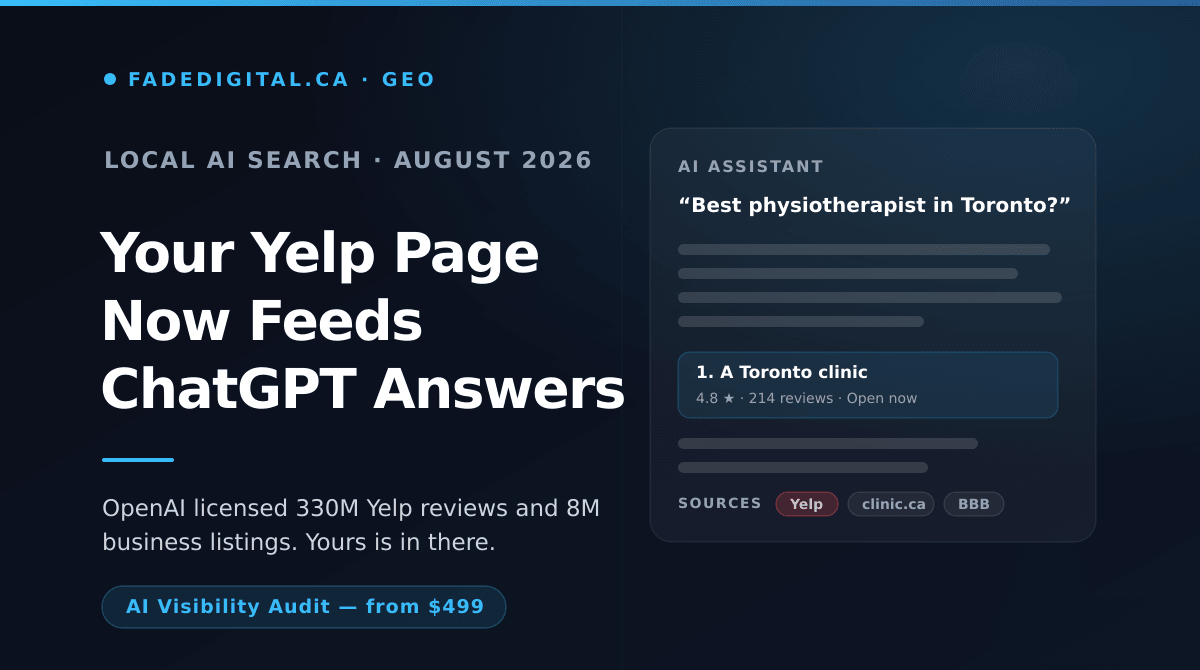
In July 2026, Axios reported the operational details of a licensing agreement Yelp first disclosed in its February 2026 earnings release: OpenAI has licensed Yelp's reviews, ratings, photos and business information for use in ChatGPT's answers to local queries. The scope is 330 million cumulative reviews and more than 8 million business listings. When ChatGPT draws on that content, Yelp branding and links appear alongside it, though OpenAI controls how the experience is presented.
This is not a crawling story. Nobody has to find your Yelp page, decide it is trustworthy, and choose to cite it. The data was bought, structured, and handed over. Your profile is inside the pipe whether it is accurate or not.
What exactly did Yelp and OpenAI agree to?
The short version: OpenAI pays for structured access to Yelp's local business corpus, and ChatGPT can use it when someone asks a local question.
A few details matter more than the headline.
It is not exclusive. Yelp confirmed the arrangement does not preclude similar deals with other AI companies. Expect Yelp data to show up in more assistants, not fewer.
Financial terms were not disclosed. Neither company has said what OpenAI is paying, which makes it hard to judge how deeply integrated the data will be over time.
Attribution is part of the deal but presentation is not yours to control. Yelp branding and links appear when its content is used, but OpenAI decides what that looks like in the interface. You do not get a say in whether ChatGPT shows your rating, your review count, or neither.
Request a Quote is coming. Yelp plans to extend the integration so its quote-request flow works inside ChatGPT, letting someone contact a participating business directly from an AI-generated answer. That is the part with revenue attached — it turns a citation into a lead.
Where does ChatGPT actually get local business information?
It helps to stop thinking of AI answers as coming from one place. When somebody asks an assistant to recommend a local business, three different inputs feed the response, and they behave very differently.
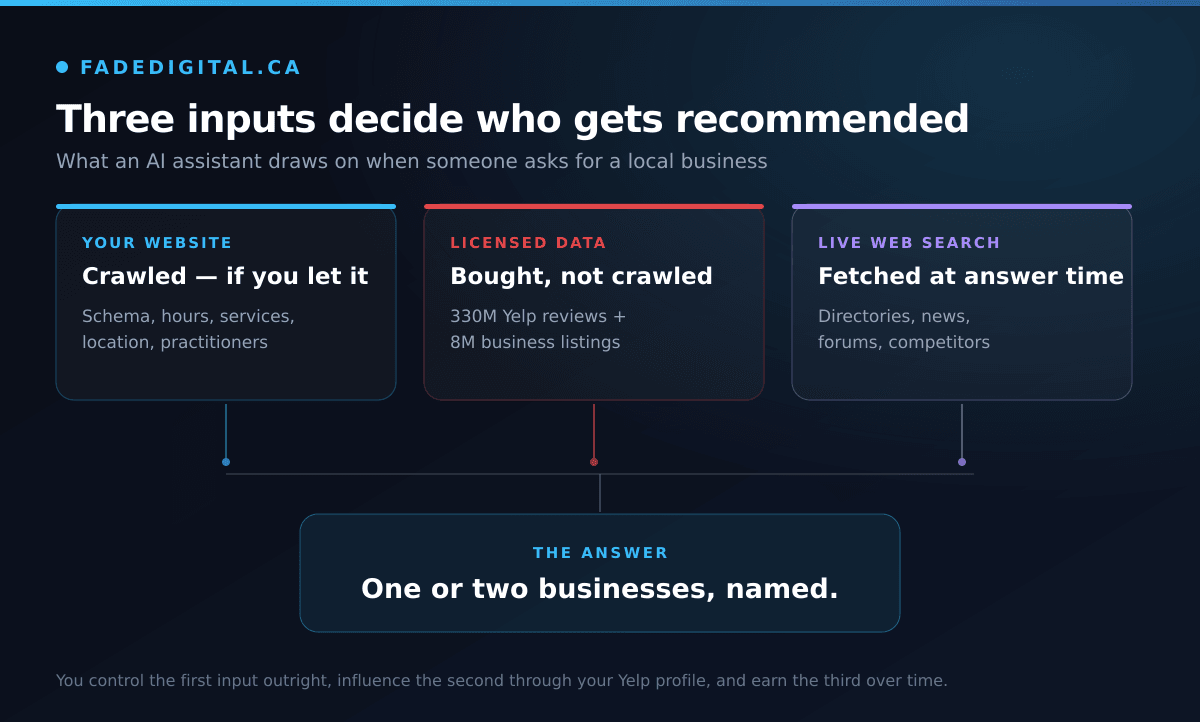
The first input is your own website, crawled if you permit it. This is the one you control outright, and it is where schema markup, service pages, hours and practitioner bios do their work. It is also the one businesses most often break by accident — we wrote about the Cloudflare crawler defaults changing on September 15 precisely because so many local businesses have quietly blocked the crawlers they need.
The second input is licensed data. This is new, and it is the category the Yelp deal falls into. It does not get crawled, ranked or judged. It gets ingested.
The third input is live web search, fired at the moment the question is asked. This is the volatile one. Earlier this month, between August 8 and August 17, Reddit's share of ChatGPT Search citations fell from roughly 3.8% to 0.5% after OpenAI changed how the model fans out its web queries. Nine days, and a citation source that people had built entire content strategies around effectively vanished.
That contrast is the strategic point of this whole post. The live-search layer moves under your feet. Licensed feeds do not. When a platform signs a contract to supply local business data, that data becomes part of the answer infrastructure in a way that a well-timed forum post never will.
Wait — didn't you say reviews don't matter to ChatGPT?
We did, and it is worth being straight about it.
In April we published Why Your 5-Star Google Reviews Mean Nothing to ChatGPT. The argument was that a strong Google review profile does not translate into AI recommendations, because AI assistants are not reading your star rating the way Google's local algorithm does. That was accurate then and it is still accurate now, with one important refinement.
The claim was never "reviews are irrelevant." It was "Google reviews, sitting in Google's ecosystem, are not the lever people assume they are." Google Business Profile data is not licensed to OpenAI. Yelp's is.
So the correct 2026 version of that post's thesis is narrower and more useful: reviews matter to AI when they live somewhere an AI engine can actually consume them. A 4.9 rating across 500 Google reviews still does very little for your ChatGPT visibility. Forty reviews on a properly claimed, fully completed Yelp profile now do considerably more than they did in April, because that data is being fed in under contract.
Everything else in that post stands. Entity consistency, schema, third-party corroboration and being cited across multiple independent platforms are still the mechanics. Yelp just became a much bigger node in that graph.
How much of AI's local answers already come from Yelp?
Here is the part that surprised us, because it predates the OpenAI deal entirely.
In May 2026, Foundation Marketing and AirOps published an analysis of more than 28 million AI responses to local business queries across ChatGPT, Gemini, Perplexity and Google AI Mode. Yelp was the most-cited local platform by a wide margin.
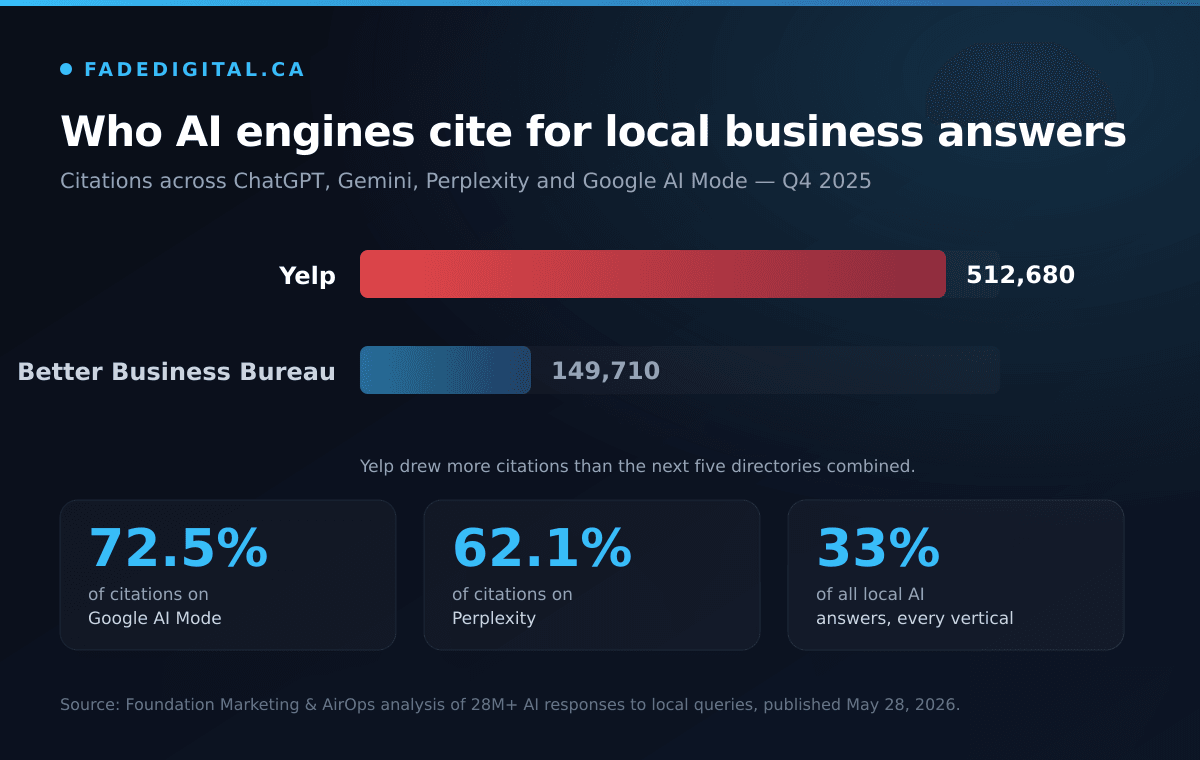
Yelp took 512,680 citations in Q4 2025 — roughly 3.4× the second-place Better Business Bureau at 149,710, and more than the next five directories combined. Its share was even more lopsided on individual engines: 72.5% of citations in the competitive set on Google AI Mode, 62.1% on Perplexity. Across every industry tested, Yelp appeared in about a third of local LLM answers.
Read that again with the timing in mind. This was measured before OpenAI licensed the corpus. Yelp was already the default local reference for AI engines because its data is clean, structured, comprehensive and easy to parse. The OpenAI deal did not create that position. It formalized it and put a contract behind it.
There is a second reason Yelp punches above its weight that most people miss: its content already syndicates to Apple Maps, Bing, Alexa, DuckDuckGo and Yahoo. Fixing one profile propagates across a surprising amount of the machine-readable web.
Why does this hit Toronto businesses harder?
Because Yelp is a weaker consumer habit in Canada than in the US, and Canadian business owners have treated it accordingly.
I want to be careful here: I have not seen a published figure for what share of Toronto business listings are unclaimed, and I am not going to invent one. What I can tell you is what we see running audits across GTA clinics, firms and contractors. Yelp profiles in this market are consistently worse than the same businesses' Google Business Profiles. Auto-generated listings nobody claimed. Categories that were picked by a data feed. Phone numbers from a previous location. Zero owner responses. Photos that are either absent or scraped from an old website.
That neglect made sense when Yelp's Canadian traffic was the whole justification for maintaining it. Judged purely on referral clicks from Yelp.ca, ignoring the profile was a defensible call.
That calculation just changed. The value of a Yelp profile in Toronto is no longer the traffic it sends you. It is that it is a licensed, structured description of your business flowing into the assistant your customers are increasingly asking for recommendations. You are not maintaining a directory listing anymore. You are maintaining a database record about your company that an AI will read aloud to a prospect.
Google Business Profile vs Yelp: what each one feeds now
Both still matter. They matter for different reasons, and conflating them is how businesses end up over-invested in one and blind in the other.
| Google Business Profile | Yelp | |
|---|---|---|
| Primary surface | Google Maps, local pack, AI Overviews | Yelp.com and syndication partners |
| Licensed to OpenAI | No | Yes — reviews, ratings, photos, business info |
| Syndicates elsewhere | Largely stays within Google | Apple Maps, Bing, Alexa, DuckDuckGo, Yahoo |
| Categories | One primary, up to nine secondary | Up to three, from ~1,500 |
| Review volume that matters | High — drives local pack ranking | Lower threshold, but completeness matters more |
| Direct lead capture in AI | Not currently | Request a Quote coming to ChatGPT |
| Typical GTA condition | Actively maintained | Neglected or unclaimed |
The takeaway is not "switch your effort to Yelp." It is that these two profiles now feed different machines, and most Toronto businesses are running one of those machines on data from six years ago.
What should you actually do about it?
Thirty minutes, eight checks, in this order. If you do nothing else from this post, do the first three.
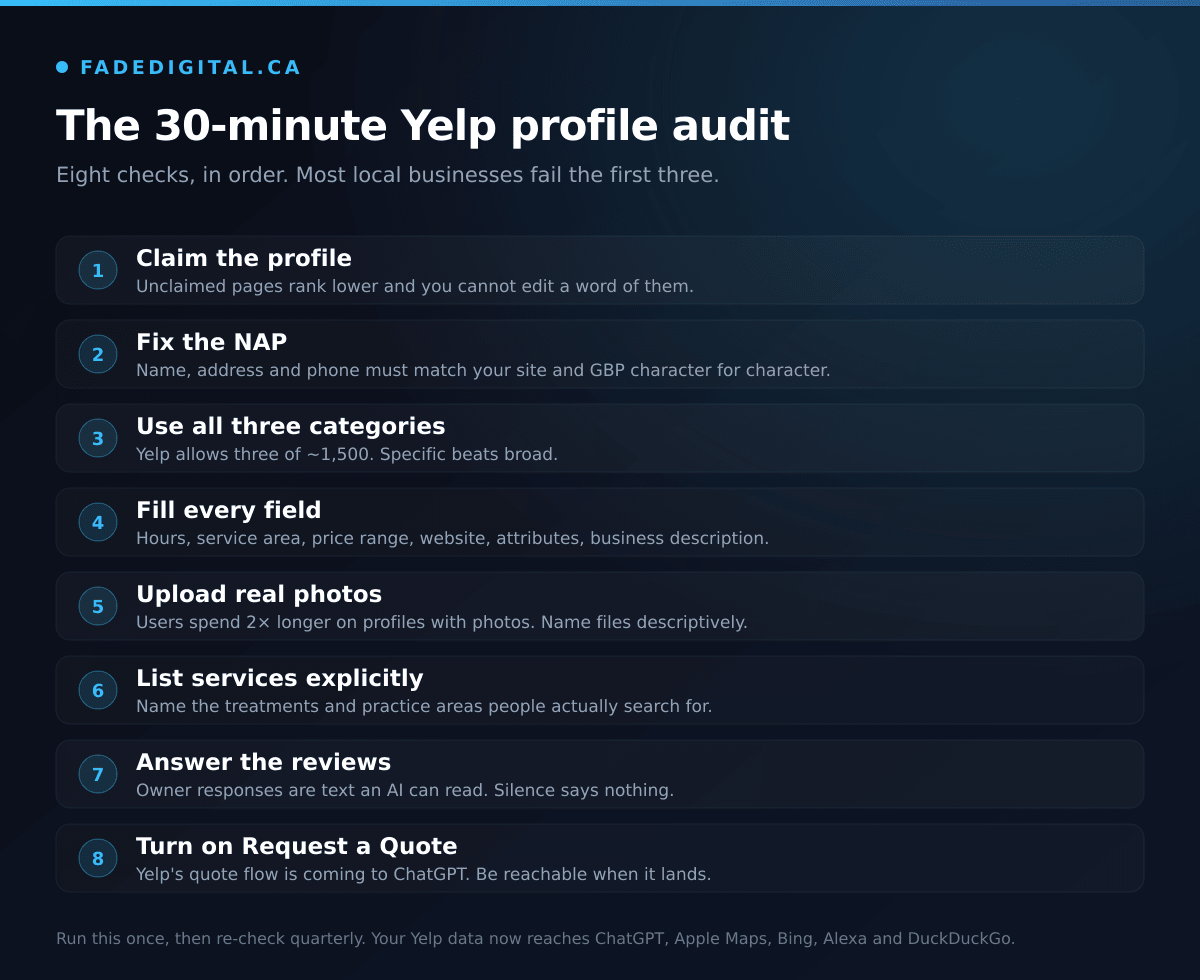
1. Claim the profile. Search your business name on Yelp. If there is a page you do not control, claim it through Yelp for Business. Claimed profiles rank higher within Yelp, and until you claim it you cannot correct a single character of what is now flowing to OpenAI. If there are duplicate listings — extremely common after a move or a rebrand — merge them. Duplicates are the single most damaging thing in this whole list, because they teach every downstream system that there are two of you.
2. Fix the NAP. Name, address and phone must match your website and your Google Business Profile character for character. Not "close enough." Suite 210 and #210 are different strings to a machine trying to decide whether two records describe the same entity. This is the same entity-consistency problem behind most of the local business errors ChatGPT makes, and it is the cheapest thing on this list to fix.
3. Use all three categories, specifically. Yelp gives you three slots out of roughly 1,500 categories. Most businesses fill one, vaguely. Pick the three that match how a customer would describe what they need, not how your industry describes itself. A clinic offering both is better served by Physical Therapy and Sports Medicine than by Health & Medical alone.
4. Fill every field. Hours, service area, price range, website URL, attributes, business description. Empty fields are not neutral. When an assistant is deciding between two businesses and one record has parking, accessibility and hours filled in while the other has nulls, the complete record is easier to recommend and less risky to name.
5. Upload real photos, named properly. Yelp reports users spend twice as long on profiles with photos, and it indexes image filenames. IMG_4471.jpg tells a machine nothing. toronto-physiotherapy-clinic-treatment-room.jpg tells it something. Shoot the actual space, the actual team, the actual equipment.
6. List your services explicitly. Name the treatments, practice areas or trades in plain language people actually use. This is the same discipline behind good service-page content and good schema markup — say the thing, in the words the customer says it in.
7. Respond to reviews, including the good ones. Owner responses are text. An AI reading your profile sees a business that engages, and it sees your framing of any complaint alongside the complaint itself. Silence contributes nothing to the record.
8. Turn on Request a Quote. If Yelp's quote flow reaches ChatGPT the way Yelp has indicated it will, the businesses configured to receive quote requests will be the ones capturing that demand. Being reachable when the feature lands is worth more than reacting to it three months later.
What this does not mean
A few guardrails, because the marketing internet is going to overcorrect on this within a week.
It does not mean buying Yelp ads improves your AI visibility. Nothing in the licensing agreement connects ad spend to how ChatGPT uses the data. Claim and complete your profile. That is free.
It does not mean Yelp reviews now outrank Google reviews. Google reviews still drive the local pack, still influence Google's own AI surfaces, and still convert humans. This is additive.
It does not guarantee you get recommended. Being in the corpus is table stakes, not an outcome. ChatGPT still has to decide you are the right answer, and that decision draws on all three inputs from the diagram above — your site, the licensed data, and whatever live search turns up. A clean Yelp profile attached to a website that blocks GPTBot is still a business that does not get named.
It does not replace your own site. Licensed directory data describes you in a schema somebody else designed. Your website is the only place you control the full narrative, and it is still the strongest signal you own. Our Toronto agent-readiness study found most local businesses failing on basics there that no directory profile can compensate for.
The 30-day version
If you want this sequenced rather than listed:
- Week 1 — Claim the profile, merge duplicates, fix NAP against your website and GBP. This is the entity-integrity work, and everything else is worth less until it is done.
- Week 2 — Categories, services, all remaining fields, and a proper photo set with descriptive filenames.
- Week 3 — Respond to every review currently sitting unanswered, oldest first. Configure Request a Quote.
- Week 4 — Check whether the picture matches. Ask ChatGPT, Perplexity and Gemini for a recommendation in your category and city, and see who gets named and what gets cited. Repeat monthly.
That last step is the one people skip, and it is the only one that tells you whether any of the rest worked. If you want it done systematically across six engines rather than by hand, that is what our AI Visibility Audit exists for — but the manual version is free and you should do it either way.
Frequently asked questions
Does the Yelp–OpenAI deal mean ChatGPT now recommends businesses based on Yelp ratings?
Not directly. The agreement gives ChatGPT licensed access to Yelp reviews, ratings, photos and business information for local queries. It does not make star rating a ranking factor. The rating is one field among many in a record the model can now read reliably, alongside your categories, hours, services and description. A complete, accurate profile is worth more than a high rating on an incomplete one.
Is my Yelp profile included even if I never claimed it?
Almost certainly, yes. The agreement covers more than 8 million business listings, and Yelp generates listings from data feeds regardless of whether an owner has claimed them. That is the uncomfortable part: an unclaimed, outdated profile is in the corpus on the same terms as a maintained one, and you cannot correct it until you claim it.
Should I stop working on Google Business Profile?
No. Google Business Profile still drives Google Maps, the local pack and Google's own AI surfaces, and it is not licensed to OpenAI, which means the two profiles now feed different systems. Treat them as parallel obligations. The mistake is not choosing wrong between them, it is maintaining one and abandoning the other.
How long until fixing my Yelp profile changes anything in ChatGPT?
There is no published refresh cadence for the licensed feed, so anyone quoting you a specific number is guessing. Based on how other AI data pipelines behave, plan on 30 to 90 days before changes show up consistently in answers, and measure rather than assume. Corrections to obviously wrong data — a closed location, a dead phone number — are worth making immediately regardless of timeline.
Does this apply to Canadian businesses, or only US ones?
It applies to any business with a Yelp listing, and Yelp operates in Canada. If anything the opportunity is larger here, because Canadian businesses have historically invested less in Yelp than their US counterparts. Lower baseline effort in your market means a completed profile stands out more against local competitors.
Will other AI companies get Yelp data too?
Probably. Yelp confirmed the OpenAI agreement is not exclusive and does not prevent similar deals elsewhere. Yelp content already syndicates to Apple Maps, Bing, Alexa, DuckDuckGo and Yahoo, so its data reaches well beyond ChatGPT already. Work done on the profile now compounds across whichever engines license it next.
Is Request a Quote in ChatGPT live today?
Not as of this writing. Yelp has stated it plans to bring the feature into ChatGPT, which is a roadmap item rather than a shipped product. Configuring it on your Yelp profile now costs nothing and means you are eligible on day one if and when it launches.
About the author: Lorne Fade is the founder of Fade Digital, a Toronto Generative Engine Optimization agency. He has 20+ years in digital marketing and is also COO of VR Vision. He writes about how AI search actually decides which businesses get recommended.
Want to know what the engines currently say about you? The AI Visibility Audit tests your business across ChatGPT, Claude, Perplexity, Gemini, Grok and Copilot, and hands you a prioritized fix list — $499, and it's yours to keep whether or not you continue.