
TL;DR
- Google Search has a new model. On November 12, 2026, Google put Gemini 4 Hydrogen into Search for all users, worldwide. Google's VP of Product for Search calls it the biggest model upgrade to Search yet.
- It reads long, messy questions. Google says you can ask in your natural flow of thought, with several parts, typos or very specific requests, and get an answer that deals with each part.
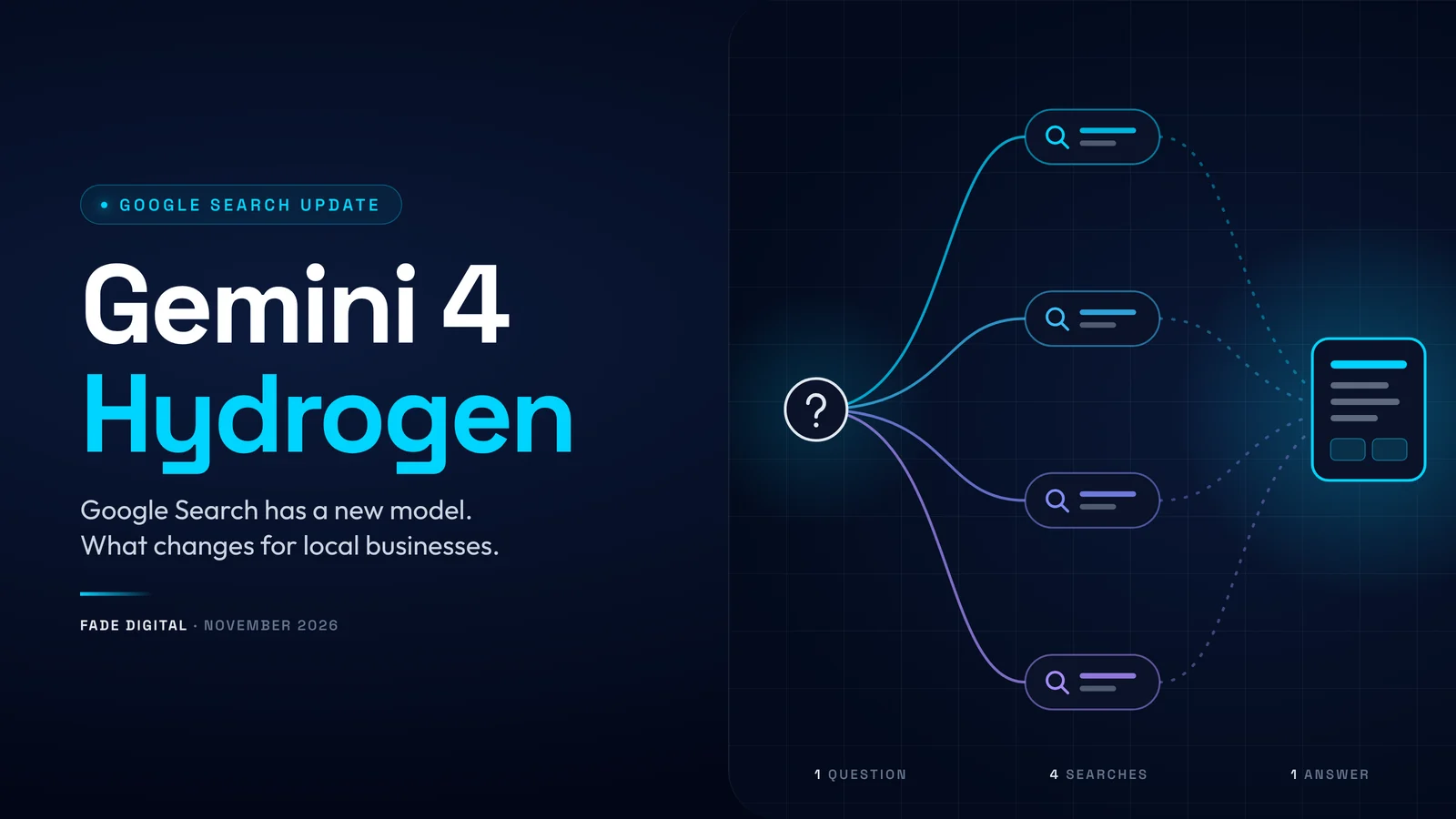
- One question becomes many searches. Hydrogen improves what Google calls query fan-out: it runs searches on every subtopic of your question at the same time, and Google says that surfaces a broader range of links.
- Answers are more visual. Google says to expect more images, structured responses, comparison tables and custom tools.
- The two big numbers are not about Search. "2.5 times faster" and "more than 5x fewer fabricated claims" come from Google's developer announcement, with no test method published. Google gave no numbers for Search at all.
- For a local business: every part of a customer's question is now searched separately. The businesses that publish specific, consistent facts are the ones that can be matched to each part.
What Google actually shipped
Google published two posts on November 12, 2026. One is about Search, written by Robby Stein, VP of Product for Google Search. The other is the official release post for the model, written by Koray Kavukcuoglu, SVP at Google DeepMind and Google's Chief AI Architect.
The Search post is short. It says Hydrogen is "now available globally in Google Search for all users" and lists four improvements:
1. Better understanding of intent
Search can handle more complicated questions, including ones with several parts, hard-to-read typos or very specific requests, and it answers each part.
2. Improved query fan-out and linking
More on this below. It is the change that matters most to anyone with a website.
3. More visual responses
More images, structured responses, comparison tables and custom tools built for the question.
4. Richer language understanding
Better answers in every language AI Mode supports.
Stein's line for all of it: "This is the biggest model upgrade to Search yet."
The model post explains where Hydrogen sits. Google's heaviest Gemini 4 models are called Carbon and Argon, and they are built for long, difficult reasoning. Hydrogen is the fast one, built for quick execution. That fits Search, where an answer has to arrive in seconds.
Google's launch artwork
Google's own line for Hydrogen is "For everyday coding and agentic work". The launch is pitched at developers first, which is where the headline numbers come from.
Read Google's official release post
Image: Google.
Hydrogen is also in the Gemini app's model menu and available to developers. This post is about Search.
What Google has not said
Three things are less settled than the headlines suggest. We checked each one against Google's own pages.
What it replaced in Search. Several reports say Hydrogen replaces Gemini 3.8 Flash. Google's model post calls Hydrogen "a major standalone upgrade for teams migrating from Gemini 3.8 Flash", which is a statement about developers. For Search, Google has not named the model it replaced. Search Engine Journal points out that the last default it reported for AI Mode was Gemini 3.5 Flash, announced at Google I/O in May.
AI Overviews. Google's Search post never mentions AI Overviews. The link comes from a thread on X by Robby Stein, reported by Search Engine Journal, which says Hydrogen is "being used for your hardest questions in AI Overviews." Google has not said which questions count as hardest, or what answers the rest.
"Default." Google's wording is "available globally in Google Search for all users." Calling it the default model in AI Mode is Search Engine Journal's description, and a fair one, but it is not Google's phrase.
The run-up to November 12
- Gemini 3 becomes the default model for AI Overviews.
- Gemini 3.5 Flash becomes the default for AI Mode, at Google I/O.
- Gemini 4 Argon is offered in AI Mode as an option for Google AI Pro and Ultra subscribers.
- The November core update begins, and Gemini 4 Carbon starts rolling out to Ultra subscribers in AI Mode.
- Gemini 4 Hydrogen goes live in Search for all users.
Everything before November 12 is as Search Engine Journal reports it. The November 12 entry is from Google's own post.
What the 2.5x and 5x figures measure
You will see two numbers repeated everywhere. Both are real, both are Google's, and neither is a measurement of Search.
| The claim | Where Google makes it | What it describes |
|---|---|---|
| Finishes tasks 2.5 times faster | The model post, in the section for developers and enterprise teams | Finishing tasks at what Google calls its "high default setting", in a sentence about teams moving from Gemini 3.8 Flash |
| More than 5x fewer fabricated claims | The same sentence | The same context. No benchmark or test method is named for it |
| Faster, more accurate Search results | Nowhere | The Search post contains no numbers |
Tap a number to see where it comes from
Google says Hydrogen finishes tasks 2.5 times faster "at its high default setting". The sentence is about developer and enterprise teams moving from Gemini 3.8 Flash. No test method is published, and it is not a measurement of Search.
So it is reasonable to expect Search answers to be quicker and to invent less. It is not accurate to say Google measured Search at 2.5 times faster or five times more reliable, because Google did not publish that.
For site owners the practical reading is simple. A model that fabricates less leans harder on what it can actually find. If a fact about your business is not published somewhere it can read, a more careful model is more likely to leave it out than to guess.
Query fan-out: one question, many searches
This is the part worth understanding.
When someone asks a long question, Google does not run it as one search. It splits the question into subtopics, searches each of them at the same time, and builds one answer from what comes back. Google calls this query fan-out, and says Hydrogen's reasoning improves it, connecting people "to a broader range of helpful links than before" and to sites they "previously might not have discovered." Google gave no figures for how many more links or sites.
Here is how that could play out for a local search. Say a customer types: "physio near Leslieville that's open Saturdays, does direct billing and treats runners". This is our illustration of the idea, not output from Google.
Illustration: one question, four searches
physio near Leslieville that's open Saturdays, does direct billing and treats runners
- Search 1Physio clinics near Leslieville
- Search 2Which are open on Saturday
- Search 3Which offer direct billing
- Search 4Which treat running injuries
"We offer a full range of services and flexible hours." Its address is on the contact page. Nothing else in the question is stated anywhere.
"Open Saturdays 9 to 2. We bill most insurers directly. Running injury assessment and treatment." Each part of the question has its own plain sentence.
Our illustration of query fan-out. Both clinics are made up. This is not output from Google, and being matched on a part is not the same as being recommended.
What has to be published for each part:
| Part of the question | The search it could become | What has to be published to match |
|---|---|---|
| "physio near Leslieville" | Physiotherapy clinics in or near Leslieville | Your address and service area, the same on your site and your Google listing |
| "open Saturdays" | Which of them open on Saturday | Your hours, current, in text and in your listing |
| "does direct billing" | Which offer direct billing | A plain sentence that says so, and with which insurers |
| "treats runners" | Which treat running injuries | A service page that names running injuries, not just "sports physio" |
A clinic that only says "we offer a full range of services and flexible hours" matches the first search and none of the others. A clinic that states each fact plainly can be matched on all four.
This is the same lesson as answers that arrive as interfaces, from the other direction. A comparison table needs the same fields from every business in it. Fan-out goes and looks for each field separately.
What this means for your business
1. Answer each part of the question your customers ask. Write down the long version of what a customer would type: the service, the area, the constraint, the worry. Then check that each piece has a clear, specific sentence on your site. Our walk-through of how AI picks a business shows the steps an answer goes through.
2. Keep your facts the same everywhere. Fan-out pulls from many places at once. If your hours differ between your website and your Google Business Profile, a model built to fabricate less has a reason to skip you. Hours, services, prices or price ranges, service area and booking details should match on your site, your listing and your directory profiles, and be marked up with schema.
3. A wider range of links is an opening, not a promise. Google says more sites will be surfaced. It did not say how many, and it said nothing about traffic. It still makes sense to be the best answer to a narrow question, because narrow questions are exactly what a long query gets split into. It also still matters where else you are mentioned: AI answers cite third-party sources far more often than brand websites.
4. Mark November 12 in your reports. If you track AI citations or referrals, this month's numbers span a model change. The change also landed two days into Google's November core update, which Search Engine Journal reports began on November 10. A shift in your figures this month could be either one. Note the date and compare like with like before you draw conclusions. Our tracking playbook covers how to keep a clean record.
5. Make sure Google can read your site at all. None of this helps a page that is blocked. The AI crawler checker shows which crawlers your robots.txt lets in.
Try it on your own business
You can test this in ten minutes.
- Write three questions the way a real customer would ask them, each with three or four parts: the service, the neighbourhood, a constraint such as hours or price, and one specific need. The builder below puts one together for you.
- Ask each one in Google's AI Mode. Note whether you are named, who is named instead, and which sites are linked.
- For every part of the question the answer got wrong about you, or left out, find where that fact is published. If you can't find it in a plain sentence on your own site, that's your first fix.
- Repeat next month with the same questions, so you are comparing the same thing.
Build your test question
physio near Leslieville, open Saturdays, treats runners, direct billing
Then tick each part that is in a plain sentence on your site
0 of 4 parts confirmed.
This runs in your browser. Nothing you type is sent or saved.
Our free AI visibility scan does a version of this for ChatGPT, Claude and Gemini and shows who gets recommended. It queries Gemini through Google's developer service, not through AI Mode itself, so treat it as a baseline and run the AI Mode test above by hand. If you would like the work done for you, that is what our GEO service is for.
Frequently Asked Questions
What is Gemini 4 Hydrogen? Gemini 4 Hydrogen is a fast AI model from Google, announced on November 12, 2026. Google describes it as built for quick execution, alongside its heavier Gemini 4 models, Carbon and Argon. It now powers answers in Google Search for all users and is also available in the Gemini app and to developers.
Did Gemini 4 Hydrogen replace Gemini 3.8 Flash in Google Search? Google has not said which model Hydrogen replaced in Search. Google's model announcement describes Hydrogen as an upgrade for developers moving from Gemini 3.8 Flash. Search Engine Journal notes that the last default it reported for AI Mode was Gemini 3.5 Flash.
Is Google Search really 2.5 times faster now? Google has not published a speed figure for Search. The 2.5 times figure comes from Google's developer announcement and describes how fast the model finishes tasks at its high default setting, in a passage about teams moving from Gemini 3.8 Flash. Google did not publish the test method.
What is query fan-out? Query fan-out is Google's name for splitting one question into several subtopics and searching all of them at the same time, then combining the results into one answer. Google says Gemini 4 Hydrogen improves this and surfaces a broader range of links.
Does Gemini 4 Hydrogen power AI Overviews? Google's Search announcement does not mention AI Overviews. Robby Stein, VP of Product for Google Search, said on X that Hydrogen is being used for the hardest questions in AI Overviews, as reported by Search Engine Journal. Google has not defined which questions those are.
What should a local business do about Gemini 4 Hydrogen? Publish specific, consistent facts. Long questions are split into parts and each part is searched separately, so state your services, area, hours, prices and booking details plainly, keep them identical on your website and your Google Business Profile, and record November 12 as a model change in any AI visibility reporting.
Sources
- Google, Robby Stein, Google Search gets a major upgrade with Gemini 4 Hydrogen, November 12, 2026.
- Google, Koray Kavukcuoglu, Introducing Gemini 4 Hydrogen, November 12, 2026, updated November 13.
- Search Engine Journal, Matt G. Southern, Google Makes Gemini 4 Hydrogen The Default Model In AI Mode, November 12, 2026.
- MakeUseOf, Anvinraj Valiyathara, Google's new Gemini 4 Hydrogen is rolling out now, and free users get it too, November 12, 2026.
We read each of these pages on November 14, 2026. Google's wording is paraphrased here except where it is in quotation marks. The physiotherapy example is ours and is not output from Google. We could not read Robby Stein's thread on X directly, so what it says is given as Search Engine Journal reports it.