A prospective client with a wrongful dismissal claim opens ChatGPT and types "employment lawyer in Toronto who handles wrongful dismissal." They get three or four firm names and a paragraph on each. They do not scroll. They do not open a tenth tab. They pick one, maybe two, and call.
If your firm is not in that answer, you were never in the running — and unlike page two of Google, there is no page two to be on.
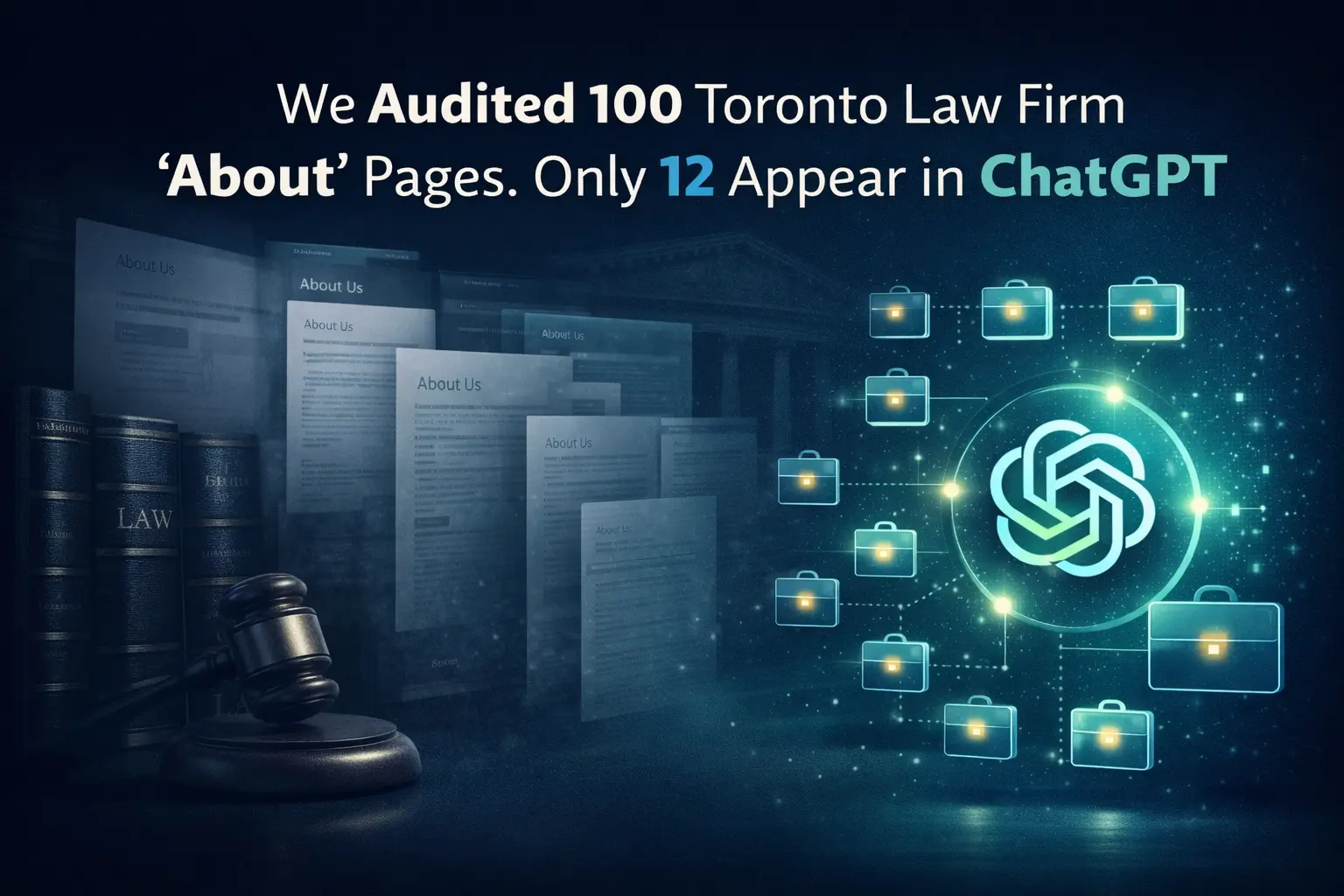
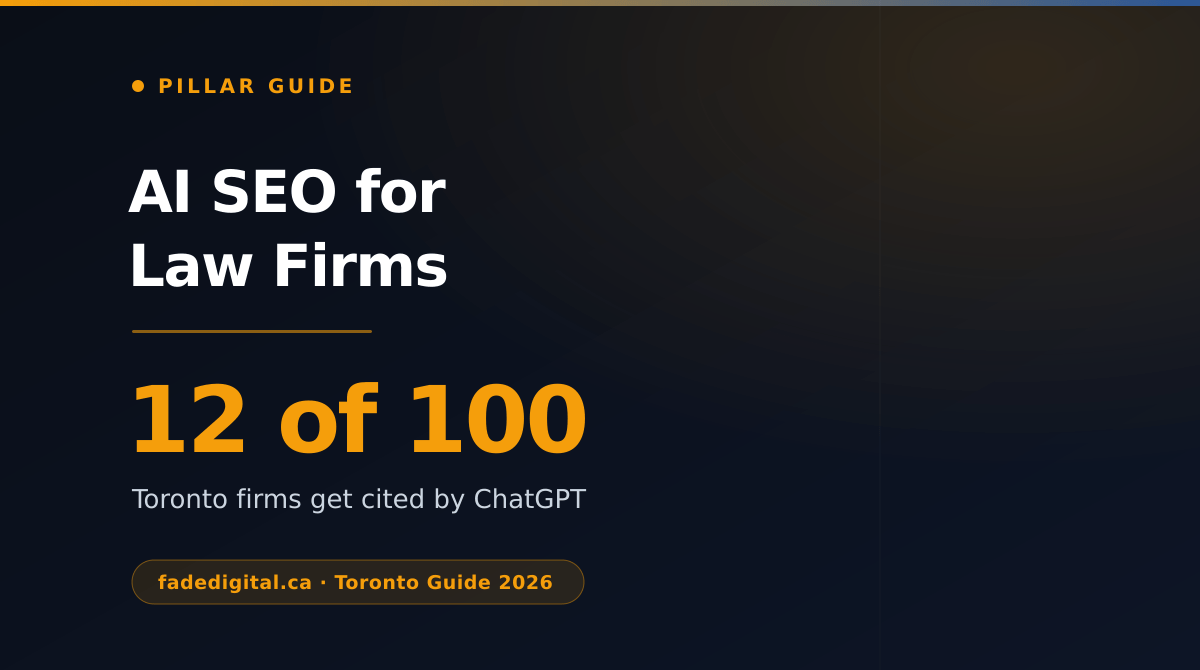
We wanted to know how often Toronto firms actually make that cut, so we audited 100 of them across four answer engines. Twelve got cited. Sixty-seven were never recommended at all. This guide is what we learned turned into something you can act on.
What "AI SEO for law firms" actually means
AI SEO — also called GEO or AEO, three names for one discipline — is the work of getting an answer engine to name your firm when someone describes their legal problem.
It is not the same job as ranking. Ranking puts you in a list of ten and lets the searcher choose. An AI answer names two or three and does the choosing for them. That changes what matters:
| Traditional legal SEO | AI SEO for law firms |
|---|---|
| Rank for "Toronto employment lawyer" | Get named when someone describes being fired unfairly |
| Keyword density and page titles | Structured data an engine can parse without guessing |
| Backlink volume | Third-party sources that corroborate who you are |
| Ten blue links | Two or three names, no alternatives shown |
| Position 8 still gets clicks | Position 4 does not exist |
The overlap is real — a firm that ranks well is usually easier for an engine to find. But ranking is neither necessary nor sufficient. Several firms in our audit ranked respectably on Google and were never cited by any engine, because the information an engine needs to verify a firm is not the information Google needs to rank one.
Why legal is harder than other verticals
Our dental baseline, using comparable methodology, sits around 18% citation. Legal came in at 12%. Same city, same engines, worse outcome.
Three structural reasons:
Legal is YMYL, and engines are conservative about it. "Your Money or Your Life" topics — health, finance, law — get more caution from every engine. An answer engine that names the wrong dentist has inconvenienced someone. One that names the wrong lawyer for an immigration matter may have cost them status. Engines respond by requiring more corroboration before naming a firm.
Practice areas are ambiguous in a way services are not. "Teeth whitening" means one thing. "Litigation" covers commercial disputes, personal injury, employment, estates and a dozen more. A firm that says "we practise litigation" has told a machine almost nothing about which client it can help.
Lawyers are the entity, not just the firm. Clients search for the person as often as the practice — "best employment lawyer Toronto," not "best employment law firm Toronto." Firms that publish no structured information about individual lawyers are invisible to half the query space.
None of that is a reason to give up. It is a reason the twelve firms that got cited were not the biggest or the best-known — they were the ones whose information was easiest to verify.
The five gaps that keep firms invisible
From the 100-firm audit, ranked by how often we found each:
| Gap | Firms affected |
|---|---|
| Missing jurisdictional and bar entity linking | 83% |
No Person schema for individual lawyers |
69% |
| Reviews present but not structured as data | 69% |
| Practice areas listed as text, not declared as entities | 61% |
| About page written as prose, not as an entity | 48% |
88% of firms had skipped most of them. Not one of these is expensive. They are easy to skip one at a time, which is exactly how a firm ends up invisible without anyone making a bad decision.
Gap 1 — Jurisdictional and bar entity linking (83%)
An engine asked for a Toronto lawyer needs to establish that you are licensed to practise in Ontario. Most firms state this in prose — "our lawyers are members of the Law Society of Ontario" — which a human reads instantly and a machine treats as an unverified string.
The fix. Link each lawyer to their Law Society of Ontario directory listing, and mark the relationship up:
{
  "@type": "Person",
  "name": "Jane Doe",
  "jobTitle": "Partner",
  "memberOf": {
    "@type": "Organization",
    "name": "Law Society of Ontario",
    "url": "https://lso.ca/"
  },
  "sameAs": [
    "https://lso.ca/public-resources/finding-a-lawyer-or-paralegal/directory/...",
    "https://www.linkedin.com/in/..."
  ],
  "knowsAbout": ["Wrongful dismissal", "Employment standards", "Human rights applications"]
}
The LSO directory is a neutral third-party source. Linking to it converts a claim into something checkable — which is precisely what a YMYL-cautious engine is looking for.
Gap 2 — Person schema for lawyers (69%)
Seven in ten firms had no structured data for any individual lawyer. Bios existed as pages; they simply were not declared as entities.
The fix. Every lawyer gets a Person node with a stable @id, jobTitle, worksFor pointing at the firm's Organization node, alumniOf for law school, memberOf for the bar, and knowsAbout listing practice areas in the language clients actually use. Use @id consistently so every mention across the site resolves to one entity rather than several.
This is the single highest-leverage item on the list, because it is what makes person-shaped queries answerable.
Gap 3 — Reviews as decoration, not data (69%)
Most firms display testimonials as styled quotes. An engine sees text with no attribution, no rating, no date, and nothing tying it to a reviewable entity.
The fix. Two parts, and both matter:
- Mark up genuine reviews with
ReviewandAggregateRating— only for reviews you actually have. Fabricated or aggregated-from-nowhere review markup is a manual action risk and, in a regulated profession, an advertising-rules problem. - Ask clients to name the matter type. "Sarah handled my wrongful dismissal claim and got it resolved in six weeks" teaches an engine what to send you. "Great service, highly recommend" teaches it nothing. This is the highest-value and least technical thing on this entire page.
Gap 4 — Practice areas listed, not declared (61%)
A bulleted list of practice areas is text. It does not tell a machine that your firm offers a service addressing a specific legal problem.
The fix. One page per practice area, each declared as a Service with the firm as provider, and each written to answer the question a client actually asks. Not "Employment Law" but "What can I do if I was fired without cause in Ontario?" — with the answer in the first paragraph.
Gap 5 — The About page as prose (48%)
Nearly half of firms had an About page that read as a brochure: founding year, values, a photograph of the boardroom. Human-readable, machine-opaque.
The fix. The About page should be the canonical entity page for the firm — LegalService or Attorney node with address, founding date, areas served, languages spoken, and links to every lawyer's Person node. It is the page an engine resolves "who are they" against, and it should be built for that job.
What the twelve cited firms had in common
They were not the largest firms, or the ones with the biggest content operations. They shared four things:
- Individual lawyers were structured entities, with bar links and named practice areas.
- Practice-area pages answered questions, in the client's language, with the answer stated early.
- Reviews named the matter type, so the engine could match a problem to a firm.
- The same facts appeared everywhere — site, Google Business Profile, LSO directory, legal directories — with no contradictions.
That fourth one did more work than anything technical. Engines resolve entities by agreement across sources. A firm whose address is formatted three different ways in three places is a firm the engine cannot confirm exists.
What to do, in order
Week one — verification. Claim and correct your Google Business Profile, Bing Places, and LSO directory entries. Make the name, address, phone and lawyer roster identical everywhere. This costs nothing and fixes the corroboration gap that suppresses everything else.
Week two — entities. Add Person schema for every lawyer with bar links. Convert the About page into the firm's entity page. These two together address the gaps affecting 69% and 48% of firms.
Weeks three and four — practice areas. One page per area, question-led, Service markup, answer in the first paragraph. Start with the two areas that bring in the most revenue, not the full list.
Ongoing — reviews. Ask every satisfied client to name the matter type. This compounds and nothing substitutes for it.
Then measure. Ask each engine — ChatGPT, Gemini, Perplexity, Claude — the questions a client would ask, in a fresh session with no history. Write down who gets named. Repeat monthly. That is your baseline and it is the only measurement that matters, because the commercial AI-visibility tools disagree with reality more often than you would like.
A note on advertising rules
Ontario firms are bound by Law Society rules on marketing and advertising, including restrictions on claims of expertise or superiority. Structured data does not exempt you. knowsAbout describing practice areas is a factual statement about what you do. A Review markup implying you are the best employment lawyer in Toronto is a claim, and claims are regulated.
Nothing in this guide requires making claims you could not make in print. If your compliance counsel would not sign off on the sentence, do not put it in the schema either.
Frequently asked questions
How long before an AI engine starts naming my firm?
Firms with existing authority and clean listings can appear within weeks. A firm starting from scratch should expect three to six months before the pattern is consistent. Directory corrections propagate fastest; review depth and third-party corroboration compound slowest.
Is this different from local SEO?
It overlaps heavily and is not identical. Local SEO optimises for the map pack and proximity. AI SEO optimises for an engine's ability to verify and describe your firm well enough to name it. The listings work serves both; the entity and schema work is specific to AI answers.
Do I need to be on page one of Google first?
No. Several firms in our audit ranked well and were never cited, and a few cited firms ranked unremarkably. Ranking helps because it makes you easier to find, but the engines are checking different things.
Can I do this myself?
The listings and review work, yes — that is most of the benefit and it needs no developer. The schema work needs someone comfortable with JSON-LD, though it is a one-time build rather than an ongoing cost.
What about AI Overviews in Google?
Same underlying signals. A firm that is verifiable, consistently described and structurally legible tends to do well across all of them. We have not seen a case where optimising for one hurt another.
Does blocking AI crawlers protect my content?
It removes you from the answer entirely. If GPTBot, OAI-SearchBot, PerplexityBot or ClaudeBot cannot reach your practice-area pages, nothing else in this guide matters. Check your robots.txt before anything else.
Where to start if you only do one thing
Ask ten past clients to leave a review that names the matter type. It costs nothing, needs no developer, addresses the gap that affects 69% of firms, and it is the input engines weight most heavily when deciding which firm to send a particular problem to.
Everything else in this guide is worth doing. That is worth doing first.
Fade Digital is a Toronto AI SEO agency working with law firms, clinics and professional service businesses across the GTA. The 100-firm audit behind this guide is published in full, including method and sample construction, here.