Executive Summary
The search industry is in the middle of its most significant disruption since Google replaced the phone book. By October 2026, more than 1.2 billion people use ChatGPT every week, Google's AI Mode has passed a billion monthly users, AI Overviews appear on 43% of US Google searches, and 68% of US Google searches end without a click to any website. The shift from link-based discovery to AI-synthesized answers is not coming. It is the default.
The bigger change since this report first came out in February is what the AI does after it answers. Between September 8 and October 8, 2026, Meta, OpenAI and Google each shipped an always-on agent that can research, compare, fill in forms and act for the person who sent it. Search is moving from "tell me who is best" to "go and sort it out", and the agent doing the sorting reads your business as data, not as a website.
This report compiles the most current data on AI search adoption, zero-click behaviour, platform share, citation dynamics, the agent launches and the growth of Generative Engine Optimization (GEO) as a discipline. It is written for business owners, marketing leaders and operators who need to understand how discovery works now, and what to do about it.
The core finding has not changed, only sharpened: the brands that AI recommends win. Everyone else is invisible. In February that meant being named in an answer. In October it also means being something an agent can read, trust and act on.
For the full tactical playbook on implementing a GEO strategy, see our companion guide: The Ultimate Guide to AI SEO & Generative Engine Optimization (GEO) in 2026.
What changed since the February edition
This edition was first published on February 22, 2026 and updated on October 13, 2026. We kept the February figures where they are still the latest available, replaced the ones that have been superseded, and dated every number so you can see which is which.
| Measure | February edition | October update | Source of the update |
|---|---|---|---|
| ChatGPT weekly users | 900M (January 2026) | More than 1.2B (October 2026) | OpenAI |
| Gemini app monthly users | 750M (early 2026) | 950M (Q2 2026) | Alphabet Q2 2026 earnings |
| Google AI Mode monthly users | Not reported | More than 1B | |
| US Google searches with an AI Overview | About 25% | 43% (May 2026) | Similarweb |
| US Google searches with no click | 58.5% (Semrush, 2025) | 68% (January to April 2026) | SparkToro |
| ChatGPT share of generative AI web traffic | 64.5% (January 2026) | About 53% (May 2026) | Similarweb |
| Gemini share of generative AI web traffic | 21.5% (January 2026) | About 27% (May 2026) | Similarweb |
| Claude share of generative AI web traffic | 2.0% (January 2026) | About 9% (May 2026) | Similarweb |
| Always-on agents from the largest platforms | None generally available | Three: Meta Muse, OpenAI Dots, Google's Gemini agent | Meta, OpenAI, Google |
Two of these rows compare different studies, so read them as direction rather than precise change: the zero-click figures come from Semrush (February) and SparkToro (October). SparkToro's own like-for-like comparison is 60.45% in 2024 against 68.01% in January to April 2026.
Table of Contents
- The New Search Landscape: Key Numbers at a Glance
- AI Platform Market Share: The Fragmentation of Search
- The Zero-Click Reality: When the Search Page Becomes the Destination
- Google AI Overviews and AI Mode: The Incumbent Fights Back
- ChatGPT as a Search Engine: Scale, Citations, and the Traffic Paradox
- Perplexity, Claude, and the Specialist Platforms
- The Citation Economy: Who Gets Recommended and Why
- The Rise of GEO: From Niche Tactic to Billion-Dollar Market
- Industry Impact: Winners, Losers, and the Publisher Reckoning
- The Agent Era: When AI Stops Answering and Starts Acting
- What Smart Businesses Are Doing Now
- Methodology and Sources
1. The New Search Landscape: Key Numbers at a Glance
Before the analysis, here is where AI search stands as of October 2026. Each figure carries its source and the period it describes.
AI Platform Adoption
- ChatGPT has more than 1.2 billion weekly users (OpenAI, October 7, 2026), up from 900 million in January 2026
- The Gemini app has 950 million monthly active users, up from 750 million early in the year (Alphabet Q2 2026 earnings, July 2026)
- Google's AI Mode has passed 1 billion monthly active users, and AI Overviews reach 2.5 billion monthly users (Google, I/O May 2026)
- Claude had about 56 million monthly app users in Q2 2026 (Sensor Tower, reported by Reuters) and about 9% of generative AI web traffic by May 2026 (Similarweb)
- Perplexity handled 780 million monthly queries in May 2025, its most recent published figure (Perplexity)
- 92% of Fortune 500 companies use ChatGPT in some capacity (Sortlist, 2026)
Zero-Click and AI Overviews
- 68.01% of US Google searches ended without a click from January to April 2026, up from 60.45% in 2024 (SparkToro, with Similarweb clickstream data, June 2026)
- AI Overviews appeared on 43% of US Google searches in May 2026, up from about 15% a year earlier (Similarweb, 2026 Generative AI Landscape report)
- On US desktop, Comscore measured AI Overviews on 39.4% of searches in June 2026, up from 25.8% in July 2025
- AI Overviews reduce organic click-through rates for the top-ranking page by 58% (Ahrefs, December 2025 data)
- 93% of Google AI Mode searches end without a click (Semrush, September 2025)
Traffic and Revenue Shifts
- AI chatbots sent 0.28% of website traffic across about 75,000 sites in March 2026 (Ahrefs). Conductor's benchmark, which measures differently, put AI referrals at 1.08% of traffic (May to September 2025 data)
- ChatGPT drove 87.4% of AI referral visits to websites in 2025 (SE Ranking)
- AI platforms generated 1.13 billion referral visits in June 2025, a 357% increase from June 2024 (Similarweb)
- Visitors arriving at US retail sites from AI services converted 54% better than other visitors (Adobe, May 2026). An earlier industry estimate put AI search visitors at 4.4 times the conversion rate of organic visitors (Superlines)
- Google's own search revenue is still growing: Search and other revenue was $63.3 billion in Q2 2026, up 17% (Alphabet)
Agents
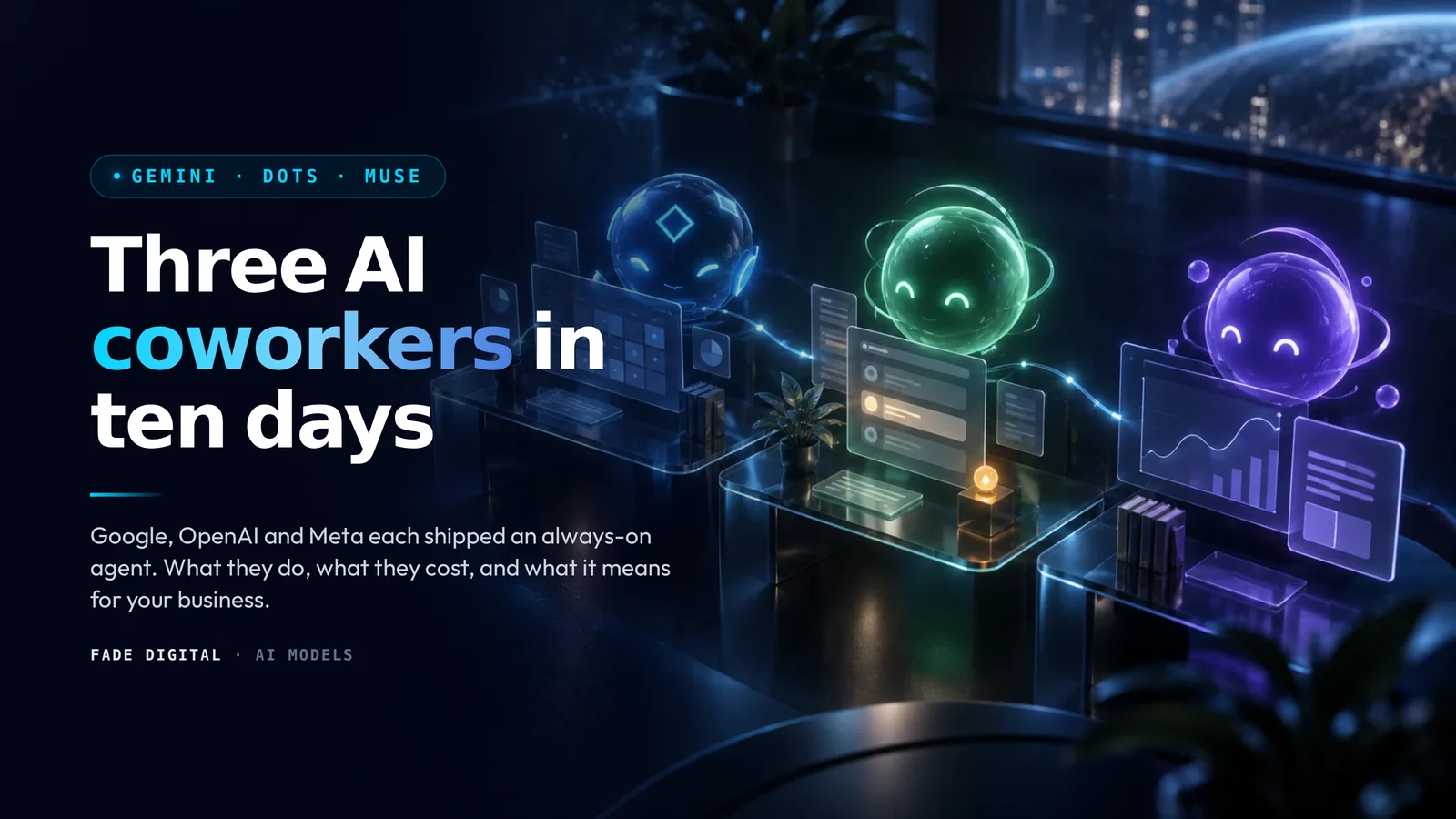
- Three always-on AI agents launched from the largest consumer platforms within 30 days: Meta's Muse (September 8), OpenAI's Dots (September 29) and Google's Gemini agent with coworker agents (October 8)
- OpenAI's GPT-6 Astra, released September 4, 2026, scored 72.6% on OSWorld 2.0, a test of whether an AI can operate a computer (OpenAI-reported)
- In our own study of 36 Toronto service business websites, 65% had no machine-readable opening hours and 44% had no business schema at all (Fade Digital, August 2026)
The GEO Market
- The GEO services market was valued at $886 million in 2024, projected to reach $7.3 billion by 2031 at a 34% CAGR (Valuates Reports, 2025)
- 63% of marketers prioritize generative search in their strategy (Incremys)
- 86% of enterprise SEO teams integrated AI tools into their workflow in 2025 (Incremys)
- 54% of US marketers plan to implement GEO strategies (Superlines)
These are not speculative projections. This is where we are right now.
Key Numbers at a Glance · October 2026
2. AI Platform Market Share: The Fragmentation of Search
For two decades, search meant Google. In 2026, search is fragmenting across an ecosystem of generative platforms, each with different retrieval methods, citation behaviors, and user demographics.
The ChatGPT-Gemini Duopoly
The most dramatic shift of the past 20 months has been the erosion of ChatGPT's dominance and the rise of Google Gemini, with Claude now growing fastest from a small base.
ChatGPT's share of generative AI web traffic fell from 86.7% in January 2025 to 64.5% in January 2026, and to about 53% by May 2026 (Similarweb). Over the same period Gemini climbed from 5.7% to 21.5% and then to about 27%. Claude went from 2.0% in January 2026 to about 9% in May, more than four times its share in four months (Similarweb).
ChatGPT is still the largest by a distance, and its user base is still growing: OpenAI reported more than 1.2 billion weekly users on October 7, 2026. Losing share while gaining users means the whole market is growing, and the newcomers are growing faster.
In January the rest of the market looked like this: DeepSeek about 3.7% (with strong adoption in China and parts of Asia), Grok about 3.4% through its integration with X, and Perplexity about 2% with a highly engaged audience (Similarweb, January 2026). We could not verify May figures for those three, so the chart below shows them only for January.
Generative AI Web Traffic Share · January vs May 2026 (Similarweb)
Thin bar: January 2026. Thick bar: May 2026, where verified. ChatGPT held 86.7% in January 2025. Its share is falling while its weekly users keep rising, because the market is growing faster than any one platform.
Why This Fragmentation Matters for Businesses
For any company that depends on being found online — and that includes virtually every service business — this fragmentation creates both risk and opportunity.
The risk: you can no longer optimize for a single platform and assume you're covered. A business that appears in ChatGPT results but is invisible to Perplexity or Gemini is leaving money on the table.
The opportunity: most of your competitors haven't figured this out yet. The businesses that build visibility across multiple AI platforms now will capture disproportionate market share before the space gets crowded.
This is exactly the multi-engine approach we take with our GEO Architecture service — optimizing for the entire AI ecosystem, not just one platform.
User Demographics: Who's Using What
Understanding who uses each platform is critical for targeting:
- More than 45% of ChatGPT users are under 25 (Statista). This skews younger than traditional Google Search.
- Perplexity users trend older and more affluent: 80% are graduates, 30% are senior company leaders, and 65% are high-income professionals (WARC).
- Gemini adoption correlates strongly with existing Google ecosystem usage, especially on Android devices.
- Claude users lean toward professional and enterprise contexts, with the highest per-session revenue among AI platforms (COSEOM, 2025).
- Meta's Muse reaches people inside apps they already use. It runs on the web, in its own iOS and Android apps and inside WhatsApp, which puts an agent in front of an audience that may never open ChatGPT.
For service businesses targeting decision-makers — especially in healthcare, legal, and real estate — the Perplexity and Claude audiences are particularly valuable. These are high-intent users who are accustomed to paying for expertise.
3. The Zero-Click Reality: When the Search Page Becomes the Destination
Zero-click search — where users get their answer directly from the search results page without clicking through to any website — has been trending upward for years. AI has accelerated it dramatically.
The Numbers Tell a Stark Story
When this report first came out, the best available figure was about 60% of Google searches ending without a click (Semrush, 2025 clickstream analysis). The 2026 data is worse. SparkToro, working with Similarweb clickstream data, found that 68.01% of US Google searches ended without a click from January to April 2026, up from 60.45% in 2024 (published June 2026). That is the average. Broken down, the picture is more alarming:
- Searches that trigger an AI Overview show a zero-click rate of approximately 83% (Similarweb aggregated data, 2025)
- Google's AI Mode — its full conversational search experience — sees a 93% zero-click rate (Semrush, September 2025)
- Mobile users are 66% more likely to experience zero-click searches than desktop users (Up and Social, 2025)
- Only 1% of users click a link within an AI Overview (Pew Research Center, July 2025)
This is the fundamental challenge facing every business that relies on organic search traffic. The search results page is no longer a gateway to your website. For a growing majority of queries, it's the final destination.
Zero-Click Rate by Search Type · 2025-2026
All US Google searches
January to April 2026, every query type
Search with AI Overview
AI summary appears above results
Google AI Mode
Full conversational AI search experience
Sources: SparkToro with Similarweb data (June 2026), Similarweb 2025, Semrush September 2025. AI Mode passed a billion monthly users in 2026, so the 93% scenario is no longer an edge case.
What Zero-Click Means for Service Businesses
For a service business — an optometry clinic, a law firm, a real estate brokerage — the implications are direct and financial.
Your potential client searches "best optometrist near me" or "how to choose a family lawyer." In the pre-AI era, they'd see a list of links, visit a few websites, compare options, and contact the one that impressed them most. You had multiple opportunities to make your case.
In 2026, the AI provides a synthesized answer. It might name three clinics, describe their specialties, mention their reviews, and give a recommendation — all without the user ever visiting anyone's website. If you're not in that AI-generated answer, you don't exist for that user.
This is why Fade Digital has moved beyond traditional SEO metrics for our clients. We track AI visibility — whether and how AI platforms mention and recommend our clients' businesses — because that's where decisions are being made. You can see examples of this approach in our case studies.
4. Google AI Overviews and AI Mode: The Incumbent Fights Back
Google isn't standing still. It's aggressively integrating AI into its core search product through two distinct features: AI Overviews (appearing within traditional search results) and AI Mode (a full conversational search experience).
AI Overview Expansion
The growth of AI Overviews has been aggressive. They appeared in 6.49% of queries in January 2025, doubled to 13.14% by March 2025, and reached about 25% of Google searches by early 2026 (Conductor 2026 Benchmarks, Semrush tracking). By May 2026, Similarweb measured AI Overviews on 43% of US Google searches, up from about 15% a year earlier (Similarweb, 2026 Generative AI Landscape report). Comscore's desktop panel tells the same story from a different method: 39.4% of US desktop searches in June 2026, up from 25.8% in July 2025.
Google says AI Overviews now reach 2.5 billion people a month (Google I/O, May 2026). For most of the people your business wants to reach, the AI summary is no longer an occasional feature. It is the first thing they see on almost half of their searches.
The types of queries affected tell an important story. Informational queries are most heavily impacted — 88.1% of queries triggering AI Overviews are informational in nature (Semrush). But commercial and local queries are increasingly affected too. For local businesses, approximately 7.9% of local searches currently trigger an AI Overview (Ahrefs, November 2025), and that figure is rising.
The CTR Devastation
The impact on organic click-through rates has been severe. Ahrefs' December 2025 study of 300,000 keywords found that AI Overviews now reduce the organic CTR for the #1 ranking position by 58%. Other research corroborates this, with estimates ranging from 49% to 90% CTR reduction depending on the query type and methodology.
To put this in business terms: even if you rank #1 in Google for your most important keyword, you're getting roughly half the clicks you would have gotten two years ago, and that number is still declining.
Google AI Mode: The 93% Zero-Click Problem
Google AI Mode takes AI integration much further. It provides a fully conversational search experience with multi-layered responses. Users spend approximately 49 seconds per session in AI Mode — more than double the 21 seconds in AI Overviews (Growth Memo, October 2025).
But here's the critical data point: 93% of AI Mode searches end without a click (Semrush, September 2025). This is the clearest preview of where search is heading. As Google pushes users toward AI Mode, the share of queries that generate any website traffic at all will continue to shrink.
AI Mode at a Billion Users
In February, AI Mode was still easy to dismiss as an experiment. It is not one any more. Google says AI Mode passed 1 billion monthly active users within its first year, and it has run on Gemini 3.5 Flash since I/O in May 2026 (Google). Similarweb counted 279 million visits to AI Mode in May 2026, up from 126 million in June 2025. Monthly users and visits measure different things, so the two numbers are not directly comparable, but both point the same way.
None of this has hurt Google's business. Alphabet reported Search and other revenue of $63.3 billion in Q2 2026, up 17% year on year, and said the Gemini app had reached 950 million monthly users. Google is not losing search to AI. It is turning search into AI, and keeping the clicks for itself. We covered what that means for marketers in our Google I/O 2026 breakdown.
What Gets Cited in AI Overviews
Not all websites are equally likely to appear in AI Overviews. Understanding what gets cited is key to maintaining visibility:
- 76.1% of URLs cited in AI Overviews also rank in the top 10 of traditional Google results (SE Ranking)
- However, 9.5% of cited pages rank between positions 11-100, and 14.4% rank outside the top 100 entirely (SE Ranking)
- Wikipedia, YouTube, Google's own properties, and Reddit are among the most cited domains (Ahrefs, September 2025)
- Content with statistics, citations, and structured data achieves 30-40% higher visibility in AI responses (Superlines)
This means traditional SEO is still foundational — ranking well in organic results significantly increases your chances of being cited in AI Overviews. But it's no longer sufficient on its own. Pages that provide structured, authoritative, citation-rich content can appear in AI answers even without top-10 rankings.
This dual optimization — traditional SEO performance plus AI-ready content structure — is at the core of what we build for clients. Our GEO Architecture service addresses both layers simultaneously.
5. ChatGPT as a Search Engine: Scale, Citations, and the Traffic Paradox
ChatGPT has quietly become the second-largest search platform in the world. When filtered for traditional search-like queries, it now commands approximately 12% of Google's search volume, surpassing Bing (ALM Corp, February 2026).
The Scale
The numbers are staggering. OpenAI said on October 7, 2026 that ChatGPT has more than 1.2 billion weekly users, up from 900 million in January. In mid-2025 it was processing about 2.5 billion prompts a day (OpenAI, reported by Axios in July 2025), and about 21.3% of prompts were "search-like" (OpenAI and Harvard study), which works out to roughly 530 million search-style queries a day at that point. Both figures have grown since, but neither has been republished.
The average session lasts 12 minutes and 41 seconds (Semrush, 2025), with users viewing about 4 pages per session. This is deep, engaged usage, not casual browsing.
On the same day, OpenAI moved every ChatGPT tier to GPT-6 and said GPT-6 Instant starts answering real search traffic 44% sooner on average than GPT-5.6 Instant. Faster answers make ChatGPT a more natural first stop for quick lookups that used to go to Google.
The Traffic Paradox
Here's where it gets complicated for businesses: despite this massive search volume, Google still sends approximately 190 times more traffic to websites than ChatGPT (ALM Corp analysis). ChatGPT specifically accounts for just 0.21% of total website referral traffic.
Why the disconnect? ChatGPT is designed to answer questions within its conversational interface, not to send users elsewhere. When it does cite sources, only a small fraction of users click through. The platform is engineered to keep users engaged within the conversation.
This creates a paradox. ChatGPT has enormous influence on user decisions — a recommendation from ChatGPT carries real weight — but that influence happens without generating measurable website traffic. Your brand is either part of the conversation or it's not, and the impact shows up in phone calls, form fills, and revenue rather than in Google Analytics pageviews.
What ChatGPT Cites
Understanding ChatGPT's citation behavior is essential for GEO:
- Wikipedia accounts for 7.8% of all ChatGPT citations, making it the single most-cited domain (as of June 2025)
- Reddit follows at 1.8%, and Forbes at 1.1%
- 89% of citations differ between ChatGPT and Perplexity for the same query — the platforms pull from very different source pools
- ChatGPT prefers content that uses definite language, contains question marks, has high entity density, and uses simple writing structures (Growth Memo, February 2026)
- There is a weak correlation between high organic traffic and ChatGPT inclusion — meaning smaller, authoritative sites can get cited if their content is well-structured (Ahrefs, June 2025)
Top ChatGPT Citation Sources — June 2025 (% of all citations)
Bars scaled relative to Wikipedia's 7.8% share. The vast majority of citations come from the long tail of authoritative industry sources — a large, winnable opportunity for specialist businesses.
ChatGPT's Expanding Commerce Features
OpenAI isn't just building a search engine. It is building a commerce platform, and 2026 filled in most of the pieces.
- Agent Mode and Instant Checkout (2025) let users hand off tasks like booking and buy products without leaving the chat. ChatGPT Atlas extends the assistant across the whole browsing experience.
- Ads arrived next to the answer. OpenAI began rolling out a self-serve ad platform in May 2026, still in beta, with ads shown below ChatGPT answers to Free and Go users. By October advertisers in Canada could use it too, though health, legal and financial services ads remain prohibited outside the US. Paid placement now sits next to organic recommendation, the same split Google has run for 25 years. Our OpenAI Ads playbook covers how it works.
- Local data was bought, not crawled. OpenAI licensed Yelp's reviews, ratings, photos and business information for local answers: 330 million cumulative reviews and more than 8 million business listings (Axios, July 2026). If your Yelp profile is stale, that stale data is now in the pipe. See what the Yelp deal means for your profile.
- Answers became interfaces. Since October 7, 2026, GPT-6 can answer with buttons, sliders, charts, forms and comparison cards instead of only text (OpenAI's Intelligent UI). An interface can only filter or compare on facts it can find, so hours, services, prices and booking details that are not published clearly cannot appear on the card. More in our Intelligent UI explainer.
- Agents that keep working. On September 29, 2026 OpenAI launched Dots, always-on agents inside ChatGPT with their own cloud computers. They are covered in chapter 10.
For service businesses, ChatGPT is now the platform where a prospective client can discover you, evaluate you, see an ad for your competitor and, increasingly, contact or book you without visiting your website. Being recommended by ChatGPT is no longer a nice-to-have. It is a revenue channel.
6. Perplexity, Claude, and the Specialist Platforms
While ChatGPT and Gemini dominate by volume, the specialist platforms are disproportionately important for certain business categories.
Perplexity: The Citation-First Engine
Perplexity operates as a "citation-first" search engine, displaying sources prominently alongside every answer. This transparency makes it particularly relevant for B2B and professional services, where credibility matters.
Perplexity has not published new usage figures in 2026, so these are its most recent:
Key Perplexity data:
- 780 million monthly queries (Perplexity, May 2025)
- 45+ million monthly active users (COSEOM, 2025)
- Average session duration of 23 minutes and 10 seconds — remarkably long for a search tool
- Sends approximately 3-5x more traffic per query than ChatGPT (ALM Corp estimate)
- 80% of its audience are graduates, 30% are senior leaders, 65% are high-income professionals (WARC)
- 4.8 out of 5 rating on Product Hunt
Perplexity's user base is exactly the demographic that makes purchasing decisions for professional services. A senior executive researching "best marketing agency for clinics" on Perplexity is a high-intent prospect. If your business appears in that answer with a cited source, you've captured attention at the moment of decision.
Claude: Enterprise Influence
Claude, developed by Anthropic, is the fastest riser of 2026. Its share of generative AI web traffic went from 2.0% in January to about 9% in May (Similarweb), and Sensor Tower estimated about 56 million monthly app users in Q2 2026 (reported by Reuters). Anthropic does not publish user counts, so treat both as outside estimates.
Its audience is still weighted toward professional work. Claude had the highest average session value among AI assistants ($4.56 per session, COSEOM, 2025), and its models now run inside other companies' products: Google says Claude models are available for orchestration inside its new Gemini agent. For service businesses targeting enterprise clients or professional buyers, Claude visibility matters more than its share suggests.
Meta Muse: The Newest Entrant
Meta launched Muse, a consumer AI agent, on September 8, 2026. It runs on the web, in iOS and Android apps and inside WhatsApp, can send emails, book travel and fill out forms, and is free with usage limits, with paid tiers at $20 and $100 a month (Meta). In one week shortly after launch, Muse recorded about 2.5 million downloads against 3.1 million for ChatGPT over the same week (PYMNTS).
Three weeks later Meta added Muse for Small Business, which connects to Facebook Pages, Instagram analytics, Meta ad accounts and fifteen third-party tools including Shopify, QuickBooks, Klaviyo and Slack, with nothing published, sent or spent without the owner's approval (Meta, September 29, 2026). It is too early for traffic share data, but Meta's distribution through WhatsApp, Instagram and Facebook means Muse does not need people to visit a new website to reach them.
Grok and the Social Search Layer
Grok, integrated with X (formerly Twitter), held about 3.4% of generative AI web traffic in January 2026 (Similarweb). Its unique advantage is access to real-time social media data, making it particularly relevant for trending topics, brand sentiment, and real-time discovery. Citation rates can vary dramatically by platform: the same brand might see a 0.59% citation rate on ChatGPT but a 27% rate on Grok, a 46x gap (Superlines research).
The Multi-Platform Imperative
This platform fragmentation means that businesses can't afford a single-platform optimization strategy. The same query on ChatGPT, Perplexity, Gemini, Claude and Muse can produce dramatically different recommendations. A business that's well-positioned on one platform but invisible on others is losing a significant share of high-intent prospects.
This is precisely why we designed our GEO Architecture service as a multi-engine optimization framework — ensuring our clients' brands appear consistently across every AI platform where their buyers are asking questions.
7. The Citation Economy: Who Gets Recommended and Why
In AI search, the old currency was "rankings." The new currency is "citations." Being cited — named, linked, or recommended within an AI-generated answer — is what drives visibility, trust, and ultimately revenue.
The Citation Hierarchy
Not all citations are equal. AI platforms draw from different source pools and prioritize different signals:
Domain Authority Is the #1 Predictor. SE Ranking's study of 2.3 million pages found that domain traffic is the strongest factor determining whether a page gets cited by AI systems, with a SHAP value of 0.63. High-traffic sites earn roughly 3x more AI citations than low-traffic ones.
But Authority Alone Isn't Enough. Content structure matters enormously. Pages with statistics, original data, and proper citations achieve 30-40% higher visibility in AI responses (Superlines). Content updated within the past 2 months earns 28% more citations than older content (Superlines).
Third-Party Validation Amplifies Everything. AI systems cross-reference claims across multiple sources. A business mentioned in Wikipedia, Crunchbase, industry databases, and credible media outlets will be cited far more frequently than one whose only online presence is its own website.
The 2026 data makes this concrete. On commercial-intent prompts, 82% of citations went to third-party sources and only 3% to the brand's own pages (NP Digital, 2026). And a citation is not the same as a mention: 61.7% of AI citations were "ghost citations", where the link appears but the brand name does not (Semrush and Growth Memo, 2026). Being linked in the footnotes while a competitor is named in the answer is not visibility. We break this down in Getting Cited Isn't Enough.
Some sources are now contracted, not crawled. OpenAI's Yelp licence (330 million reviews and more than 8 million listings, Axios, July 2026) means the data AI uses about a local business can come from a deal between two companies rather than from anything on the business's own site.
The Sources AI Trusts Most
Understanding where AI platforms pull information helps prioritize where your brand needs to appear:
- Wikipedia remains the single most-cited source across AI platforms. Having a well-maintained Wikipedia presence (where notability criteria are met) is an enormous GEO advantage.
- Reddit is heavily weighted across ChatGPT, Perplexity, and Google AI Overviews. Authentic, helpful Reddit presence in your industry translates directly to AI citations.
- YouTube serves as a visual verification layer — AI platforms reference video content to confirm claims and establish authority.
- Industry-specific databases (G2 for software, Healthgrades for healthcare, Avvo for legal) carry significant weight in category-specific queries.
- LinkedIn and professional platforms contribute to authority signals, particularly for B2B and professional services.
- High-authority publications (Forbes, industry journals, authoritative blogs) remain strong citation sources.
Building Citation Authority: The Fade Digital Approach
At Fade Digital, we think about citation authority in three layers:
Layer 1 — Foundation: Structured Data and Schema. Your website needs to speak the language machines understand. A coherent schema graph — connecting your organization, services, people, and content into a machine-readable knowledge graph — is the foundation that enables AI systems to recognize and trust your brand as a distinct entity.
Layer 2 — Amplification: Third-Party Signals. Build genuine presence in the data sources AI systems trust. This means earning mentions in industry databases, directories, professional communities, and authoritative publications. Not link building for SEO — citation building for AI.
Layer 3 — Optimization: Content Structure for AI Retrieval. Create content that AI systems can easily parse, verify, and cite. That means clear entity references, original data, structured formatting, and regular updates. See our detailed breakdown in our GEO guide.
This three-layer approach is what we execute through our Content Studio and GEO Architecture services.
8. The Rise of GEO: From Niche Tactic to Billion-Dollar Market
Generative Engine Optimization has gone from a niche concept to a recognized industry discipline in under 18 months.
Market Size and Growth
The numbers validate what practitioners have been saying: this isn't a fad.
The GEO services market was valued at $886 million in 2024 and is projected to reach $7.3 billion by 2031, growing at a compound annual rate of 34% (Valuates Reports, July 2025). Some estimates project even faster growth — Dimension Market Research projects the market reaching $33.7 billion by 2034 at a 50.5% CAGR.
For context, the entire SEO software market was valued at $727 million in 2023 (Statista). GEO services already exceed that figure and are growing nearly 3x faster.
GEO Market Size Trajectory · 2024–2031 (Valuates Reports, 34% CAGR)
Sources: Valuates Reports (2025), Dimension Market Research (2025). 2031 projection at 34% CAGR. High-growth scenario projects $33.7B by 2034 at a 50.5% CAGR. GEO already exceeds the entire 2023 SEO software market.
GEO vs. SEO: Complementary, Not Competitive
A common misconception is that GEO replaces SEO. It doesn't. The relationship is additive.
Traditional SEO remains the foundation: your site needs to be crawlable, fast, well-structured, and ranking for relevant terms. AI platforms still pull heavily from indexed web content — 76% of URLs cited in AI Overviews also rank in the top 10 of organic results.
GEO builds on that foundation by optimizing for the specific signals AI systems use to decide what to cite: entity clarity, content structure, third-party authority, data freshness, and multi-modal assets.
The way we think about it at Fade Digital: SEO gets you into the index. GEO gets you into the answer. You need both.
For the full tactical breakdown of how to implement both layers, our Ultimate GEO Guide covers the six core signals in detail.
The ROI Case for GEO
Early adopters are reporting meaningful returns:
- AI search visitors convert at 4.4x the rate of traditional organic visitors (industry benchmarks cited by Superlines and Incremys)
- GEO-optimized content is discovered up to 10x faster by generative engines compared to relying on organic SEO alone (Sequencr)
- Companies implementing GEO report an average ROI improvement of 22% over traditional SEO-only approaches (Incremys)
- Early adopters report 40% increases in AI-driven visibility (Incremys)
The logic makes sense: someone asking ChatGPT "what's the best optometrist in Toronto for dry eye treatment" is a much more qualified lead than someone browsing a generic search results page. They've articulated their specific need, and the AI has recommended you specifically. That's an extremely warm introduction.
9. Industry Impact: Winners, Losers, and the Publisher Reckoning
The shift to AI search isn't affecting all industries equally. Understanding the differential impact helps businesses calibrate their urgency.
Most Impacted Industries
News and Media Publishing. The impact on publishers has been devastating. Organic visits to news sites plummeted from over 2.3 billion monthly in mid-2024 to under 1.7 billion by May 2025. Business Insider saw organic search traffic fall 55% between April 2022 and April 2025. HuffPost lost half its search referrals over the same period. Smaller publishers are shutting down entirely.
Informational Content (How-To, Education, Health). AI Overviews trigger most frequently for informational queries (88.1% of affected queries). DIY, recipe, health, and educational content sites are seeing 40-70% traffic drops as AI-generated summaries satisfy user intent without requiring a click.
Affiliate and Review Sites. AI platforms are increasingly making direct product recommendations, undermining the review-site model that depended on users clicking through comparison content.
Less Impacted (For Now)
Local Service Businesses. Only 7.9% of local searches currently trigger an AI Overview (Ahrefs, November 2025). Transactional and local-intent queries remain more resilient because users still need to take action: book an appointment, visit a location, make a call. That protection is weakening fast. Since February, OpenAI has licensed Yelp's local data, ChatGPT can answer with comparison cards and forms, and three agents built to make bookings and fill in forms have launched. The step that kept local businesses safe, a human having to act, is exactly the step agents are built to take over.
Branded Searches. AI Overviews appear in fewer than 5% of branded search results, and branded searches can actually see an 18% CTR boost from AI features. If someone is searching specifically for your business name, AI search is generally helpful.
E-commerce (Transactional Queries). Users who intend to purchase still click through to complete transactions, though ChatGPT's Instant Checkout feature could change this. The visitors who do arrive from AI are valuable: Adobe found that AI-referred visitors to US retail sites converted 54% better than other visitors in May 2026.
The Service Business Opportunity
For service businesses — the core of our client base across healthcare, dental clinics, legal, and real estate — the AI search shift creates an asymmetric opportunity.
Most local service businesses haven't adapted to AI search at all. Their competitors are still running the same SEO playbook from 2020. The first businesses in each local market to implement GEO properly — building schema graphs, earning AI-trusted citations, structuring content for machine readability — will capture a disproportionate share of AI recommendations in their category.
10. The Agent Era: When AI Stops Answering and Starts Acting
This chapter is new in the October 2026 update. When the report was first published, AI search meant a person asking a question and reading an answer. Between September 8 and October 8, 2026, the three largest consumer platforms each shipped something different: an agent that takes an objective, keeps working after the person closes the laptop, and comes back with finished work.
That changes who your website is for. An agent that is shortlisting physiotherapists, comparing quotes from three roofers or booking a consultation does not admire your hero image. It looks for facts it can read and act on: what you do, where, when you are open, what it costs and how to book.
What launched, and when
| Date (2026) | Launch | What it does | Who can use it |
|---|---|---|---|
| May 19-20 | Google Gemini Spark (I/O) | Personal agent that runs around the clock on Google Cloud machines and connects to outside tools through the Model Context Protocol | Trusted testers first |
| September 4 | OpenAI GPT-6 Astra | Agent model built to operate a computer; 72.6% on OSWorld 2.0 (OpenAI-reported) | API, $10 / $50 per million input / output tokens |
| September 8 | Meta Muse | Consumer agent that can send emails, book travel and fill out forms, on the web, in apps and in WhatsApp | US and Canada; free, $20 or $100 a month |
| September 15 | Cloudflare AI crawler controls | A new Disallow AI Training setting keeps a site in search while refusing training; Block now also stops Googlebot, Bingbot and Applebot; new ad-funded domains default to Disallow AI Training and block agents on pages with ads | Every Cloudflare plan; existing settings migrated automatically |
| September 29 | OpenAI Dots and ChatGPT Space | Always-on agents in ChatGPT, each with its own cloud computer and browser | First Dot included with ChatGPT Pro and Business Premium; Pro excludes the EEA, Switzerland and the UK |
| September 29 | Meta Muse for Small Business | Connects to Facebook, Instagram, Meta ads and fifteen tools including Shopify, QuickBooks and Slack; nothing goes out without approval | Free with usage limits, paid plans above that |
| October 7 | OpenAI GPT-6 and Intelligent UI | Answers that arrive as buttons, forms, charts and comparison cards | Every ChatGPT tier |
| October 8 | Google Gemini agent and coworker agents | One work agent across Workspace, Microsoft 365 and Slack; coworker agents get their own email, calendar and Drive | Private preview; no price or date published |
Sources: Google, OpenAI, Meta, Cloudflare, VentureBeat, SiliconANGLE and TechCrunch, as listed in chapter 12. Our full comparison is in Gemini Agent vs ChatGPT Dots vs Meta Muse, and the model behind Dots is covered in GPT-6 Astra: what it means for your business.
Why this matters for discovery
The three launches look similar because they are built on the same bet: the chat box was a transitional interface, and what people want is a colleague who takes a task and finishes it. For a business that wants to be found, that has three consequences.
The shortlist gets made without you. When an agent compares options on someone's behalf, it is the agent that reads your site, your Google Business Profile, your reviews and the directories you appear in. The person sees the result. If the agent cannot find your hours or confirm you offer the service, you are dropped before a human ever sees your name.
Structured facts beat persuasive copy. Agents work from what they can extract. Schema markup, clear service and pricing pages, published hours, a working booking link and consistent details across third-party sites are what an agent can use. Our agentic commerce guide explains what "machine-readable" means in practice.
Access is now a setting someone can get wrong. Cloudflare now treats "agent" as its own crawler category. A security plugin or a one-click "block AI bots" toggle can stop the very agents a buyer has sent to check you out. Our Cloudflare guide shows how to check in a few minutes.
Most local businesses are not ready
In August 2026 we tested 36 Toronto-area service business websites across nine industries for what an AI agent could extract. Not one reachable site hid its content behind JavaScript, and only one blocked AI crawlers. But 65% could not tell a machine when they are open, and 44% had no business schema at all (full study). The doors are open. There is just nothing written down inside.
What we don't know yet
None of these companies has published data on how many bookings, purchases or enquiries their agents complete, how agents choose between businesses, or how often they fall back to a human. Two of the three products are in preview or limited to paid tiers. We will add those numbers to this report when the vendors or independent researchers publish them, and we will not guess before then.
11. What Smart Businesses Are Doing Now
Based on the data in this report, here's what forward-thinking businesses are doing to adapt to AI search in 2026.
Immediate Actions (This Quarter)
Audit your AI visibility. Ask ChatGPT, Perplexity, Gemini, and Claude questions that your ideal clients would ask. Are you recommended? Are your competitors? This takes 30 minutes and will tell you exactly where you stand. If you want a systematic audit, contact our team for a GEO assessment.
Fix your schema graph. Most business websites have either no structured data or fragmented, inconsistent schema that AI systems can't reliably parse. A coherent schema graph — connecting your organization, services, locations, and people — is the single highest-leverage technical GEO action you can take. Our GEO Architecture service starts here.
Claim and optimize your presence on AI-trusted platforms. Ensure your business information is accurate and comprehensive on Google Business Profile, Yelp, relevant industry databases, Wikipedia (where applicable), and professional directories. These are the sources AI systems cross-reference when deciding whether to recommend you, and in Yelp's case the data now flows to ChatGPT under licence.
Check that AI crawlers and agents can reach you. Look at your robots.txt, your Cloudflare bot settings and any security plugin. If Googlebot, Bingbot, OAI-SearchBot, ChatGPT-User, Claude-SearchBot or PerplexityBot are blocked, nothing else in this list matters. Training crawlers such as GPTBot, ClaudeBot and Google-Extended are a separate, deliberate choice.
Publish the facts an agent needs. Opening hours, services, service area, prices or price ranges, and a booking or contact method, on your site in plain text and in schema. These are the gaps that kept most of the businesses in our agent-readiness study off an agent's shortlist.
Medium-Term Strategy (Next 6 Months)
Build content designed for AI citation. This means content with original data, clear entity references, structured formatting, FAQ sections, and regular updates. The goal isn't just to rank in Google — it's to create content that AI systems will pull into their answers. Our Content Studio specializes in exactly this type of content.
Invest in multi-platform authority. Build genuine presence across the platforms AI trusts: earn mentions in industry publications, participate authentically in relevant Reddit and LinkedIn communities, create YouTube content that establishes visual authority, and ensure your brand appears in key industry databases.
Track AI visibility as a KPI. Traditional SEO metrics — rankings, traffic, impressions — capture less than half the picture in 2026. Add AI citation tracking to your measurement framework: how often and how favorably AI platforms mention your business when users ask relevant questions.
Long-Term Positioning (12+ Months)
Build your knowledge graph. Go beyond basic schema to create a comprehensive, machine-readable representation of your business entity, its relationships, and its expertise. This is the foundation that makes your brand reliably recognizable to AI systems across all platforms.
Develop proprietary data and insights. AI systems preferentially cite content that provides original information they can't find elsewhere. Industry surveys, proprietary benchmarks, and original research are among the most powerful GEO assets you can create.
Prepare for AI-mediated commerce. ChatGPT, Gemini and Muse can now research, compare and fill in forms for the people using them. Make sure an agent can complete the last step with you: a booking flow that works without a phone call, forms that a machine can fill in, and confirmation by email. Decide too whether paid placement inside ChatGPT is worth a test budget now that OpenAI's ad platform is open to US advertisers.
This is the work we do day to day: our GEO Architecture service builds exactly this knowledge-graph foundation. To see where your brand stands across the engines right now, run a free AI Visibility Scan.
If you are weighing outside help, our guide to the best GEO agencies in Toronto lists eight agencies with a dedicated AI search service, alphabetically, with the questions to ask each one.
12. Methodology and Sources
The February 2026 edition synthesized data published between late 2025 and February 2026 from Similarweb, Semrush, Ahrefs, Conductor, SE Ranking, Backlinko, Pew Research Center, Valuates Reports, Dimension Market Research, WARC, Statista, Superlines, Incremys and COSEOM.
The October 13, 2026 update added data published up to October 8, 2026. On October 20, 2026 we corrected the Cloudflare entry in chapter 10's launch timeline, which had described the July plan rather than what Cloudflare shipped on September 15, and the ChatGPT ads note in chapter 5, which had described ads as US-only and inside the answer. Where a newer figure replaced an older one, we kept the older figure with its date so the change is visible. Where no newer figure exists, as with Perplexity's usage, we say so rather than estimate. Where sources conflict, we cite the most conservative credible figure and name the method. Vendor figures (OpenAI, Google, Meta) are the vendors' own claims, and benchmark scores are as reported by the company that ran them.
Primary sources added in the October update:
- OpenAI, GPT-6 and Intelligent UI for everyone, October 7, 2026: ChatGPT weekly users, GPT-6 rollout, search answer speed
- Alphabet, Q2 2026 earnings remarks, July 22, 2026: Gemini app users, AI Mode, Search revenue
- Google I/O 2026, May 19-20, 2026: AI Overviews and AI Mode users, Gemini 3.5 Flash, Gemini Spark
- Similarweb, generative AI statistics and the 2026 Generative AI Landscape report (reported by TechCrunch, July 2026): traffic share, AI Overview prevalence, AI Mode visits
- SparkToro with Similarweb clickstream data, June 2026: US zero-click rate
- Comscore, June 2026: AI Overview prevalence on US desktop
- Ahrefs, March 2026: AI chatbot share of website traffic
- Adobe, May 2026: conversion of AI-referred retail visitors
- Sensor Tower, reported by Reuters: Claude monthly app users, Q2 2026
- NP Digital, 2026, and Semrush with Growth Memo, 2026: third-party and ghost citations
- Axios, July 2026: the Yelp and OpenAI licensing agreement
- Google Cloud, Welcome to Gemini at Work 2026, October 8, 2026
- VentureBeat, OpenAI launches Dots and ChatGPT Space, September 29, 2026
- Meta, Muse for Small Business, September 29, 2026, and PYMNTS on Muse downloads
- Cloudflare, "Have it both ways: stay discoverable in search while disallowing AI training", September 15, 2026
- Fade Digital, AI agent readiness study of 36 Toronto business websites, August 2026
We will update this report again as new data is published. The date at the top of the page shows the last revision.
Cite and Share This Report
This report is free to read and free to quote. If you use a figure from it, please link back to this page and credit the original source named next to that figure in its chapter.
Suggested citation
Fade, L. (2026, updated October 13, 2026). The State of AI Search 2026: How Generative Engines Are Rewriting the Rules of Discovery. Fade Digital. https://fadedigital.ca/blog/state-of-ai-search-2026.html