
Services
Get Found by AI Paid Client Acquisition Local Dominance Content & Authority Website & ConversionIndustries
Healthcare Dental & Clinics Legal Real Estate ResultsCompany
About Us GEO Insights Knowledge Base Contact Client PortalGEO Architecture
Our proprietary stack for dominating AI recommendations.
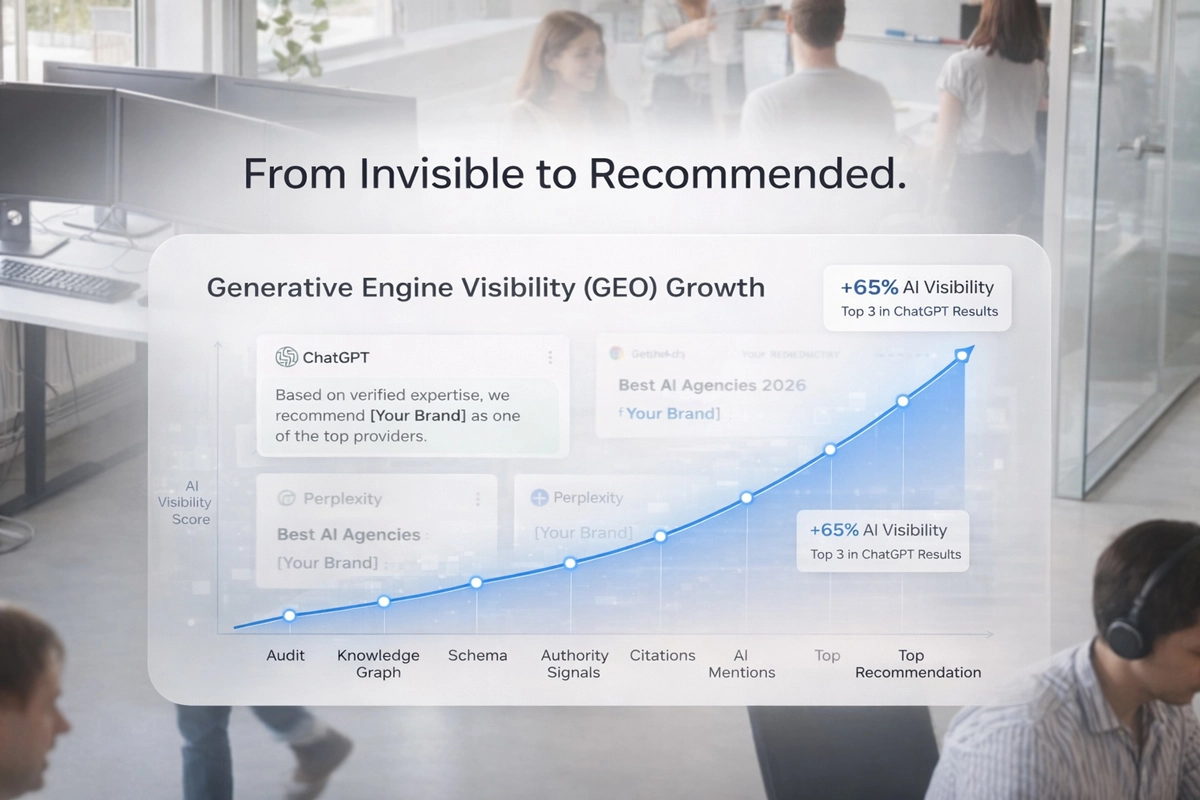
Search Isn't Just Google Anymore
AI tools like ChatGPT, Perplexity, and Gemini now recommend businesses directly to customers — bypassing traditional search results entirely. The brands appearing in AI answers today built their authority months ago.
Our goal is to position your brand to appear in AI answers, local searches, and recommendations so more people discover you before they ever see your competitors.
Knowledge Graph
We rebuild your data schema (JSON-LD) so LLMs clearly understand your entities, relationships, and authority.
- • Entity Association
- • Semantic Triplets
- • Brand Knowledge Panels
Conversational NLP
Targeting natural language queries. We optimize for "Best X near me for Y condition" rather than just "Keyword".
- • Long-tail NLP targeting
- • Q&A Formatting
- • Voice Search Prep
Digital Authority
AI trusts what others say about you. We secure citations in high-authority niche publications that LLMs use for training.
- • Niche Citations
- • Sentiment Management
- • Competitor Disavowal
Citations & Mentions That Move the Needle
AI models trust what authoritative sources say about you. We secure mentions, backlinks, and coverage in the high-authority publications that LLMs use to build their understanding of which businesses to recommend.
More trusted citations means stronger signals — and more recommendations from the AI tools your customers rely on.

Total Search Domination
The strategy to capture visibility across the entire decentralized search ecosystem.
Map the New Search Ecosystem
Your customers aren't just using Google. We map and optimize your presence across the platforms that matter most to your specific audience:
Target Conversational Queries
Traditional keyword research misses how people actually talk to AI. Instead of "best CRM software," people ask "what's the most user-friendly CRM for a 50-person sales team?"
- Google "People Also Ask" Analysis
- Perplexity Keyword Expansion
- AI Chat Suggestion Scraping
Build Topic Clusters
We pick core topics and go deep. If you're targeting "email marketing," we don't just write one post. We create an entire ecosystem of content around automation, deliverability, subject lines, and segmentation.
Multi-Format Distribution:
Signal Authority to AI
AI platforms favor authoritative sources. We systematically build the trust signals that Large Language Models look for when selecting answers.
- → Consistent Link Building: AI favors sites that already rank well in traditional search.
- → Third-Party Validation: Reviews and mentions on independent platforms.
- → Brand Velocity: Increasing brand mentions across the open web.
The Evolution of Search
Why traditional SEO is failing in the age of AI.
Traditional SEO
- Keyword Stuffing & Density
- Generic Backlink Building
- Optimizing for 10 Blue Links
GEO Architecture
- Entity & Knowledge Graph Optimization
- Digital PR & Niche Authority
- Optimizing for Direct Answers (ChatGPT)
Want the full technical breakdown? Read our Ultimate Guide to AI SEO & GEO →
Execution Roadmap
From invisible to inevitable. How we deploy your authority architecture.
Calibration
- Technical Schema Audit
- Entity Identity Setup
- Competitor Gap Analysis
Expansion
- Content structuring for AI crawlability
- Citation acquisition & authority signals
- Conversational query optimization
Domination
- Brand Velocity Scaling
- Multi-Platform Integration
- Share of Voice Reporting
Deployment Packages
One-time analysis of your AI visibility and Schema health.
Full local domination & knowledge graph management.
Full-scale ecosystem dominance & bespoke architecture.
What's Included Per Tier
| Deliverable | Audit $499 · one-time |
Growth $2,850/mo |
Authority Custom |
|---|---|---|---|
| Schema types implemented | Diagnostic only | Organization, LocalBusiness, FAQPage, Person, BreadcrumbList | Full graph — all applicable types + custom entity markup |
| Pages optimized / mo | Review only | Up to 15 pages | Up to 50 pages |
| Citations targeted / mo | Identified, not built | 3–5 publisher placements | 10–20 publisher placements |
| Prompt monitoring | One-time snapshot | Monthly · 15 tracked queries | Monthly · 40 tracked queries |
| Reporting cadence | One-time report | Monthly report + bi-weekly sync | Weekly updates + monthly exec review |